
ParticleToken is an omnichain token implementation utilizing LayerZero's OFT standard. The contract architecture is robust, leveraging standard libraries for cross-chain messaging and ERC-20 compliance. The primary risk involves the minting capabilities inherent to the OFT standard, which are necessary for cross-chain functionality but represent a centralized control point.
On-chain security analysis — is it a scam or legit?
Is PARTI Token Safe?
Not verified
This record has not gone through deep verification and is not being monitored. The score is a dated snapshot — the token’s risk can change at any time.Own this token? Put it under verification →ParticleToken is an omnichain token implementation utilizing LayerZero's OFT standard.
Read the full analysis- Issuer controls retained
Exact factors
- Issuer controls retained (admin key, mint) — counterparty risk on a known issuer, not a rug vector
Each factor is an on-chain fact recorded at the time of this analysis. The score is computed from them by a deterministic function, so the same contract returns the same score for anyone who runs the audit. How scores are computed
Security Checklist
as of audit · Oct 29Holders
as of audit · Oct 29, 2026- Contractstreasury, vesting, bridge, staking80.5%
- Walletsanonymous holders, free to sell15.5%
- DEX poolsthe pools' own liquidity1.2%
- Everyone else12,907 holders2.8%
How holder types affect the score
Share held by contracts — treasury, vesting, bridge or staking — is discounted against share held by wallets when the score is computed: a contract cannot decide to sell the way an anonymous holder can, though it can still be drained or voted to sell. Effective concentration is the figure the risk score is actually calculated from.
Holder balances as recorded by the audit of Oct 29, 2026
Liquidity
as of audit · Oct 29- Uniswap v3WETHAnalysed$335.8K100.0%
- PancakeswapWETH$50.0%
- Uniswap v2USDC$40.0%
- PancakeswapUSDC$40.0%
- PancakeswapUSDC$30.0%
- PancakeswapWETH$20.0%
Show 4 more pairs
The 9 remaining pairs hold $6 between them and are not listed. The risk score reads depth across every pair.
The LP tokens of the analysed pool are not locked or burned, so whoever holds them can withdraw that liquidity.
0xfa2b…52bb0x375f…9491No privileged address appears among these holders: the unlocked liquidity sits with independent providers, not with the deployer.
Security Findings
InfoPrivileged Minting via Cross-Chain Messaging
The functions send, lzReceiveSimulate, and lzReceive allow for the minting of new tokens as part of the cross-chain transfer process. While this is required for the OFT standard to function, it allows the LayerZero endpoint to increase the total supply, which could dilute existing holders if the cross-chain bridge is compromised.CP-01
Issue
The functions send, lzReceiveSimulate, and lzReceive allow for the minting of new tokens as part of the cross-chain transfer process. While this is required for the OFT standard to function, it allows the LayerZero endpoint to increase the total supply, which could dilute existing holders if the cross-chain bridge is compromised.
Fix
Monitor the LayerZero endpoint and peer configurations closely. Ensure that only authorized chains are set as peers to prevent unauthorized minting from malicious or compromised chains.
Status
Unresolved
InfoWho holds the supply
The ten largest holders own 97.2% of supply. Of that, 1.2% in DEX pools — not holders that can sell, so excluded from the concentration score. What remains: 15.5% in wallets, 80.5% in other contracts. 12,917 holders in total. For a verified reference asset the largest holders are custodians, exchanges and bridges; concentration is reported, not scored.QA-HOLDERS
Issue
The ten largest holders own 97.2% of supply. Of that, 1.2% in DEX pools — not holders that can sell, so excluded from the concentration score. What remains: 15.5% in wallets, 80.5% in other contracts. 12,917 holders in total. For a verified reference asset the largest holders are custodians, exchanges and bridges; concentration is reported, not scored.
Fix
Watch the largest wallets that are not exchanges, pools or locks — those are the ones that can move the price.
Status
Acknowledged
InfoIdentity verified by independent sources
Listed on CoinGecko as Particle Network (PARTI), market cap $9M, rank #1339. Traded on Binance. 12,917 holders. Verified by: exchange listings.QA-IDENTITY
Issue
Listed on CoinGecko as Particle Network (PARTI), market cap $9M, rank #1339. Traded on Binance. 12,917 holders. Verified by: exchange listings.
Fix
Match the contract address against the project's official channels before trading.
Status
Acknowledged
InfoThe market for this token
Liquidity $336K (DexScreener, all pools). 24h trading volume $8.4M (CoinGecko, all markets, daily snapshot). 24h trading volume $324K (DexScreener, all pools). CoinGecko's record for this coin: all-time high $0.419 on 2025-05-13; the price is now 90.7115% below it.QA-MARKET
Issue
Liquidity $336K (DexScreener, all pools). 24h trading volume $8.4M (CoinGecko, all markets, daily snapshot). 24h trading volume $324K (DexScreener, all pools). CoinGecko's record for this coin: all-time high $0.419 on 2025-05-13; the price is now 90.7115% below it.
Fix
Size any position to the liquidity and daily volume shown — they set how much you can sell and at what price.
Status
Acknowledged
InfoAsset class: Wrapped or bridged asset
A token representing another asset's units 1:1, backed by a wrapping contract, a custodian or a bridge. Scored as an established reference asset: its identity is verified, so the issuer's or protocol's controls (listed as findings) are real and are priced once as counterparty risk, and LP locks and holder concentration are not scored — its pools belong to market makers and its largest holders are exchanges, bridges and custody. Basis: a copy of the coin from its home chain (binance-smart-chain), minted here by LayerZero (lzReceive). Tokenomics — Supply: minted here by LayerZero (lzReceive) against tokens locked or burned on other chains. Control: a 3-of-4 multisig. Code: not upgradeable (no proxy). Fees: no buy or sell tax. Market: $336K of DEX liquidity across 19 pools. Launch: 584 days of market history.QA-PROFILE
Issue
A token representing another asset's units 1:1, backed by a wrapping contract, a custodian or a bridge. Scored as an established reference asset: its identity is verified, so the issuer's or protocol's controls (listed as findings) are real and are priced once as counterparty risk, and LP locks and holder concentration are not scored — its pools belong to market makers and its largest holders are exchanges, bridges and custody. Basis: a copy of the coin from its home chain (binance-smart-chain), minted here by LayerZero (lzReceive). Tokenomics — Supply: minted here by LayerZero (lzReceive) against tokens locked or burned on other chains. Control: a 3-of-4 multisig. Code: not upgradeable (no proxy). Fees: no buy or sell tax. Market: $336K of DEX liquidity across 19 pools. Launch: 584 days of market history.
Fix
The backing is the risk: check who holds the underlying asset and how redemption works.
Status
Acknowledged
Analysis
AI Copilotas of audit · Oct 29The contract follows industry-standard patterns for cross-chain token transfers (7.1 Architecture). Code security is high due to the use of audited LayerZero OFT libraries (7.2 Code Security). Access control is strictly enforced via the owner role and LayerZero endpoint validation (7.3 Access Control). Operations are well-defined, though the reliance on external endpoints introduces dependency risks (7.8 Operations).
Economic stability is maintained through standard ERC-20 mechanisms (7.4 Economic). Governance is currently centralized under a 3-of-4 multisig, providing a balance between security and agility (7.5 Governance). External dependencies on the LayerZero protocol are the primary economic vector (7.6 External).
The contract is not currently deployed as a proxy, meaning logic is immutable (7.7 Upgrades). This eliminates risks associated with malicious implementation swaps. Future upgrades would require a full contract migration.
The protocol should maintain the current multisig threshold and ensure that the LayerZero endpoint configuration is monitored for any unauthorized changes.
Given the minting capability, periodic audits of the cross-chain messaging configuration are recommended to ensure no misconfigurations allow for unauthorized supply expansion. Users should be aware that the token supply is dynamic due to the cross-chain nature of the OFT standard. Ensure that the multisig signers are geographically and organizationally distributed to mitigate single-point-of-failure risks.
Contract & Record
Free for any token on the record. It links to this page and always shows the current score and the date it was checked.
- Oct 29, 20268Low
Score changes are recorded as dated snapshots — history is append-only and cannot be edited.
Frequently Asked Questions
What is the PARTI contract address?
The PARTI Token (PARTI) contract on Base is 0x59264f02d301281f3393e1385c0aefd446eb0f00. Compare it with the address the project itself publishes before trading: other contracts can carry the same name and ticker.
Is PARTI Token a scam?
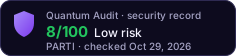
Quantum Audit's risk score for PARTI Token is 8/100 (Low risk) as of Oct 29, 2026, computed by a deterministic function from on-chain facts — Contract verified: Verified; Ownership: Retained; Mint: Mintable; Liquidity lock: Not locked; Upgradeability: Fixed code; Honeypot: None found; Buy / sell tax: 0% / 0%. A score is a dated snapshot of those facts, not a guarantee; each one is listed on this page.
Is PARTI liquidity locked?
Liquidity lock: Not locked (as of Oct 29, 2026). Total DEX liquidity: $335.8K.
Who holds PARTI?
As of Oct 29, 2026, the 10 largest holders own 97.2% of the supply across 12,917 holders. The Holders section on this page shows who they are by holder type.
Would You Like a More Detailed Audit of PARTI Token?
Our AI-powered scanner gives you a deeper, real-time smart contract analysis — free, with every scoring factor shown.
Get Detailed Audit Is this your token? Add your links and get it Verified