
Quantum Audit Logo
Base · Smart Contract Security · Updated Jul 24, 2026

Is Briun Armstrung Safe? BRIUN

On-chain security analysis — is it a scam or legit?

Contract 0x8c81…e987 DexScreener ↗
Medium Risk How is this score calculated? →
Volume 24h
$60.9K
Liquidity
$38.0K
Price
$0.0001204
Token Age
2y
Top 10 Holders
0.0%

Security Checklist

Contract VerifiedFail
Ownership RenouncedPass
No Mint FunctionUnknown
Liquidity LockedFail
Not a ProxyPass

Audit History

Jul 2432

Every audit run adds a dated snapshot — history is append-only and cannot be edited.

Audit Summary

The BriunArmstrung token contract is a standard ERC20 implementation built upon battle-tested OpenZeppelin libraries. The contract's ownership has been renounced, making it immutable in terms of administrative control. The primary risk identified is the centralized initial distribution of the entire token supply to the deployer, which is an economic rather than a technical vulnerability.
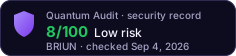

Final Recommendation: The BriunArmstrung token contract is a robust and secure ERC20 implementation, largely due to its reliance on OpenZeppelin's battle-tested libraries and the renounced ownership. The primary area for consideration is the initial token distribution strategy, which is currently centralized. Future token distribution should aim for broader decentralization to enhance community trust and mitigate potential market manipulation risks.

Category Ratings

TechnicalMedium
6/10

The contract demonstrates high technical quality, primarily due to its reliance on OpenZeppelin's well-audited ERC20 and Ownable implementations (7.2 Code Security). There are no complex custom logic, external calls, or reentrancy vectors. Standard Solidity 0.8.0+ features mitigate integer over

GovernanceMedium
6/10

The contract's ownership has been renounced (7.3 Access Control), which removes a single point of administrative control and enhances decentralization for contract functions. However, the entire initial token supply is minted to the deployer (7.4 Economic), presenting a centralized distribution

UpgradesLow
8/10

The contract is not designed to be upgradeable (7.7 Upgrades). This eliminates upgrade-related risks such as proxy implementation vulnerabilities or administrative key compromise. The immutability provides certainty regarding the contract's future behavior.

What Raised This Score

Each factor is an on-chain fact recorded at the time of this analysis. The score is computed from them by a deterministic function, so the same contract returns the same score for anyone who runs the audit. How scores are computed

Security Findings

1 Low 2 Info
L-01LowUnresolved

Centralized Initial Token Distribution

The contract's constructor mints the entire initial supply of 1,000,000,000 tokens (1 billion) to the deployer address. This results in 100% of the token supply being held by a single address immediately after deployment (7.4 Economic).

Recommendation: While not a technical vulnerability in the contract code, this represents a significant centralization risk for the token's economic model. Future distribution strategies should aim for broader decentralization to mitigate potential market manipulation or single points of failure, aligning with principles of decentralized finance.
I-01InformationalUnresolved

Ownership Renounced

The contract's `Ownable` ownership has been renounced, as indicated by the `ownership_renounced: true` flag in the provided metadata. This means the `owner()` function will return the zero address, and any functions protected by the `onlyOwner` modifier are no longer callable. This affects `transferOwnership` and `renounceOwnership` functions.

Recommendation: Confirm that renouncing ownership was an intentional design choice. This makes the contract immutable in terms of administrative control, preventing future changes to ownership or other `onlyOwner` protected functions. This is often a desired state for fully decentralized tokens.
I-02InformationalUnresolved

Standard OpenZeppelin ERC20 Implementation

The contract is a standard implementation of the ERC20 token specification, leveraging well-audited OpenZeppelin Contracts (v4.9.3). This includes robust handling of transfers, approvals, and supply management. The use of battle-tested libraries significantly reduces the risk of common vulnerabilities (7.2 Code Security).

Recommendation: Continue to rely on battle-tested libraries for core functionalities. Ensure any custom logic introduced in future versions maintains the same security standards and undergoes thorough testing and auditing.

Would You Like a More Detailed Audit of Briun Armstrung?

Our AI-powered scanner gives you a deeper, real-time smart contract analysis — free, no signup required.

Get Detailed Audit
Run Free Audit →