
Quantum Audit Logo

Is Bitway Token Safe?

On-chain security analysis — is it a scam or legit?

Is this your token? Publish your own audit on this page →

Bitway Token BTW
0x4440…acaa
BNB Chain Not verifiedLast checked 2d ago 2 audits on record
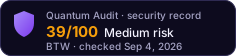
How is this score calculated? → Medium Risk
Executive SummaryAI Copilot

The BitwayToken contract implements an ERC20 token with custom transfer restrictions based on a timestamp and a whitelist. The contract utilizes OpenZeppelin's Ownable and ERC20Permit. A significant finding is the owner's ability to indefinitely extend the transfer lockup period, posing a high centralization risk. Other findings include a nuanced whitelist application for minting vs. burning, and minor code quality issues. The owner is a multisig, which is a positive security practice for critical operations.

1 High1 Medium1 Low1 Informational
Volume 24h
$160.2K
Liquidity
$39.3K
Price
$0.4517
Token Age
4mo
Top 10 Holders
96.1%

Security Findings

High

Owner Can Indefinitely Extend Transfer Lockup Period

H-01The `setTransferAllowedTimestamp` function's logic for `ETA` (Estimated Time of Arrival) does not consistently restrict the owner's ability to extend the `transferAllowedTimestamp`. If the current `transferAllowedTimestamp` is still in the future (`transferAllowedTimestamp > block.timestamp`), the owner can set a `newTimestamp` arbitrarily far into the future without any `ETA` constraint. This allows the owner to indefinitely postpone the lifting of transfer restrictions for non-whitelisted users, effectively freezing token liquidity at will.
IssueThe `setTransferAllowedTimestamp` function's logic for `ETA` (Estimated Time of Arrival) does not consistently restrict the owner's ability to extend the `transferAllowedTimestamp`. If the current `transferAllowedTimestamp` is still in the future (`transferAllowedTimestamp > block.timestamp`), the owner can set a `newTimestamp` arbitrarily far into the future without any `ETA` constraint. This allows the owner to indefinitely postpone the lifting of transfer restrictions for non-whitelisted users, effectively freezing token liquidity at will.
FixModify the `setTransferAllowedTimestamp` function to ensure that the `ETA` mechanism or a similar constraint applies consistently, regardless of whether the current `transferAllowedTimestamp` is in the past or future. For example, always enforce a maximum extension period or introduce a timelock for changes that extend the lockup. Consider a governance mechanism or a fixed, non-extendable lockup period if decentralization is a goal.
StatusUnresolved
Medium

Inconsistent Whitelist Application for Minting and Burning

M-01The `_update` function, which enforces the transfer lockup and whitelist, contains a conditional check: `if (from != address(0)) { require(whitelist[from], "Not allowed"); }`. This means that when `from` is `address(0)` (as in `_mint` operations), the whitelist check is bypassed. However, for `burn` operations, where `from` is `_msgSender()`, the whitelist check *is* applied. This design choice means that during the restricted period, tokens can be minted to any address, but burning tokens requires the burner to be whitelisted. While potentially intentional, this inconsistency could lead to user confusion or unexpected behavior if not clearly documented.
IssueThe `_update` function, which enforces the transfer lockup and whitelist, contains a conditional check: `if (from != address(0)) { require(whitelist[from], "Not allowed"); }`. This means that when `from` is `address(0)` (as in `_mint` operations), the whitelist check is bypassed. However, for `burn` operations, where `from` is `_msgSender()`, the whitelist check *is* applied. This design choice means that during the restricted period, tokens can be minted to any address, but burning tokens requires the burner to be whitelisted. While potentially intentional, this inconsistency could lead to user confusion or unexpected behavior if not clearly documented.
FixClearly document the specific behavior of the whitelist for both minting and burning operations in the contract's NatSpec and external documentation. If this behavior is not intentional, adjust the `_update` logic to apply the whitelist consistently or as desired for all `from` addresses, or consider if `burn` should also bypass the whitelist if `_mint` does.
StatusUnresolved
Low

Unused OpenZeppelin Pausable Import

L-01The `Pausable` contract from OpenZeppelin is imported in `BitwayToken.sol` but is not inherited or used anywhere within the contract. This results in unnecessary code being included in the contract's dependencies.
IssueThe `Pausable` contract from OpenZeppelin is imported in `BitwayToken.sol` but is not inherited or used anywhere within the contract. This results in unnecessary code being included in the contract's dependencies.
FixRemove the unused `import {Pausable} from "@openzeppelin/contracts/utils/Pausable.sol";` statement to reduce contract size and improve code clarity.
StatusUnresolved
Info

Complex and Potentially Misleading ETA Logic

I-01The `ETA` (Estimated Time of Arrival) logic within the `setTransferAllowedTimestamp` function is somewhat complex, involving conditional checks based on `transferAllowedTimestamp > block.timestamp` and `ETA == 0`. This complexity, combined with the high-severity issue of potential bypass, makes the function harder to reason about and increases the risk of misinterpretation or future vulnerabilities.
IssueThe `ETA` (Estimated Time of Arrival) logic within the `setTransferAllowedTimestamp` function is somewhat complex, involving conditional checks based on `transferAllowedTimestamp > block.timestamp` and `ETA == 0`. This complexity, combined with the high-severity issue of potential bypass, makes the function harder to reason about and increases the risk of misinterpretation or future vulnerabilities.
FixRefactor the `setTransferAllowedTimestamp` function to simplify the `ETA` logic. Consider using clearer variable names, adding comments to explain complex conditions, or breaking down the logic into smaller, more manageable parts. Ensure the intended behavior of `ETA` is explicitly and unambiguously enforced.
StatusUnresolved

Category Ratings

TechnicalLow8/10

The BitwayToken contract is built upon well-audited OpenZeppelin libraries (ERC20, Ownable, ERC20Permit), which contributes to a solid foundation (7.2 Code Security). The custom `_update` logic correctly enforces the transfer lockup and whitelist conditions. However, the `setTransferAllowedTimestamp` function's `ETA` mechanism is complex and contains a logic flaw that allows the owner to bypass its intended restriction (7.2 Code Security). Additionally, the `Pausable` contract is imported but not utilized, adding unnecessary complexity (7.1 Architecture).

GovernanceMedium5/10

The contract exhibits a high degree of centralization, with the owner having significant control over token transferability (7.3 Access Control). Specifically, the owner can indefinitely extend the `transferAllowedTimestamp` as long as the current timestamp is in the future, effectively controlling when non-whitelisted users can transfer tokens (7.4 Economic). While the owner is a multisig, which mitigates single-point-of-failure risk (7.5 Governance), the extensive power over token liquidity remains a concern. The whitelist mechanism also grants the owner full control over who can bypass transfer restrictions (7.3 Access Control).

UpgradesLow7/10

The BitwayToken contract is not designed with an upgrade mechanism (7.7 Upgrades). This means its logic is immutable once deployed, eliminating risks associated with proxy patterns or upgradeability flaws. Any future changes would require a new contract deployment and migration of assets, which should be considered in long-term planning.

Security Checklist

Contract VerifiedPass
Ownership RenouncedFail
No Mint FunctionPass
Liquidity LockedFail
Not a ProxyPass

Holder Composition

10.7% in wallets85.5% in contracts
Effective Concentration44.9%

Share held by contracts — treasury, vesting, bridge or staking — is discounted against share held by wallets when the score is computed: a contract cannot decide to sell the way an anonymous holder can, though it can still be drained or voted to sell. Effective concentration is the figure the risk score is actually calculated from.

Liquidity Depth

The risk score reads depth across every pair. The volume figure and the volume-to-liquidity ratio elsewhere on this page describe only the pair this audit analysed, so the two are not directly comparable.

LP Distribution

Top-1 Unlocked Holder21.5%
Top-3 Unlocked38.2%

Key Addresses

Deployer
0x1942…8419
Unlocked LP Held By
0x1fb6…8fc00x2b87…1f400x3fe9…f2fe0xac30…0ae10xa5f3…4cf20xe81e…53040x9489…57370x611c…fba10x2adc…50480xddec…cb52

No privileged address appears among these holders: the unlocked liquidity sits with independent providers, not with the deployer.

What Raised This Score

  • Ownership NOT renounced — strong Multisig (4-of-6)
  • Top-10 concentration > 30% (96.1% total → 44.9% effective; 10.7% in EOAs, 85.5% in contracts — moderate)
  • Liquidity not locked, but no owner/deployer address holds LP — market-depth risk, not rug risk
  • 1 High finding(s) from audit
  • 1 Medium finding(s) from audit
  • 1 Low finding(s) from audit

Each factor is an on-chain fact recorded at the time of this analysis. The score is computed from them by a deterministic function, so the same contract returns the same score for anyone who runs the audit. How scores are computed

Frequently Asked Questions

Is Bitway Token a scam?

Based on automated analysis, Bitway Token scores 61/100 (High Risk) on our risk scale. No honeypot was detected, but always verify independently before investing.

Is Bitway Token safe to buy?

Our scanner flagged a risk score of 61/100. Ownership has not been renounced, which is a risk factor. DYOR before purchasing any token.

Has Bitway Token been audited?

The contract has not been verified on-chain. Verification is not the same as a full security audit. Use Quantum Audit's free tool to run a deeper analysis of the contract code.

Related Audits

MarsCoinMedium RiskCZ'S DOG (BROCCOLI)Medium RiskCharacterX (CAI)Medium RiskMame Inu (MAME)Medium RiskAPRO oracle Token (AT)Medium Riskutility token (UTILITY)Medium Risk

Would You Like a More Detailed Audit of Bitway Token?

Our AI-powered scanner gives you a deeper, real-time smart contract analysis — free, with every scoring factor shown.

Get Detailed Audit