
Quantum Audit Logo

Is Covalent X Token Safe?

On-chain security analysis — is it a scam or legit?

Is this your token? Publish your own audit on this page →

Covalent X Token CXT
0x7abc…2c4d
Ethereum Not verifiedLast checked 3d ago 2 audits on record
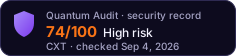
How is this score calculated? → Critical Risk
Executive SummaryAI Copilot

The CovalentXToken contract is an ERC20 token with custom access control for minting and cap management. It leverages OpenZeppelin libraries for standard functionality and role-based access. The primary risks identified are related to the high degree of centralization in critical roles, particularly the `DEFAULT_ADMIN_ROLE` and `CAP_MANAGER_ROLE`, which can significantly impact token supply and value if compromised. The contract is not upgradeable, meaning any future changes would require a new deployment.

2 High1 Medium1 Low2 Informational
Volume 24h
$2.3K
Liquidity
$52.5K
Price
$0.001575
Token Age
2y
Top 10 Holders
56.0%

Security Findings

High

Centralized Control of Minting Cap

H-01The `updateMintCap` function, controlled by the `CAP_MANAGER_ROLE`, allows setting `mintPerSecondCap` to any `uint256` value without an upper bound. If the address holding `CAP_MANAGER_ROLE` is compromised, an attacker could set an extremely high or infinite minting cap, effectively removing all emission controls and leading to arbitrary token inflation. This poses a severe economic risk to the token's value.
IssueThe `updateMintCap` function, controlled by the `CAP_MANAGER_ROLE`, allows setting `mintPerSecondCap` to any `uint256` value without an upper bound. If the address holding `CAP_MANAGER_ROLE` is compromised, an attacker could set an extremely high or infinite minting cap, effectively removing all emission controls and leading to arbitrary token inflation. This poses a severe economic risk to the token's value.
FixImplement a multi-signature wallet for the `CAP_MANAGER_ROLE` to distribute control. Consider adding a maximum allowable value for `mintPerSecondCap` or a time-locked delay for significant cap increases to provide a window for community review or emergency intervention.
StatusUnresolved
High

High Power of DEFAULT_ADMIN_ROLE

H-02The `protocolCouncil` address is granted the `DEFAULT_ADMIN_ROLE` in the constructor. This role has the power to grant and revoke any other role, including itself. This creates a single point of failure where compromise of the `protocolCouncil` address would grant an attacker complete control over all access control mechanisms, including minting, cap management, and Permit2 allowance toggling.
IssueThe `protocolCouncil` address is granted the `DEFAULT_ADMIN_ROLE` in the constructor. This role has the power to grant and revoke any other role, including itself. This creates a single point of failure where compromise of the `protocolCouncil` address would grant an attacker complete control over all access control mechanisms, including minting, cap management, and Permit2 allowance toggling.
FixAssign the `DEFAULT_ADMIN_ROLE` to a robust multi-signature wallet with a high number of required confirmations. This significantly reduces the risk of a single compromised key leading to full protocol takeover. Regularly review and audit the signers of this multi-sig.
StatusUnresolved
Medium

Miner Manipulability of `block.timestamp` for Minting

M-01The `mint` function calculates `maxMint` based on `block.timestamp - lastMint`. While `block.timestamp` is generally reliable, miners have a limited ability to manipulate it (e.g., up to 900 seconds on Ethereum) to slightly increase the `timeElapsedSinceLastMint` and thus the `maxMint` amount within a block. Although the impact might be minor given the `mintPerSecondCap`, a malicious miner could potentially front-run or manipulate block timestamps to mint slightly more tokens than intended.
IssueThe `mint` function calculates `maxMint` based on `block.timestamp - lastMint`. While `block.timestamp` is generally reliable, miners have a limited ability to manipulate it (e.g., up to 900 seconds on Ethereum) to slightly increase the `timeElapsedSinceLastMint` and thus the `maxMint` amount within a block. Although the impact might be minor given the `mintPerSecondCap`, a malicious miner could potentially front-run or manipulate block timestamps to mint slightly more tokens than intended.
FixWhile `block.timestamp` is a common and generally accepted practice for time-based calculations, for highly sensitive operations like token minting, consider if an alternative time source (e.g., an oracle for time) or a mechanism that averages `block.timestamp` over several blocks could further reduce this risk, if deemed necessary. For this specific use case, the risk is mitigated by the `mintPerSecondCap` and `lastMint` update.
StatusUnresolved
Low

Missing Zero Address Check for `emissionManager` in Constructor

L-01The constructor explicitly checks if `migration`, `protocolCouncil`, or `emergencyCouncil` are `address(0)` and reverts with `InvalidAddress`. However, there is no such check for the `emissionManager` address. While `_grantRole` would likely revert if `emissionManager` is `address(0)`, an explicit check improves clarity and consistency.
IssueThe constructor explicitly checks if `migration`, `protocolCouncil`, or `emergencyCouncil` are `address(0)` and reverts with `InvalidAddress`. However, there is no such check for the `emissionManager` address. While `_grantRole` would likely revert if `emissionManager` is `address(0)`, an explicit check improves clarity and consistency.
FixAdd an explicit `require(emissionManager != address(0), "InvalidAddress")` check for the `emissionManager` parameter in the constructor to ensure all critical role addresses are valid.
StatusUnresolved
Info

Non-Upgradeable Contract

I-01The CovalentXToken contract is deployed as a standard implementation contract and is not designed with an upgradeable proxy pattern. This means that once deployed, its logic cannot be modified. Any future bug fixes, feature enhancements, or changes to the token's economic model would necessitate deploying an entirely new contract and migrating existing token holders.
IssueThe CovalentXToken contract is deployed as a standard implementation contract and is not designed with an upgradeable proxy pattern. This means that once deployed, its logic cannot be modified. Any future bug fixes, feature enhancements, or changes to the token's economic model would necessitate deploying an entirely new contract and migrating existing token holders.
FixAcknowledge the implications of non-upgradeability. For future contracts, consider implementing an upgradeable proxy pattern (e.g., UUPS or Transparent) if flexibility for future changes is desired. Ensure thorough testing and auditing of the current non-upgradeable contract to minimize the need for future redeployments.
StatusUnresolved
Info

Permit2 Default Max Approval

I-02The contract grants `type(uint256).max` allowance to the hardcoded Permit2 address by default if `permit2Enabled` is true. While this is a common pattern for Permit2 integration to simplify user experience, it delegates significant trust to the Permit2 contract itself. If a vulnerability were to be discovered in Permit2, or if the `PERMIT2_REVOKER_ROLE` were compromised, it could lead to unauthorized token transfers.
IssueThe contract grants `type(uint256).max` allowance to the hardcoded Permit2 address by default if `permit2Enabled` is true. While this is a common pattern for Permit2 integration to simplify user experience, it delegates significant trust to the Permit2 contract itself. If a vulnerability were to be discovered in Permit2, or if the `PERMIT2_REVOKER_ROLE` were compromised, it could lead to unauthorized token transfers.
FixEnsure the `PERMIT2_REVOKER_ROLE` is secured with a multi-signature wallet. Regularly monitor the security landscape of the Permit2 contract and be prepared to disable the integration via `updatePermit2Allowance(false)` if any critical vulnerabilities are identified in Permit2.
StatusUnresolved

Category Ratings

TechnicalMedium6/10

The contract demonstrates good technical architecture (7.1) by utilizing battle-tested OpenZeppelin libraries for ERC20 and AccessControl functionalities, enhancing code security (7.2). The minting logic correctly uses `block.timestamp` and updates `lastMint` to prevent re-entry issues within the same block. However, the reliance on `block.timestamp` for `maxMint` calculation introduces a minor risk of miner manipulation (7.2). The Permit2 integration is well-implemented, providing a revocable default max approval.

GovernanceHigh2/10

The economic model (7.4) is highly dependent on the security of the `EMISSION_ROLE` and `CAP_MANAGER_ROLE`, as these control token supply and emission limits. The governance model (7.5) is centralized, with the `protocolCouncil` holding the `DEFAULT_ADMIN_ROLE`, `CAP_MANAGER_ROLE`, and `PERMIT2_REVOKER_ROLE`. This concentration of power means a compromise of the `protocolCouncil` address could lead to unlimited token minting via `updateMintCap` (H-01) or full control over all roles (H-02), posing a significant economic risk to token holders. The initial mint of 1 billion tokens to a `migration` address is a critical operational (7.8) decision.

UpgradesMedium4/10

The CovalentXToken contract is not designed to be upgradeable (7.7). This means that any future changes, bug fixes, or feature additions would require a complete redeployment of the contract and a migration of existing token holders. While this eliminates risks associated with proxy upgrade mechanisms, it introduces inflexibility for future protocol evolution.

Security Checklist

Contract VerifiedPass
Ownership Renounced?
No Mint FunctionFail
Liquidity LockedPass
Not a ProxyPass

Holder Composition

12.2% in wallets43.8% in contracts
Effective Concentration29.8%

Share held by contracts — treasury, vesting, bridge or staking — is discounted against share held by wallets when the score is computed: a contract cannot decide to sell the way an anonymous holder can, though it can still be drained or voted to sell. Effective concentration is the figure the risk score is actually calculated from.

Liquidity Depth

The risk score reads depth across every pair. The volume figure and the volume-to-liquidity ratio elsewhere on this page describe only the pair this audit analysed, so the two are not directly comparable.

LP Distribution

Top-1 Unlocked Holder99.6%
Top-3 Unlocked99.9%

Key Addresses

Deployer
0xebba…652a
Unlocked LP Held By
0x220b…e57e0xf385…5f850xebfc…291d0xcf8e…2520

No privileged address appears among these holders: the unlocked liquidity sits with independent providers, not with the deployer.

What Raised This Score

  • Ownership status UNKNOWN (owner could not be resolved)
  • Mintable supply — no cap found, dilution unbounded
  • Top-10 concentration > 20% (56.0% total → 29.8% effective; 12.2% in EOAs, 43.8% in contracts — mild)
  • LP top1 unlocked holder = 99.6% (independent LP — depth risk)
  • LP top3 unlocked holders = 99.9% (independent LP — depth risk)
  • LP claimed locked but only 0.0% actually locked
  • 2 High finding(s) from audit
  • 1 Medium finding(s) from audit
  • 1 Low finding(s) from audit

Each factor is an on-chain fact recorded at the time of this analysis. The score is computed from them by a deterministic function, so the same contract returns the same score for anyone who runs the audit. How scores are computed

Frequently Asked Questions

Is Covalent X Token a scam?

Based on automated analysis, Covalent X Token scores 66/100 (High Risk) on our risk scale. No honeypot was detected, but always verify independently before investing.

Is Covalent X Token safe to buy?

Our scanner flagged a risk score of 66/100. Ownership has not been renounced, which is a risk factor. DYOR before purchasing any token.

Has Covalent X Token been audited?

The contract has not been verified on-chain. Verification is not the same as a full security audit. Use Quantum Audit's free tool to run a deeper analysis of the contract code.

Related Audits

Main Street USD (MSUSD)Critical RiskUSDxCritical RiskNEXOCritical RiskCronos (CRO)Critical RiskEpic Chain (EPIC)Critical RisktrUSDCritical Risk

Would You Like a More Detailed Audit of Covalent X Token?

Our AI-powered scanner gives you a deeper, real-time smart contract analysis — free, with every scoring factor shown.

Get Detailed Audit