
The LayerZeroToken contract is a standard implementation of LayerZero's Omnichain Fungible Token (OFT) using OpenZeppelin's Ownable. It primarily relies on well-audited external libraries for its core functionality. The contract itself is minimal, reducing the surface area for custom code vulnerabilities. However, the critical role of the owner/delegate in configuring cross-chain parameters and the inherent dependency on the LayerZero protocol introduce significant operational and economic risks.
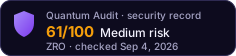
On-chain security analysis — is it a scam or legit?
Is LayerZero Safe?
Not verified
This record has not gone through deep verification and is not being monitored. The score is a dated snapshot — the token’s risk can change at any time.Own this token? Put it under verification →The LayerZeroToken contract is a standard implementation of LayerZero's Omnichain Fungible Token (OFT) using OpenZeppelin's Ownable.
Read the full analysis- Ownership not renounced — strong Multisig
- Top-10 concentration > 50%
- Liquidity not locked, but no owner/deployer address holds LP — market-depth risk, not rug risk
- LP top1 unlocked holder = 100.0%
- LP top3 unlocked holders = 100.0%
- 1 Critical finding(s) from audit
- 2 Medium finding(s) from audit
- 1 Low finding(s) from audit
Exact factors
- Ownership NOT renounced — strong Multisig (3-of-5)
- Top-10 concentration > 50% (59.7% total → 59.7% effective; 59.7% in EOAs, 0.0% in contracts — heavy)
- Liquidity not locked, but no owner/deployer address holds LP — market-depth risk, not rug risk
- LP top1 unlocked holder = 100.0% (independent LP — depth risk, pool = 30% of DEX liquidity)
- LP top3 unlocked holders = 100.0% (independent LP — depth risk, pool = 30% of DEX liquidity)
- 1 Critical finding(s) from audit
- 2 Medium finding(s) from audit
- 1 Low finding(s) from audit
Each factor is an on-chain fact recorded at the time of this analysis. The score is computed from them by a deterministic function, so the same contract returns the same score for anyone who runs the audit. How scores are computed
Security Checklist
as of audit · Sep 4Holders
as of audit · Sep 4, 2026- Walletsanonymous holders, free to sell59.7%
- Everyone elsethe rest of the supply40.3%
How holder types affect the score
Share held by contracts — treasury, vesting, bridge or staking — is discounted against share held by wallets when the score is computed: a contract cannot decide to sell the way an anonymous holder can, though it can still be drained or voted to sell. Effective concentration is the figure the risk score is actually calculated from.
Holder balances as recorded by the audit of Sep 4, 2026
Liquidity
as of audit · Sep 4- AerodromeWETHAnalysed$69.6K30.0%
- AerodromeWETH$35.4K15.2%
- AerodromeZEN$27.8K12.0%
- Uniswap v4USDC$23.8K10.2%
- Uniswap v3WETH$21.0K9.1%
- Uniswap v3USDC$17.3K7.4%
Show 4 more pairs
The 7 remaining pairs hold $8.1K between them and are not listed. The risk score reads depth across every pair.
The LP tokens of the analysed pool are not locked or burned, so whoever holds them can withdraw that liquidity.
0x9b81…7db9No privileged address appears among these holders: the unlocked liquidity sits with independent providers, not with the deployer.
Security Findings
CriticalCritical Owner Privileges
The owner address (initialized as _delegate in the constructor) possesses critical administrative privileges over the LayerZeroToken contract's cross-chain functionality. Specifically, the owner can call setPeer to configure trusted OApp instances on other chains and setDelegate to change the delegate address on the LayerZero endpoint. A compromise of this owner address would grant an attacker full control over the contract's cross-chain configuration, potentially leading to unauthorized token transfers or denial of service for cross-chain operations (7.3 Access Control, 7.8 Operations).C-01
Issue
The owner address (initialized as _delegate in the constructor) possesses critical administrative privileges over the LayerZeroToken contract's cross-chain functionality. Specifically, the owner can call setPeer to configure trusted OApp instances on other chains and setDelegate to change the delegate address on the LayerZero endpoint. A compromise of this owner address would grant an attacker full control over the contract's cross-chain configuration, potentially leading to unauthorized token transfers or denial of service for cross-chain operations (7.3 Access Control, 7.8 Operations).
Fix
Implement a robust multi-signature wallet with a high threshold for the owner address. Consider integrating a time-lock mechanism for critical administrative functions like setPeer and setDelegate to introduce a delay before changes take effect, allowing for detection and potential intervention in case of a malicious or erroneous action. Ensure the private keys for the multi-signature signers are stored securely and follow best practices for key management.
Status
Unresolved
MediumRenounce Ownership Risk
The contract inherits renounceOwnership() from OpenZeppelin's Ownable contract. If the owner accidentally or maliciously calls this function, the contract would become unowned and unmanageable. This would prevent any future updates to critical LayerZero configurations, such as setPeer or setDelegate, effectively bricking the cross-chain functionality of the token (7.3 Access Control, 7.8 Operations).M-01
Issue
The contract inherits renounceOwnership() from OpenZeppelin's Ownable contract. If the owner accidentally or maliciously calls this function, the contract would become unowned and unmanageable. This would prevent any future updates to critical LayerZero configurations, such as setPeer or setDelegate, effectively bricking the cross-chain functionality of the token (7.3 Access Control, 7.8 Operations).
Fix
Consider overriding renounceOwnership() to revert, or remove it entirely if it's not intended to be used. If renouncing ownership is a desired feature, ensure there is a clear, documented process and strong safeguards to prevent accidental invocation. For critical infrastructure, renouncing ownership is generally not recommended.
Status
Unresolved
MediumDependency on LayerZero Endpoint Security
The LayerZeroToken contract's core cross-chain functionality is entirely dependent on the security and correct operation of the external LayerZero endpoint contract. Any vulnerability, misconfiguration, or compromise within the LayerZero endpoint itself could directly impact the security and functionality of this token, potentially leading to loss of funds or disruption of cross-chain transfers (7.6 External, 7.4 Economic).M-02
Issue
The LayerZeroToken contract's core cross-chain functionality is entirely dependent on the security and correct operation of the external LayerZero endpoint contract. Any vulnerability, misconfiguration, or compromise within the LayerZero endpoint itself could directly impact the security and functionality of this token, potentially leading to loss of funds or disruption of cross-chain transfers (7.6 External, 7.4 Economic).
Fix
While direct mitigation within this contract is limited, it is crucial to stay informed about the security posture and audits of the LayerZero protocol. Monitor LayerZero announcements and security advisories closely. Implement off-chain monitoring for LayerZero endpoint activity relevant to this token. Diversify cross-chain solutions if possible, or have contingency plans in place for potential LayerZero endpoint issues.
Status
Unresolved
LowImmutable LayerZero Endpoint Address
The lzEndpoint address is set as an immutable variable in the constructor of OAppCore (a base contract for LayerZeroToken). While immutability prevents malicious changes post-deployment, it also means that if the LayerZero endpoint address ever needs to change (e.g., due to a major upgrade, deprecation, or critical bug in the endpoint itself), the LayerZeroToken contract would need to be redeployed, and all token holders would need to migrate their tokens (7.1 Architecture, 7.8 Operations).L-01
Issue
The lzEndpoint address is set as an immutable variable in the constructor of OAppCore (a base contract for LayerZeroToken). While immutability prevents malicious changes post-deployment, it also means that if the LayerZero endpoint address ever needs to change (e.g., due to a major upgrade, deprecation, or critical bug in the endpoint itself), the LayerZeroToken contract would need to be redeployed, and all token holders would need to migrate their tokens (7.1 Architecture, 7.8 Operations).
Fix
Acknowledge this design choice. If future flexibility is desired, consider a design pattern where the endpoint address can be updated by the owner, possibly with a time-lock. However, this introduces additional complexity and potential attack surface. For many applications, an immutable endpoint is acceptable given the stability of LayerZero's infrastructure.
Status
Unresolved
InfoCombined Owner and Delegate Role
In the constructor, the _delegate address is used to initialize both the Ownable contract (making it the contract owner) and the LayerZero endpoint delegate via endpoint.setDelegate(_delegate). This design centralizes significant control in a single address, simplifying management but also consolidating risk (7.3 Access Control, 7.8 Operations).I-01
Issue
In the constructor, the _delegate address is used to initialize both the Ownable contract (making it the contract owner) and the LayerZero endpoint delegate via endpoint.setDelegate(_delegate). This design centralizes significant control in a single address, simplifying management but also consolidating risk (7.3 Access Control, 7.8 Operations).
Fix
Ensure that the implications of this combined role are fully understood by the operational team. While it simplifies setup, it means that the security of this single address is paramount for both contract ownership and LayerZero endpoint delegation. Document the responsibilities and security procedures for this address clearly.
Status
Unresolved
Analysis
AI Copilotas of audit · Sep 4The contract exhibits good technical quality, primarily due to its reliance on battle-tested OpenZeppelin and LayerZero OApp-v2 libraries. The custom logic in LayerZeroToken.sol is minimal, serving as a simple wrapper around the OFT implementation. This approach reduces the likelihood of common coding vulnerabilities such as reentrancy or integer overflows (7.2 Code Security). The architecture (7.1 Architecture) is straightforward, inheriting directly from OFT, which simplifies understanding and auditing. No significant technical flaws were identified in the contract's direct implementation.
The contract's economic and governance model (7.4 Economic, 7.5 Governance) is centralized, with a single owner/delegate address holding critical configuration privileges. This owner can set trusted peers for cross-chain communication via setPeer and change the delegate on the LayerZero endpoint via setDelegate. A compromise of this owner address could lead to unauthorized cross-chain token transfers or disruption of service. Additionally, the contract's functionality is entirely dependent on the security and operational integrity of the external LayerZero endpoint (7.6 External), introducing a significant external dependency risk.
The LayerZeroToken contract is not designed to be upgradeable (7.7 Upgrades). It is a standard implementation contract without any proxy patterns. This eliminates upgrade-related risks such as proxy storage collisions or incorrect upgrade logic. However, it also means that any future changes or bug fixes to the core contract logic would require a redeployment and migration of assets.
It is crucial to secure the owner/delegate address with the highest possible security measures, such as a robust multi-signature wallet with a high threshold.
Implement comprehensive monitoring for all owner-controlled functions, especially setPeer and setDelegate, to detect and respond to any unauthorized activity promptly. Consider implementing a time-lock for critical administrative actions to provide a window for intervention in case of a compromise.
Contract & Record
Free for any token on the record. It links to this page and always shows the current score and the date it was checked.
- Jul 27, 202661Medium
- Jul 25, 202668High
Score changes are recorded as dated snapshots — history is append-only and cannot be edited.
Frequently Asked Questions
Is LayerZero a scam?
Based on automated analysis, LayerZero scores 68/100 (High Risk) on our risk scale. No honeypot was detected, but always verify independently before investing.
Is LayerZero safe to buy?
Our scanner flagged a risk score of 68/100. Ownership has not been renounced, which is a risk factor. DYOR before purchasing any token.
Has LayerZero been audited?
The contract has not been verified on-chain. Verification is not the same as a full security audit. Use Quantum Audit's free tool to run a deeper analysis of the contract code.
Would You Like a More Detailed Audit of LayerZero?
Our AI-powered scanner gives you a deeper, real-time smart contract analysis — free, with every scoring factor shown.
Get Detailed Audit Is this your token? Publish your own audit on this page