Quantum Audit Logo
Base · Smart Contract Security · Updated Jul 24, 2026

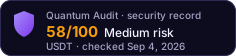
Is Tether USD Safe? USDT

On-chain security analysis — is it a scam or legit?

Contract 0xfde4…9bb2 DexScreener ↗
Volume 24h
$6.66M
Liquidity
$1.74M
Price
$0.9989
Token Age
1y
Top 10 Holders
25.6%

Security Checklist

Contract VerifiedPass
Ownership RenouncedFail
No Mint FunctionFail
Liquidity LockedFail
Not a ProxyPass

Audit History

Jul 2350Jul 2360

Every audit run adds a dated snapshot — history is append-only and cannot be edited.

Audit Summary

The audited contract is an ERC-20 token implementation, leveraging OpenZeppelin Contracts v3.4.1 for standard functionalities like `ERC20`, `Ownable`, `Pausable`, and `SafeMath`. The contract exhibits robust technical security due to the use of battle-tested libraries, including proper handling of integer overflows/underflows. However, it features a highly centralized control model, where an owner can mint, burn, and pause operations, which introduces significant governance and economic risks. The standard ERC-20 `approve` race condition is present, though mitigated by `increaseAllowance` and `decreaseAllowance` functions.

Final Recommendation: It is recommended to carefully manage the private keys associated with the `_owner` and `_pauser` roles due to their extensive control over the token's supply and operational status. Consider implementing a multi-signature wallet for these critical roles to enhance security and decentralization. For users, it is advisable to prefer `increaseAllowance` and `decreaseAllowance` over the direct `approve` function to mitigate front-running risks.

Category Ratings

TechnicalLow
7/10

The contract demonstrates good technical security (7.2 Code Security) by utilizing OpenZeppelin Contracts v3.4.1, which include `SafeMath` for all arithmetic operations, effectively preventing integer overflow/underflow vulnerabilities. The ERC-20 implementation is standard and adheres to best pract

GovernanceHigh
2/10

The contract exhibits a high degree of centralization (7.3 Access Control, 7.4 Economic, 7.5 Governance). The `_owner` role has extensive privileges, including the ability to `mint` and `burn` tokens, directly impacting the total supply and economic stability. Additionally, the `_pauser` role can `p

UpgradesHigh
2/10

The contract is not designed with an upgrade mechanism (7.7 Upgrades), meaning its logic is immutable once deployed. This eliminates upgrade-related risks such as proxy misconfigurations or logic bugs introduced during upgrades. Any changes to the token's functionality would require a new deplo

What Raised This Score

Each factor is an on-chain fact recorded at the time of this analysis. The score is computed from them by a deterministic function, so the same contract returns the same score for anyone who runs the audit. How scores are computed

Security Findings

1 High 1 Medium 1 Low 1 Info
H-01HighUnresolved

Extensive Centralized Control

The `_owner` possesses significant control, including the ability to `mint` and `burn` tokens, directly influencing the total supply and token value. Additionally, the `_pauser` can `pause` and `unpause` all core token operations (transfers, approvals, minting, burning), leading to potential denial of service for users. This design introduces high trust assumptions and a single point of failure (7.3 Access Control, 7.4 Economic, 7.8 Operations).

Recommendation: Implement a multi-signature wallet for the `_owner` and `_pauser` roles to distribute control and reduce the risk of a single point of compromise. Clearly communicate the extent of centralized control to users and stakeholders.
M-01MediumUnresolved

ERC-20 `approve` Race Condition

The standard `approve` function is susceptible to a known front-running attack. If a user approves an amount, then approves a different amount without first setting the allowance to zero, a malicious actor could potentially spend both the old and new allowances. While `increaseAllowance` and `decreaseAllowance` are provided as safer alternatives, the direct `approve` function remains (7.2 Code Security).

Recommendation: Educate users to primarily use `increaseAllowance` and `decreaseAllowance` instead of directly calling `approve` when modifying existing allowances. If `approve` must be used, advise users to first set the allowance to zero before setting a new value.
L-01LowUnresolved

Immutability of Core Token Parameters

The token's name, symbol, and decimals are set during construction and cannot be modified post-deployment. While standard for ERC-20 tokens, this means any initial misconfiguration of these parameters would require a new contract deployment (7.1 Architecture).

Recommendation: Ensure thorough verification of all constructor parameters, especially token name, symbol, and decimals, before deployment to prevent irreversible misconfigurations.
I-01InformationalUnresolved

Use of OpenZeppelin Contracts v3.4.1

The contract leverages well-audited OpenZeppelin libraries (Context, IERC20, SafeMath, ERC20, Ownable, Pausable) version 3.4.1. This significantly reduces the risk of common vulnerabilities by using battle-tested code, but means the contract inherits any potential, albeit unlikely, issues within these specific library versions (7.6 External).

Recommendation: Regularly monitor OpenZeppelin security advisories for the specific versions used. Consider upgrading to newer, actively maintained versions of OpenZeppelin Contracts if feasible and beneficial for new deployments, as they often include further optimizations and security enhancements.

Would You Like a More Detailed Audit of Tether USD?

Our AI-powered scanner gives you a deeper, real-time smart contract analysis — free, no signup required.

Get Detailed Audit
Run Free Audit →