
The SecuritiesToken is a highly centralized, upgradeable ERC-20 token designed for regulated environments. It utilizes a Beacon Proxy pattern for logic updates and relies on external compliance and pause management contracts. While the code follows standard OpenZeppelin patterns, the high degree of administrative control over core token logic and transfer rules necessitates strict multi-signature governance.
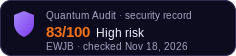
Early-stage security check — honeypot & rug-pull analysis
Is iShares MSCI Japan ETF a Scam?
Not verified
This record has not gone through deep verification and is not being monitored. The score is a dated snapshot — the token’s risk can change at any time.Own this token? Put it under verification →The SecuritiesToken is a highly centralized, upgradeable ERC-20 token designed for regulated environments.
Read the full analysis- A privileged address can replace a contract every transfer depends on
- Owner can change the buy/sell tax
- A privileged address can change transfer or wallet limits
- Mintable supply — no cap found, dilution unbounded
- Upgradeable proxy — the admin can replace the logic
- Ownership status UNKNOWN
- Liquidity not locked
- Top-10 concentration > 70%
- The deployer has launched a honeypot before
Exact factors
- A privileged address can replace a contract every transfer depends on
- Owner can change the buy/sell tax
- A privileged address can change transfer or wallet limits
- Mintable supply — no cap found, dilution unbounded
- Upgradeable proxy — the admin can replace the logic
- Ownership status UNKNOWN (owner could not be resolved)
- Liquidity NOT locked (100% of the pool; this pool is 99% of DEX liquidity) — held by independent providers — market-depth risk
- Top-10 concentration > 70% (95.1% total → 72.4% effective; 68.2% in EOAs, 10.7% in contracts; 16.3% burned, locked or in pools excluded)
- The deployer has launched a honeypot before
Each factor is an on-chain fact recorded at the time of this analysis. The score is computed from them by a deterministic function, so the same contract returns the same score for anyone who runs the audit. How scores are computed
Security Checklist
as of audit · Nov 18Holders
as of audit · Nov 18, 2026- Contractstreasury, vesting, bridge, staking10.7%
- Walletsanonymous holders, free to sell68.2%
- DEX poolsthe pools' own liquidity16.3%
- Everyone else922 holders4.9%
How holder types affect the score
Share held by contracts — treasury, vesting, bridge or staking — is discounted against share held by wallets when the score is computed: a contract cannot decide to sell the way an anonymous holder can, though it can still be drained or voted to sell. Effective concentration is the figure the risk score is actually calculated from.
Holder balances as recorded by the audit of Nov 18, 2026
Liquidity
as of audit · Nov 18- Pancakeswap v3USDTAnalysed$203.0K99.0%
- Uniswap v4USDT$1.1K0.5%
- Uniswap v4USDC$5000.2%
- Uniswap v4USDT$1960.1%
- Uniswap v4USDT$1930.1%
The risk score reads depth across every pair.
The LP tokens of the analysed pool are not locked or burned, so whoever holds them can withdraw that liquidity.
0x8145…09920xf3f7…4872No privileged address appears among these holders: the unlocked liquidity sits with independent providers, not with the deployer.
Security Findings
HighCentralized Control Over Token Logic
The functions setPauseManager and setCompliance allow an administrator to replace the external contracts that govern token transfers. If these roles are compromised, an attacker could redirect token logic to a malicious contract, effectively controlling or freezing all user transfers.CP-03
Issue
The functions setPauseManager and setCompliance allow an administrator to replace the external contracts that govern token transfers. If these roles are compromised, an attacker could redirect token logic to a malicious contract, effectively controlling or freezing all user transfers.
Fix
Restrict these functions to a multi-signature wallet with a mandatory time-lock delay to allow users to react to changes.
Status
Unresolved
MediumDynamic Transfer Fee Manipulation
The setUIMultiplier function allows an administrator to change the transfer fee multiplier at any time. This gives the controller the ability to unilaterally increase transaction costs for all users.CP-07
Issue
The setUIMultiplier function allows an administrator to change the transfer fee multiplier at any time. This gives the controller the ability to unilaterally increase transaction costs for all users.
Fix
Implement a maximum fee cap in the contract logic to prevent arbitrary fee increases by the administrator.
Status
Unresolved
MediumLiquidity not locked
0.0% of the pool's LP is burned or time-locked. 100.0% is held, unlocked, by 1 address(es) other than the owner/deployer. One of them — a wallet, 0x8145…0992 — holds 100.0% and can remove that share at once; who controls it is not visible on-chain, so it is not treated as an independent provider. Some pools are concentrated-liquidity (V3/V4) positions; shares above are by position as GoPlus reports them.QA-LIQUIDITY
Issue
0.0% of the pool's LP is burned or time-locked. 100.0% is held, unlocked, by 1 address(es) other than the owner/deployer. One of them — a wallet, 0x8145…0992 — holds 100.0% and can remove that share at once; who controls it is not visible on-chain, so it is not treated as an independent provider. Some pools are concentrated-liquidity (V3/V4) positions; shares above are by position as GoPlus reports them.
Fix
Check the lock's end date and beneficiary on the locker's own page before relying on it.
Status
Acknowledged
LowAdministrative Control Over Transfer Limits
The setUIMultiplier function also controls numeric limits related to transaction thresholds. An administrator can modify these limits, potentially restricting or enabling specific user behaviors at will.CP-08
Issue
The setUIMultiplier function also controls numeric limits related to transaction thresholds. An administrator can modify these limits, potentially restricting or enabling specific user behaviors at will.
Fix
Document the intended range for these limits and consider making them immutable or subject to a governance vote if they are intended to be fixed.
Status
Unresolved
InfoWho holds the supply
The ten largest holders own 95.1% of supply. Of that, 16.3% in DEX pools — not holders that can sell, so excluded from the concentration score. What remains: 68.2% in wallets, 10.7% in other contracts. 932 holders in total.QA-HOLDERS
Issue
The ten largest holders own 95.1% of supply. Of that, 16.3% in DEX pools — not holders that can sell, so excluded from the concentration score. What remains: 68.2% in wallets, 10.7% in other contracts. 932 holders in total.
Fix
Watch the largest wallets that are not exchanges, pools or locks — those are the ones that can move the price.
Status
Acknowledged
InfoNot listed by any independent source
932 holders. Not listed by CoinGecko or any exchange GoPlus tracks. Nothing independent confirms who is behind this token, so every power its contract grants is scored at face value.QA-IDENTITY
Issue
932 holders. Not listed by CoinGecko or any exchange GoPlus tracks. Nothing independent confirms who is behind this token, so every power its contract grants is scored at face value.
Fix
Match the contract address against the project's official channels before trading.
Status
Acknowledged
InfoThe market for this token
Liquidity $205K (DexScreener, all pools). 24h trading volume $1.3M (DexScreener, all pools).QA-MARKET
Issue
Liquidity $205K (DexScreener, all pools). 24h trading volume $1.3M (DexScreener, all pools).
Fix
Size any position to the liquidity and daily volume shown — they set how much you can sell and at what price.
Status
Acknowledged
InfoAsset class: Project token
A token issued by a project for use, governance or fundraising. Scored on its contract and market facts. The class itself adds no points; the contract and market facts decide the score. Basis: no class-specific evidence. Tokenomics — Supply: mintable with no on-chain cap found. Control: an owner that could not be resolved. Code: upgradeable proxy. Fees: no buy or sell tax. Market: $205K of DEX liquidity across 30 pools. Launch: under a day of market history.QA-PROFILE
Issue
A token issued by a project for use, governance or fundraising. Scored on its contract and market facts. The class itself adds no points; the contract and market facts decide the score. Basis: no class-specific evidence. Tokenomics — Supply: mintable with no on-chain cap found. Control: an owner that could not be resolved. Code: upgradeable proxy. Fees: no buy or sell tax. Market: $205K of DEX liquidity across 30 pools. Launch: under a day of market history.
Fix
Check the project's own documentation for what the token is used for; this report covers what the contract allows.
Status
Acknowledged
InfoRecently launched — less than a day of market history
The token's oldest DEX pool is less than a day old. Age is not part of the risk score — a new token is not a risky one by default — but a short history means fewer trades and holder changes behind the facts in this report.QA-RECENT
Issue
The token's oldest DEX pool is less than a day old. Age is not part of the risk score — a new token is not a risky one by default — but a short history means fewer trades and holder changes behind the facts in this report.
Fix
Re-check ownership, liquidity and holder distribution as the token matures; those are the facts that move early.
Status
Acknowledged
Analysis
AI Copilotas of audit · Nov 18The architecture leverages modular compliance and pause management, which effectively separates concerns for regulated assets. 7.1 Architecture and 7.2 Code Security are well-implemented using standard libraries. However, 7.3 Access Control is highly centralized, allowing administrators to redirect token logic via setCompliance and setPauseManager. This design requires trust in the administrative entities.
7.4 Economic and 7.5 Governance rely entirely on the security of the administrative roles. The ability to modify transfer fees and limits via setUIMultiplier allows for dynamic economic adjustments. These powers are significant and could be used to freeze or tax user assets if governance is compromised.
7.7 Upgrades are handled via a Beacon Proxy pattern, which is a robust and standard approach for managing multiple instances. 7.8 Operations are supported by clear administrative functions for minting and burning. The upgradeability mechanism is secure provided the Beacon owner is protected by a multi-signature wallet.
It is strongly recommended to transition all administrative roles to a multi-signature wallet (e.g., Gnosis Safe) with a time-lock mechanism to prevent immediate, unilateral changes to compliance or pause logic.
Ensure that the addresses assigned to the compliance and pause manager roles are also secured with similar high-threshold governance structures. Regularly audit the external contracts linked to the compliance and pause manager roles, as these represent the most significant attack vectors for the token's transfer logic. Maintain transparent documentation of all administrative actions taken via the privileged functions to ensure accountability for token holders.
Contract & Record
Free for any token on the record. It links to this page and always shows the current score and the date it was checked.
- Nov 18, 202683High
Score changes are recorded as dated snapshots — history is append-only and cannot be edited.
Would You Like a More Detailed Audit of iShares MSCI Japan ETF?
This token is brand new. Run a deeper AI-powered analysis of the contract code — free and instant.
Get Detailed Audit Is this your token? Add your links and get it Verified