
Quantum Audit Logo

Is Genius Safe?

On-chain security analysis — is it a scam or legit?

Is this your token? Publish your own audit on this page →

Genius GENIUS
0x1f12…e9a6
BNB Chain Not verifiedLast checked 3d ago 1 audit on record
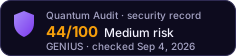
How is this score calculated? → Medium Risk
Executive SummaryAI Copilot

The GeniusToken contract is a standard ERC20Permit implementation, leveraging battle-tested OpenZeppelin libraries. It features a fixed total supply minted to a single owner address during deployment. The contract is not upgradeable and lacks complex economic or governance mechanisms, resulting in a low overall risk profile.

2 Low2 Informational
Volume 24h
$1.5K
Liquidity
$48.8K
Price
$0.2909
Token Age
4mo
Top 10 Holders
98.8%

Security Findings

Low

Centralized Initial Token Supply

L-01The entire fixed supply of 1,000,000,000 * 10^18 tokens is minted to a single `owner` address during the contract's constructor. This centralizes control of the entire token supply to one address immediately after deployment. If this address is compromised, the entire token supply could be at risk (7.3 Access Control, 7.4 Economic).
IssueThe entire fixed supply of 1,000,000,000 * 10^18 tokens is minted to a single `owner` address during the contract's constructor. This centralizes control of the entire token supply to one address immediately after deployment. If this address is compromised, the entire token supply could be at risk (7.3 Access Control, 7.4 Economic).
FixWhile this is a design choice, it is recommended that the `owner` address be a highly secured entity, such as a multi-signature wallet, to minimize the risk of a single point of failure. For future token designs, consider distributing the initial supply across multiple addresses or vesting contracts.
StatusUnresolved
Low

`permit` Function Front-Running Risk

L-02The `ERC20Permit` functionality allows users to approve token transfers via a signed message, enabling gasless approvals. However, the `permit` function is susceptible to front-running. An attacker could observe a pending `permit` transaction, extract the signed message, and submit their own transaction with a higher gas price to execute the `permit` before the legitimate user. This could lead to the attacker gaining an approval that was intended for someone else or for a different purpose, potentially exploiting the user's signed intent (7.2 Code Security, 7.8 Operations).
IssueThe `ERC20Permit` functionality allows users to approve token transfers via a signed message, enabling gasless approvals. However, the `permit` function is susceptible to front-running. An attacker could observe a pending `permit` transaction, extract the signed message, and submit their own transaction with a higher gas price to execute the `permit` before the legitimate user. This could lead to the attacker gaining an approval that was intended for someone else or for a different purpose, potentially exploiting the user's signed intent (7.2 Code Security, 7.8 Operations).
FixThis is an inherent characteristic of the EIP-2612 standard and not a flaw in the contract's implementation. Users should be educated about this risk. When using `permit`, users should ensure their transactions are submitted securely, potentially using privacy-preserving transaction relays or by carefully monitoring the mempool for their signed messages.
StatusUnresolved
Info

Lack of Upgradeability

I-01The GeniusToken contract is implemented as a standard, non-upgradeable contract. This means that once deployed, its code cannot be modified. While this eliminates risks associated with upgrade mechanisms (e.g., malicious upgrades, upgrade bugs), it also means that any discovered vulnerabilities, desired feature enhancements, or changes to tokenomics would necessitate deploying an entirely new contract and migrating existing token holders (7.1 Architecture, 7.7 Upgrades).
IssueThe GeniusToken contract is implemented as a standard, non-upgradeable contract. This means that once deployed, its code cannot be modified. While this eliminates risks associated with upgrade mechanisms (e.g., malicious upgrades, upgrade bugs), it also means that any discovered vulnerabilities, desired feature enhancements, or changes to tokenomics would necessitate deploying an entirely new contract and migrating existing token holders (7.1 Architecture, 7.7 Upgrades).
FixThis is a design choice. If future flexibility or bug-fixing capabilities are deemed important, consider implementing an upgradeable proxy pattern (e.g., UUPS) for future contracts. For this contract, acknowledge the immutability and plan accordingly for any future changes.
StatusUnresolved
Info

Absence of Emergency Control Mechanisms

I-02The contract does not include any emergency control mechanisms such as pausing transfers or blacklisting malicious addresses. While this promotes decentralization and immutability, it means that in the event of a critical vulnerability, exploit, or regulatory requirement, there is no built-in way to halt operations or restrict specific addresses. This could lead to irreversible losses or uncontrolled token movement (7.3 Access Control, 7.8 Operations).
IssueThe contract does not include any emergency control mechanisms such as pausing transfers or blacklisting malicious addresses. While this promotes decentralization and immutability, it means that in the event of a critical vulnerability, exploit, or regulatory requirement, there is no built-in way to halt operations or restrict specific addresses. This could lead to irreversible losses or uncontrolled token movement (7.3 Access Control, 7.8 Operations).
FixThis is a design choice that prioritizes decentralization. If the project anticipates scenarios requiring emergency intervention, consider adding features like a pausable mechanism (e.g., OpenZeppelin's `Pausable`) or a role-based access control system for specific emergency functions in future iterations. For this contract, acknowledge the lack of such controls.
StatusUnresolved

Category Ratings

TechnicalLow8/10

The technical implementation of GeniusToken is robust, primarily due to its reliance on audited OpenZeppelin ERC20 and ERC20Permit contracts. This ensures strong protection against common vulnerabilities like reentrancy and integer overflows (7.2 Code Security). Error handling is comprehensive, utilizing custom ERC20Errors. A minor technical consideration is the inherent front-running risk associated with the `permit` function, which is a known characteristic of the EIP-2612 standard rather than an implementation flaw (7.2 Code Security).

GovernanceHigh1/10

The economic model for GeniusToken is straightforward: a fixed supply of 1 billion tokens (plus decimals) is minted entirely to a single owner address upon deployment (7.4 Economic). This design simplifies the tokenomics but centralizes initial control over the supply. There are no complex governance mechanisms or fee structures implemented (7.5 Governance), which reduces the attack surface but also limits community input or adaptive capabilities.

UpgradesMedium6/10

The GeniusToken contract is not designed to be upgradeable, meaning its logic is immutable once deployed (7.7 Upgrades). This eliminates the risks associated with proxy patterns, such as upgradeability bugs or malicious upgrades. However, it also means that any future bug fixes or feature enhancements would require a new contract deployment and a token migration process, which can be complex and costly (7.1 Architecture).

Security Checklist

Contract VerifiedPass
Ownership Renounced?
No Mint FunctionPass
Liquidity LockedFail
Not a ProxyPass

Holder Composition

16.7% in wallets82.2% in contracts
Effective Concentration49.5%

Share held by contracts — treasury, vesting, bridge or staking — is discounted against share held by wallets when the score is computed: a contract cannot decide to sell the way an anonymous holder can, though it can still be drained or voted to sell. Effective concentration is the figure the risk score is actually calculated from.

Liquidity Depth

The risk score reads depth across every pair. The volume figure and the volume-to-liquidity ratio elsewhere on this page describe only the pair this audit analysed, so the two are not directly comparable.

LP Distribution

Top-1 Unlocked Holder62.6%
Top-3 Unlocked85.4%

Key Addresses

Deployer
0x6f39…781e
Unlocked LP Held By
0xf949…02980xbc7a…3e710x26b3…c34c0xaaf2…a6010xaa3e…fc430xf022…cdbe0xd379…60d80x1c59…2ef3

No privileged address appears among these holders: the unlocked liquidity sits with independent providers, not with the deployer.

What Raised This Score

  • Ownership status UNKNOWN (owner could not be resolved)
  • Top-10 concentration > 30% (98.8% total → 49.5% effective; 16.7% in EOAs, 82.2% in contracts — moderate)
  • Liquidity not locked, but no owner/deployer address holds LP — market-depth risk, not rug risk
  • Liquidity < $50k ($49,884 across 5 pairs — thin market)
  • LP top1 unlocked holder = 62.6% (independent LP — depth risk, pool = 98% of DEX liquidity)
  • LP top3 unlocked holders = 85.4% (independent LP — depth risk, pool = 98% of DEX liquidity)
  • 2 Low finding(s) from audit

Each factor is an on-chain fact recorded at the time of this analysis. The score is computed from them by a deterministic function, so the same contract returns the same score for anyone who runs the audit. How scores are computed

Related Audits

吉祥马Medium RiskARAI Token (AA)Medium RiskCZBURN (CBURN)Medium RiskRiverMedium RiskGUAMedium RiskTrenchesStarterPack (战壕入门包)Medium Risk

Would You Like a More Detailed Audit of Genius?

Our AI-powered scanner gives you a deeper, real-time smart contract analysis — free, with every scoring factor shown.

Get Detailed Audit