
Quantum Audit Logo

Is 吉祥马 Safe?

On-chain security analysis — is it a scam or legit?

Is this your token? Publish your own audit on this page →

吉祥马 吉祥马
0x57ee…7777
BNB Chain Not verifiedLast checked 3d ago 1 audit on record
How is this score calculated? → Medium Risk
Executive SummaryAI Copilot

The FlapTaxTokenV2 contract implements an upgradeable ERC20 token with advanced tax mechanisms, including anti-farmer and time-dependent taxes, and dynamic liquidation thresholds. The contract utilizes OpenZeppelin's upgradeable standards and incorporates gas optimizations. While the core tax and liquidation logic is well-structured with reentrancy guards, the high degree of owner centralization presents a significant governance risk. Minor logical inconsistencies and dependencies on external contracts for critical operations were also identified.
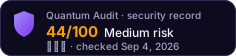

1 High2 Medium2 Low2 Informational
Volume 24h
$11.4K
Liquidity
$179.5K
Price
$0.001203
Token Age
3mo
Top 10 Holders
74.3%

Security Findings

High

Excessive Owner Privileges and Centralization Risk

H-01The `owner` role has extensive control over critical contract parameters, including `taxRate`, `taxDuration`, `antiFarmerDuration`, `liquidationThreshold`, `liqExpectedOutputAmount`, `quoteToken`, `v2Router`, `taxProcessor`, `dividendContract`, and the ability to add/remove pools and manage migration states. This high degree of centralization means a single compromised owner key could lead to malicious changes, such as setting prohibitive tax rates, redirecting tax funds, or disrupting core functionality, posing a significant risk to the protocol's integrity and user funds. (7.3 Access Control, 7.5 Governance)
IssueThe `owner` role has extensive control over critical contract parameters, including `taxRate`, `taxDuration`, `antiFarmerDuration`, `liquidationThreshold`, `liqExpectedOutputAmount`, `quoteToken`, `v2Router`, `taxProcessor`, `dividendContract`, and the ability to add/remove pools and manage migration states. This high degree of centralization means a single compromised owner key could lead to malicious changes, such as setting prohibitive tax rates, redirecting tax funds, or disrupting core functionality, posing a significant risk to the protocol's integrity and user funds. (7.3 Access Control, 7.5 Governance)
FixImplement a multi-signature wallet (e.g., Gnosis Safe) for the `owner` role to require multiple approvals for critical operations. For highly sensitive functions, consider adding a time-lock mechanism to allow users to react to pending changes. Explore progressive decentralization by introducing community governance for certain parameters over time.
StatusUnresolved
Medium

Inconsistent Initialization of `taxExpirationTime`

M-01In the `initialize` function, `poolState.taxExpirationTime` is set to `params.taxDuration`, which is a duration in seconds. However, in `finalizeMigration`, this value is then updated by adding `block.timestamp` to convert it into an absolute timestamp. This design means `taxExpirationTime` stores a duration initially and only becomes an absolute timestamp after `finalizeMigration` is called. If `finalizeMigration` is significantly delayed or never called, the intended tax expiration logic could be misinterpreted or behave unexpectedly, potentially leading to taxes expiring prematurely or much later than anticipated from the initial `taxDuration` parameter. (7.2 Code Security)
IssueIn the `initialize` function, `poolState.taxExpirationTime` is set to `params.taxDuration`, which is a duration in seconds. However, in `finalizeMigration`, this value is then updated by adding `block.timestamp` to convert it into an absolute timestamp. This design means `taxExpirationTime` stores a duration initially and only becomes an absolute timestamp after `finalizeMigration` is called. If `finalizeMigration` is significantly delayed or never called, the intended tax expiration logic could be misinterpreted or behave unexpectedly, potentially leading to taxes expiring prematurely or much later than anticipated from the initial `taxDuration` parameter. (7.2 Code Security)
FixTo improve clarity and consistency, consider initializing `taxExpirationTime` directly as an absolute timestamp (`block.timestamp + params.taxDuration`) in the `initialize` function if the tax is intended to start immediately upon deployment. If the tax period is meant to begin only after migration finalization, ensure this is clearly documented and that `finalizeMigration` is called promptly. Alternatively, rename the `taxExpirationTime` variable to `taxDuration` in `initialize` to accurately…
StatusUnresolved
Medium

Single Point of Failure in Tax Liquidation via `v2Router`

M-02The `_liquidateTax` function relies on an external `v2Router` address (e.g., Uniswap V2 Router) to swap collected tax tokens for `quoteToken`. If this `v2Router` contract is compromised, becomes unavailable, or is maliciously upgraded (even if the owner can change it), the tax liquidation mechanism could fail. This would lead to an accumulation of tax tokens within the contract, preventing their proper processing and distribution, and potentially disrupting the token's economic model. (7.6 External)
IssueThe `_liquidateTax` function relies on an external `v2Router` address (e.g., Uniswap V2 Router) to swap collected tax tokens for `quoteToken`. If this `v2Router` contract is compromised, becomes unavailable, or is maliciously upgraded (even if the owner can change it), the tax liquidation mechanism could fail. This would lead to an accumulation of tax tokens within the contract, preventing their proper processing and distribution, and potentially disrupting the token's economic model. (7.6 External)
FixWhile the owner can update `v2Router`, consider implementing a fallback mechanism or a grace period for `v2Router` changes. Additionally, explore integrating with multiple DEX routers or a decentralized oracle for price discovery during liquidation to reduce reliance on a single external entity. Implement monitoring for `v2Router` functionality to detect issues promptly.
StatusUnresolved
Low

`uint96` for `liquidationThreshold` with `maxSupply` Considerations

L-01The `PackedPoolState` struct uses `uint96` for `liquidationThreshold`. A `custom:security-note` in the code correctly highlights that if the `maxSupply` of the token (currently `1e9 ether`) were to increase beyond `~79B ether`, `uint96` might not be sufficient, leading to potential overflow issues. While `1e9 ether` is well within `uint96` limits, this represents a future upgrade risk if the `maxSupply` is ever significantly increased without a corresponding adjustment to the `liquidationThreshold` type. (7.7 Upgrades, 7.2 Code Security)
IssueThe `PackedPoolState` struct uses `uint96` for `liquidationThreshold`. A `custom:security-note` in the code correctly highlights that if the `maxSupply` of the token (currently `1e9 ether`) were to increase beyond `~79B ether`, `uint96` might not be sufficient, leading to potential overflow issues. While `1e9 ether` is well within `uint96` limits, this represents a future upgrade risk if the `maxSupply` is ever significantly increased without a corresponding adjustment to the `liquidationThreshold` type. (7.7 Upgrades, 7.2 Code Security)
FixMaintain vigilance regarding the `maxSupply` and `liquidationThreshold` types during any future upgrades or modifications to the token's supply. If `maxSupply` is ever increased beyond `uint96` capacity, ensure `liquidationThreshold` is upgraded to a larger type (e.g., `uint128` or `uint256`) to prevent silent overflows and maintain correct liquidation logic. Document this constraint clearly for future developers.
StatusUnresolved
Low

Revert Risk from External Calls in `_liquidateTax`

L-02The `_liquidateTax` function makes external calls to `ITaxProcessor(taxProcessor).processTax` and `IDividend(dividendContract).trackShare`. If these external contracts revert due to an error, unexpected state, or malicious design, the `_liquidateTax` function will also revert. Since `_liquidateTax` is called within the `_transfer` function, a failure in these external calls could prevent users from transferring tokens when the liquidation condition is met, leading to a denial of service for transfers. (7.2 Code Security, 7.6 External)
IssueThe `_liquidateTax` function makes external calls to `ITaxProcessor(taxProcessor).processTax` and `IDividend(dividendContract).trackShare`. If these external contracts revert due to an error, unexpected state, or malicious design, the `_liquidateTax` function will also revert. Since `_liquidateTax` is called within the `_transfer` function, a failure in these external calls could prevent users from transferring tokens when the liquidation condition is met, leading to a denial of service for transfers. (7.2 Code Security, 7.6 External)
FixConsider wrapping the external calls to `processTax` and `trackShare` in `try/catch` blocks. This would allow the `_liquidateTax` function (and thus `_transfer`) to complete even if the external calls fail, potentially logging the error and allowing the tax tokens to accumulate for later manual processing or retry. This would prioritize token transfer availability over immediate tax processing in case of external contract issues.
StatusUnresolved
Info

Redundant `IERC20` Import

I-01The contract imports `IERC20` from `lib/openzeppelin-contracts/contracts/token/ERC20/IERC20.sol`. However, `ERC20Upgradeable` (which `FlapTaxTokenV2` inherits from) already imports `IERC20` internally. Additionally, `SafeERC20` is used for external `IERC20` interactions, which also handles its own `IERC20` requirements. Therefore, this explicit import of `IERC20` is redundant and can be removed without affecting functionality. (7.2 Code Security)
IssueThe contract imports `IERC20` from `lib/openzeppelin-contracts/contracts/token/ERC20/IERC20.sol`. However, `ERC20Upgradeable` (which `FlapTaxTokenV2` inherits from) already imports `IERC20` internally. Additionally, `SafeERC20` is used for external `IERC20` interactions, which also handles its own `IERC20` requirements. Therefore, this explicit import of `IERC20` is redundant and can be removed without affecting functionality. (7.2 Code Security)
FixRemove the redundant `import {IERC20} from "lib/openzeppelin-contracts/contracts/token/ERC20/IERC20.sol";` statement to clean up the code and improve readability.
StatusUnresolved
Info

Missing Zero Address Checks in Setter Functions

I-02Several setter functions, such as `setQuoteToken`, `setV2Router`, and `setTaxProcessor`, do not include explicit checks to prevent setting critical addresses to `address(0)`. While `taxProcessor` is checked in `initialize`, it can be subsequently set to `address(0)` by the owner. Setting these critical addresses to zero could lead to broken functionality (e.g., tax liquidation failing if `v2Router` or `quoteToken` is zero) and operational issues. (7.2 Code Security)
IssueSeveral setter functions, such as `setQuoteToken`, `setV2Router`, and `setTaxProcessor`, do not include explicit checks to prevent setting critical addresses to `address(0)`. While `taxProcessor` is checked in `initialize`, it can be subsequently set to `address(0)` by the owner. Setting these critical addresses to zero could lead to broken functionality (e.g., tax liquidation failing if `v2Router` or `quoteToken` is zero) and operational issues. (7.2 Code Security)
FixAdd `require(newAddress != address(0), "Zero address not allowed")` checks to setter functions for critical addresses like `setQuoteToken`, `setV2Router`, and `setTaxProcessor` to prevent accidental or malicious misconfiguration. For `setDividendContract`, where `address(0)` might be a valid 'no dividend' state, ensure this behavior is clearly documented.
StatusUnresolved

Category Ratings

TechnicalLow8/10

The contract demonstrates good technical practices, including the use of OpenZeppelin upgradeable contracts and a gas-optimized `PackedPoolState` struct (7.1 Architecture, 7.2 Code Security). A reentrancy guard (`notLiquidating`) is correctly implemented for the `_liquidateTax` function. However, the reliance on external `v2Router` for liquidation introduces a dependency risk (7.6 External), and external calls within `_liquidateTax` could cause `_transfer` to revert if the called contracts fail (7.2 Code Security). A logical inconsistency in `taxExpirationTime` initialization was also noted (7.2 Code Security).

GovernanceLow7/10

The contract features configurable tax rates, durations, and dynamic liquidation thresholds, providing flexibility for protocol management (7.4 Economic). However, the owner possesses extensive control over all critical parameters, including tax rates, liquidation settings, and external contract addresses (7.3 Access Control, 7.5 Governance). This high degree of centralization means the protocol's economic stability and integrity are heavily reliant on the owner's trustworthiness and the security of the owner's private key. A compromised owner could maliciously alter parameters, leading to adverse economic impacts.

UpgradesMedium5/10

The contract is designed for upgradeability using OpenZeppelin's `Initializable` pattern, correctly calling `_disableInitializers()` in the constructor and using the `initializer` modifier (7.7 Upgrades). This ensures a robust upgrade path. A `custom:security-note` within the `PackedPoolState` struct highlights awareness of potential storage layout issues if `maxSupply` were to exceed `uint96` limits, demonstrating proactive consideration for future upgrades (7.7 Upgrades).

Security Checklist

Contract VerifiedPass
Ownership RenouncedPass
No Mint FunctionPass
Liquidity LockedPass
Not a ProxyFail

Proxy Upgrade Controls

Proxy TypeEtherscan Detected Custom
ImplementationVerified source

Holder Composition

55.1% in wallets19.3% in contracts
Effective Concentration62.8%

Share held by contracts — treasury, vesting, bridge or staking — is discounted against share held by wallets when the score is computed: a contract cannot decide to sell the way an anonymous holder can, though it can still be drained or voted to sell. Effective concentration is the figure the risk score is actually calculated from.

Liquidity Depth

The risk score reads depth across every pair. The volume figure and the volume-to-liquidity ratio elsewhere on this page describe only the pair this audit analysed, so the two are not directly comparable.

LP Distribution

LP Burned68.0%
LP Locked68.0%

Key Addresses

Deployer
0x4af2…ba4e
Unlocked LP Held By
0x5132…8a160x5db0…ed460xb36c…e9d30x8b92…e14f0x2341…95dd0x5658…12ab0x587b…9a5f0xf11b…18e00x8b10…ec87

No privileged address appears among these holders: the unlocked liquidity sits with independent providers, not with the deployer.

What Raised This Score

  • Proxy contract (upgradeable — admin can replace logic)
  • Non-standard proxy storage (Etherscan-confirmed)
  • Top-10 concentration > 50% (74.3% total → 62.8% effective; 55.1% in EOAs, 19.3% in contracts — heavy)
  • 1 High finding(s) from audit
  • 2 Medium finding(s) from audit
  • 2 Low finding(s) from audit

Each factor is an on-chain fact recorded at the time of this analysis. The score is computed from them by a deterministic function, so the same contract returns the same score for anyone who runs the audit. How scores are computed

Related Audits

ARAI Token (AA)Medium RiskCZBURN (CBURN)Medium RiskGeniusMedium RiskRiverMedium RiskGUAMedium RiskTrenchesStarterPack (战壕入门包)Medium Risk

Would You Like a More Detailed Audit of 吉祥马?

Our AI-powered scanner gives you a deeper, real-time smart contract analysis — free, with every scoring factor shown.

Get Detailed Audit