The FunPayToken contract is a standard ERC-20 implementation with additional administrative controls for trading restrictions and address management. The protocol relies heavily on centralized ownership, which introduces significant trust requirements for token holders. While the core ERC-20 logic is standard, the ability for the owner to modify critical system addresses and toggle trading status creates high centralization risk.
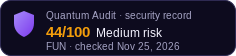
On-chain security analysis — is it a scam or legit?
Is FunPay Safe?
Not verified
This record has not gone through deep verification and is not being monitored. The score is a dated snapshot — the token’s risk can change at any time.Own this token? Put it under verification →The FunPayToken contract is a standard ERC-20 implementation with additional administrative controls for trading restrictions and address management.
Read the full analysis- A privileged address can replace a contract every transfer depends on
- Owner can pause all transfers
- A privileged address controls a switch that decides whether transfers go through
- Top-10 concentration > 30%
Exact factors
- A privileged address can replace a contract every transfer depends on
- Owner can pause all transfers
- A privileged address controls a switch that decides whether transfers go through
- Top-10 concentration > 30% (99.3% total → 39.2% effective; 0.0% in EOAs, 98.0% in contracts; 1.4% burned, locked or in pools excluded)
Security Checklist
as of audit · Nov 25Holders
as of audit · Nov 25, 2026- Contractstreasury, vesting, bridge, staking98.0%
- DEX poolsthe pools' own liquidity1.4%
- Everyone else31,333 holders0.7%
How holder types affect the score
Share held by contracts — treasury, vesting, bridge or staking — is discounted against share held by wallets when the score is computed: a contract cannot decide to sell the way an anonymous holder can, though it can still be drained or voted to sell. Effective concentration is the figure the risk score is actually calculated from.
Holder balances as recorded by the audit of Nov 25, 2026
Liquidity
as of audit · Nov 25The LP tokens of the analysed pool are locked or burned.
0x9808…3348No privileged address appears among these holders: the unlocked liquidity sits with independent providers, not with the deployer.
Security Findings
HighCentralized Control Over Critical System Addresses
The owner can use the setAddresses function to change the addresses of the community, node, liquidity, guardian, and marketing wallets.CP-03
Issue
The owner can use the setAddresses function to change the addresses of the community, node, liquidity, guardian, and marketing wallets. Because the token's transfer logic depends on these addresses, the owner has the power to redirect funds or alter the fundamental behavior of the token at any time.
Fix
Implement a multi-signature requirement or a timelock for the setAddresses function to prevent unilateral changes to critical system infrastructure.
Status
Unresolved
MediumOwner-Controlled Trading Switch
The setStartTrade function allows the owner to toggle the ability for users to trade the token.CP-05
Issue
The setStartTrade function allows the owner to toggle the ability for users to trade the token. This creates a risk where the owner can arbitrarily disable trading, effectively locking user funds or preventing liquidity movement.
Fix
Consider removing the trading switch once the initial launch phase is complete, or implement a governance-based voting mechanism to authorize changes to the trading status.
Status
Unresolved
InfoWho holds the supply
The ten largest holders own 99.3% of supply. Of that, 1.4% in DEX pools — not holders that can sell, so excluded from the concentration score.QA-HOLDERS
Issue
The ten largest holders own 99.3% of supply. Of that, 1.4% in DEX pools — not holders that can sell, so excluded from the concentration score. What remains: 0.0% in wallets, 98.0% in other contracts. 31,343 holders in total.
Fix
Watch the largest wallets that are not exchanges, pools or locks — those are the ones that can move the price.
Status
Acknowledged
InfoNot listed by any independent source
31,343 holders. Not listed by CoinGecko or any exchange GoPlus tracks.QA-IDENTITY
Issue
31,343 holders. Not listed by CoinGecko or any exchange GoPlus tracks.
Fix
Match the contract address against the project's official channels before trading.
Status
Acknowledged
InfoLiquidity burned — cannot be withdrawn
100.0% of the pool's LP is burned or time-locked. 100.0% of the LP tokens were sent to a burn address — that liquidity can never be withdrawn by anyone.QA-LIQUIDITY
Issue
100.0% of the pool's LP is burned or time-locked. 100.0% of the LP tokens were sent to a burn address — that liquidity can never be withdrawn by anyone.
Status
Acknowledged
InfoThe market for this token
Liquidity $3.3M (DexScreener, all pools). 24h trading volume $63K (DexScreener, all pools).QA-MARKET
Issue
Liquidity $3.3M (DexScreener, all pools). 24h trading volume $63K (DexScreener, all pools).
Fix
Size any position to the liquidity and daily volume shown — they set how much you can sell and at what price.
Status
Acknowledged
InfoAsset class: Project token
A token issued by a project for use, governance or fundraising.QA-PROFILE
Issue
A token issued by a project for use, governance or fundraising. Basis: no class-specific evidence. Tokenomics — Supply: fixed — the contract has no mint function. Control: a 3-of-4 multisig. Code: not upgradeable (no proxy). Fees: 3% on buy, 5% on sell. Market: $3.3M of DEX liquidity across 1 pools. Launch: 170 days of market history.
Fix
Check the project's own documentation for what the token is used for; this report covers what the contract allows.
Status
Acknowledged
Analysis
AI Copilotas of audit · Nov 25The contract utilizes standard OpenZeppelin libraries for ERC-20 functionality, ensuring robust base logic. 7.1 Architecture is straightforward, though 7.2 Code Security is impacted by the high degree of administrative control. 7.3 Access Control is implemented via Ownable, but the owner has excessive power to alter core logic. 7.6 External dependencies are managed through configurable addresses, which is a significant point of failure.
7.4 Economic and 7.5 Governance aspects are highly centralized. The owner can unilaterally halt trading and redirect critical system addresses, which directly impacts the economic flow of the token. There are no time-locks or decentralized governance mechanisms in place to protect users from malicious or accidental owner actions.
7.7 Upgrades are not supported as this is not a proxy contract. The logic is immutable once deployed, though the behavior can be altered via the administrative functions. 7.8 Operations are limited to the owner's ability to manage the whitelist and trading status.
It is recommended to implement a Timelock controller for all privileged functions to provide transparency and a delay period for sensitive changes.
Additionally, consider renouncing ownership or transitioning to a multi-signature wallet with a larger, more diverse set of signers to mitigate the risk of a single point of failure. Users should be aware that the owner has the capability to restrict transfers and change the destination of funds, which effectively centralizes control over the token's utility and economic ecosystem.
Contract & Record
Free for any token on the record. It links to this page and always shows the current score and the date it was checked.
- Nov 25, 202644Medium
Score changes are recorded as dated snapshots — history is append-only and cannot be edited.
Would You Like a More Detailed Audit of FunPay?
Our AI-powered scanner gives you a deeper, real-time smart contract analysis — free, with every scoring factor shown.
Get Detailed Audit Is this your token? Add your links and get it Verified