
Quantum Audit Logo
BNB Chain · Smart Contract Security · Updated Jul 24, 2026

Is Build On BNB Safe? BOB

On-chain security analysis — is it a scam or legit?

Contract 0x5136…560e DexScreener ↗
Volume 24h
$121.0K
Liquidity
$1.10M
Price
$0.0000000157
Token Age
1y
Top 10 Holders
77.9%

Security Checklist

Contract VerifiedPass
Ownership RenouncedPass
No Mint FunctionPass
Liquidity LockedPass
Not a ProxyPass

Audit History

Jul 2360Jul 2315

Every audit run adds a dated snapshot — history is append-only and cannot be edited.

Audit Summary

The Build On BNB (BOB) token contract is an ERC-20 implementation with custom tokenomics including taxes, max transaction limits, and an anti-bot transfer delay. The audit identified a critical vulnerability related to uninitialized trading parameters combined with renounced ownership, which could render the token untradable. High-severity issues include the absence of a `receive()` function, potentially locking ETH. Economic risks stem from fixed high initial taxes and an immutable tax wallet. The contract is not upgradeable, making any post-deployment fixes impossible without redeployment.
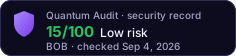

Final Recommendation: Address the critical issue of uninitialized trading and liquidity parameters by ensuring `uniswapV2Router`, `uniswapV2Pair`, `tradingOpen`, and `swapEnabled` are properly set in the constructor or via a one-time initialization function callable before ownership renunciation. Implement a `receive()` or `fallback()` function to securely handle incoming ETH from swap operations. Reconsider the use of `SafeMath` for Solidity 0.8+ to reduce bytecode size. Evaluate the implications of renounced ownership on the immutability of high initial taxes and the fixed tax wallet, ensuring these parameters align with long-term project goals and do not create unmanageable situations.

Category Ratings

TechnicalLow
7/10

The contract utilizes `SafeMath` for arithmetic, although it's redundant in Solidity 0.8+. A critical vulnerability exists where core trading and liquidity parameters (`uniswapV2Router`, `uniswapV2Pair`, `tradingOpen`, `swapEnabled`) are uninitialized in the constructor and, if their setters ar

GovernanceLow
7/10

The tokenomics feature high initial buy/sell taxes (22%) that reduce over time, along with max transaction and wallet size limits. With ownership renounced, these parameters are immutable, preventing any adjustments to the initial high tax phase (7.4 Economic, M-01) or the fixed `_taxWallet` address

UpgradesLow
9/10

The contract is not designed with any upgradeability mechanisms, as indicated by `is_proxy: false` (7.7 Upgrades). This means the contract's logic is immutable once deployed. While this eliminates upgrade-related risks like proxy misconfigurations or malicious upgrades, it also means that any d

LP Distribution

LP Burned99.9% · ≈ permanent lock
LP Locked99.9%

What Raised This Score

Each factor is an on-chain fact recorded at the time of this analysis. The score is computed from them by a deterministic function, so the same contract returns the same score for anyone who runs the audit. How scores are computed

Security Findings

1 Critical 1 High 2 Medium 1 Low 1 Info
C-01CriticalUnresolved

Unmanageable Trading & Liquidity Setup After Ownership Renunciation

The contract relies on `uniswapV2Router`, `uniswapV2Pair`, `tradingOpen`, and `swapEnabled` for its core trading and liquidity functions. These variables are not initialized in the provided constructor. If their setter functions are `onlyOwner` and ownership has been renounced (as indicated by `ownership_renounced: true`), these critical parameters can never be set. This would render the token untradable and prevent liquidity provision, effectively bricking the token's functionality.

Recommendation: Ensure all critical trading and liquidity parameters (`uniswapV2Router`, `uniswapV2Pair`, `tradingOpen`, `swapEnabled`) are initialized within the constructor or through a dedicated, one-time initialization function that is called immediately after deployment and before ownership is renounced.
H-01HighUnresolved

Missing `receive()`/`fallback()` Function

The contract is designed to interact with Uniswap for swapping tokens to ETH and potentially adding liquidity. If the contract itself is the recipient of ETH during these operations (e.g., `swapExactTokensForETHSupportingFeeOnTransferTokens` sends ETH to the contract), a `receive()` or `fallback()` function is required to accept the ETH. Without such a function, incoming ETH will be locked in the router or revert the transaction, leading to loss of funds or operational failure.

Recommendation: Implement a `receive() external payable` function to allow the contract to accept incoming ETH. This is crucial for the proper functioning of the swap and liquidity mechanisms.
M-01MediumUnresolved

Fixed and High Initial Taxes

The contract implements high initial buy/sell taxes (22%). While these taxes are designed to reduce to 0% over time, the initial high rate can deter early adoption and trading. With ownership renounced, these tax parameters are immutable, meaning the initial high tax phase cannot be adjusted or removed by an owner, regardless of market conditions or community feedback.

Recommendation: Consider if the initial tax rates are appropriate for the project's long-term goals, especially given their immutability. If flexibility is desired, an owner-controlled mechanism to adjust these parameters would be necessary, but this conflicts with renounced ownership. Ensure the community is fully aware of the fixed tax structure.
M-02MediumUnresolved

Fixed Tax Wallet Address

The `_taxWallet` address is set in the constructor and cannot be changed after deployment. If this address becomes compromised, inaccessible, or the intended recipient changes (e.g., due to a multi-sig upgrade or a new treasury address), all collected taxes will be sent to an unrecoverable or incorrect address. With ownership renounced, this address cannot be updated.

Recommendation: If the project requires flexibility for the tax wallet, consider implementing an owner-controlled function to update the `_taxWallet` address. However, this would require ownership not to be renounced. If ownership remains renounced, ensure the `_taxWallet` is a highly secure, multi-signature controlled address that is intended for permanent use.
L-01LowUnresolved

`tx.origin` Usage for Anti-Bot Measure

The `_holderLastTransferTimestamp` mechanism uses `tx.origin` to enforce a transfer delay, intended as an anti-bot measure. While `tx.origin` is generally discouraged in smart contracts due to potential phishing attack vectors if used for access control, in this specific context, it's used for an anti-bot measure. However, it means that if a contract calls `transfer`, the `tx.origin` will be the EOA that initiated the transaction, not the contract itself, which might have unintended side effects for complex interactions.

Recommendation: While the risk is low in this specific implementation, it's generally recommended to use `msg.sender` for all address-related checks to avoid `tx.origin` related complexities and potential misunderstandings. If the anti-bot logic specifically requires `tx.origin`, ensure its implications are fully understood and documented.
I-01InformationalUnresolved

Redundant SafeMath Library

The contract uses the `SafeMath` library for arithmetic operations. However, Solidity version `^0.8.8` includes built-in overflow and underflow checks by default, making the `SafeMath` library redundant. This adds unnecessary bytecode to the contract and slightly increases deployment and transaction gas costs without providing additional security benefits.

Recommendation: Remove the `SafeMath` library and its `using SafeMath for uint256;` directive. Rely on Solidity's native overflow/underflow protection for `uint256` operations in version 0.8.0 and higher.

Would You Like a More Detailed Audit of Build On BNB?

Our AI-powered scanner gives you a deeper, real-time smart contract analysis — free, no signup required.

Get Detailed Audit
Run Free Audit →