Quantum Audit Logo
Launch App

Early-stage security check — honeypot & rug-pull analysis

Is FOTF a Scam?

Base
Not verified This record has not gone through deep verification and is not being monitored. The score is a dated snapshot — the token’s risk can change at any time.Own this token? Put it under verification →
Last checked Nov 11, 2026 · 1 audit on recordNew Launch · 9h old
SummaryAI Copilot

The DERC20 contract is a standard ERC-20 implementation with added governance, voting, and vesting capabilities.

Read the full analysis
What raised the score
  • Owner can pause all transfers
  • A privileged address controls a switch that decides whether transfers go through
  • Mintable supply — no cap found, dilution unbounded
  • Liquidity not locked
  • Top-10 concentration > 30%
Exact factors
  • Owner can pause all transfers
  • A privileged address controls a switch that decides whether transfers go through
  • Mintable supply — no cap found, dilution unbounded
  • Liquidity NOT locked (100% of the pool) — held by independent providers — market-depth risk
  • Top-10 concentration > 30% (95.5% total → 38.5% effective; 0.5% in EOAs, 95.0% in contracts)

Each factor is an on-chain fact recorded at the time of this analysis. The score is computed from them by a deterministic function, so the same contract returns the same score for anyone who runs the audit. How scores are computed

Early-stage analysis. This token has limited on-chain history (9h old). New tokens carry elevated risk — data may change rapidly. Always verify independently before investing.

Security Checklist

as of audit · Nov 114 of 7 checks passed
Contract verifiedVerified
OwnershipRetained
MintMintable
Liquidity lockNot locked
UpgradeabilityFixed code
HoneypotNone found
Buy / sell tax0% / 0%

Holders

as of audit · Nov 11, 2026156 holders
95.0%Contracts4.5%
95.0%Contracts4.5%
ContractsWalletsEveryone elseBubble area = share of supply
95.5%of supply sits with the top 10 holders
  • Contractstreasury, vesting, bridge, staking95.0%
  • Walletsanonymous holders, free to sell0.5%
  • Everyone else146 holders4.5%
Effective concentrationwhat the score reads38.5%
How holder types affect the score

Share held by contracts — treasury, vesting, bridge or staking — is discounted against share held by wallets when the score is computed: a contract cannot decide to sell the way an anonymous holder can, though it can still be drained or voted to sell. Effective concentration is the figure the risk score is actually calculated from.

Holder balances as recorded by the audit of Nov 11, 2026

Liquidity

as of audit · Nov 11$58.72M across 2 pairs

The risk score reads depth across every pair.

LP tokensNot locked

The LP tokens of the analysed pool are not locked or burned, so whoever holds them can withdraw that liquidity.

Analysed pool$58.72MShare of depth100.0%
Top-1 Unlocked Holder100.0%
Top-3 Unlocked100.0%
Unlocked LP held by
0x25aa…fe51

No privileged address appears among these holders: the unlocked liquidity sits with independent providers, not with the deployer.

Security Findings

3 Medium5 Info
Medium

Centralized Control Over Token Supply

The owner has the authority to call updateMintRate and release, which can increase the total supply of the token. This allows the owner to dilute the holdings of all existing token holders at their discretion.CP-01

Issue

The owner has the authority to call updateMintRate and release, which can increase the total supply of the token. This allows the owner to dilute the holdings of all existing token holders at their discretion.

Fix

Implement a timelock for all minting-related functions to ensure that any changes to the token supply are transparent and subject to a delay, allowing users to exit if they disagree with the policy.

Status

Unresolved

Medium

Centralized Control Over Transfer Functionality

The owner can use the lockPool and unlockPool functions to enable or disable transfers of the token. This gives the owner the power to effectively freeze the liquidity of the token for all users.CP-05

Issue

The owner can use the lockPool and unlockPool functions to enable or disable transfers of the token. This gives the owner the power to effectively freeze the liquidity of the token for all users.

Fix

Remove the ability for the owner to arbitrarily lock transfers, or restrict this functionality to specific emergency scenarios governed by a decentralized consensus mechanism.

Status

Unresolved

Medium

Liquidity not locked

0.0% of the pool's LP is burned or time-locked. 100.0% is held, unlocked, by 1 address(es) other than the owner/deployer. One of them — a wallet, 0x25aa…fe51 — holds 100.0% and can remove that share at once; who controls it is not visible on-chain, so it is not treated as an independent provider. Some pools are concentrated-liquidity (V3/V4) positions; shares above are by position as GoPlus reports them.QA-LIQUIDITY

Issue

0.0% of the pool's LP is burned or time-locked. 100.0% is held, unlocked, by 1 address(es) other than the owner/deployer. One of them — a wallet, 0x25aa…fe51 — holds 100.0% and can remove that share at once; who controls it is not visible on-chain, so it is not treated as an independent provider. Some pools are concentrated-liquidity (V3/V4) positions; shares above are by position as GoPlus reports them.

Fix

Check the lock's end date and beneficiary on the locker's own page before relying on it.

Status

Acknowledged

Info

Who holds the supply

The ten largest holders own 95.5% of supply. What remains: 0.5% in wallets, 95.0% in other contracts. 156 holders in total.QA-HOLDERS

Issue

The ten largest holders own 95.5% of supply. What remains: 0.5% in wallets, 95.0% in other contracts. 156 holders in total.

Fix

Watch the largest wallets that are not exchanges, pools or locks — those are the ones that can move the price.

Status

Acknowledged

Info

Not listed by any independent source

156 holders. Not listed by CoinGecko or any exchange GoPlus tracks. Nothing independent confirms who is behind this token, so every power its contract grants is scored at face value.QA-IDENTITY

Issue

156 holders. Not listed by CoinGecko or any exchange GoPlus tracks. Nothing independent confirms who is behind this token, so every power its contract grants is scored at face value.

Fix

Match the contract address against the project's official channels before trading.

Status

Acknowledged

Info

The market for this token

Liquidity $58.7M (DexScreener, all pools). 24h trading volume $339K (DexScreener, all pools).QA-MARKET

Issue

Liquidity $58.7M (DexScreener, all pools). 24h trading volume $339K (DexScreener, all pools).

Fix

Size any position to the liquidity and daily volume shown — they set how much you can sell and at what price.

Status

Acknowledged

Info

Asset class: Project token

A token issued by a project for use, governance or fundraising. Scored on its contract and market facts. The class itself adds no points; the contract and market facts decide the score. Basis: no class-specific evidence. Tokenomics — Supply: mintable with no on-chain cap found. Control: a ProxyAdmin contract. Code: not upgradeable (no proxy). Fees: no buy or sell tax. Market: $58.7M of DEX liquidity across 2 pools. Launch: under a day of market history.QA-PROFILE

Issue

A token issued by a project for use, governance or fundraising. Scored on its contract and market facts. The class itself adds no points; the contract and market facts decide the score. Basis: no class-specific evidence. Tokenomics — Supply: mintable with no on-chain cap found. Control: a ProxyAdmin contract. Code: not upgradeable (no proxy). Fees: no buy or sell tax. Market: $58.7M of DEX liquidity across 2 pools. Launch: under a day of market history.

Fix

Check the project's own documentation for what the token is used for; this report covers what the contract allows.

Status

Acknowledged

Info

Recently launched — less than a day of market history

The token's oldest DEX pool is less than a day old. Age is not part of the risk score — a new token is not a risky one by default — but a short history means fewer trades and holder changes behind the facts in this report.QA-RECENT

Issue

The token's oldest DEX pool is less than a day old. Age is not part of the risk score — a new token is not a risky one by default — but a short history means fewer trades and holder changes behind the facts in this report.

Fix

Re-check ownership, liquidity and holder distribution as the token matures; those are the facts that move early.

Status

Acknowledged

Analysis

AI Copilotas of audit · Nov 11
Executive SummaryWhat the contract is and what the review found

The DERC20 contract is a standard ERC-20 implementation with added governance, voting, and vesting capabilities. The protocol relies heavily on a centralized owner to manage inflation, token distribution, and transfer restrictions. While the code follows standard OpenZeppelin patterns, the high degree of administrative control presents a significant centralization risk for token holders.
Technical8/10Low risk

The contract utilizes robust, battle-tested OpenZeppelin libraries for ERC-20, voting, and permit functionality. 7.1 Architecture is modular, and 7.2 Code Security is high due to the use of standard, audited base contracts. 7.3 Access Control is implemented via Ownable, though it grants extensive power to the owner. 7.6 External dependencies are limited to standard libraries, minimizing integration risks.

Governance2/10High risk

7.4 Economic and 7.5 Governance aspects are highly centralized. The owner has the ability to mint tokens and restrict transfers, which directly impacts the token's value and liquidity. While 7.8 Operations are simplified by these functions, they create a single point of failure where the owner could unilaterally alter the tokenomics.

Upgrades4/10Medium risk

7.7 Upgrades are not supported as the contract is not a proxy. This ensures immutability of the logic, which is a strength for security. No upgrade-related risks are present.

Final RecommendationWhat to do about this score

To improve the security posture, consider transitioning the ownership to a decentralized governance model, such as a multi-signature wallet or a DAO, to mitigate the risks associated with a single privileged address.

Additionally, implementing a timelock on sensitive functions like updateMintRate would provide transparency and allow the community to react to significant economic changes.

Contract & Record

1 audit on record
TypeToken
NetworkBase
Token age9h
Contract0x3b47…06f9
Deployer0x94e3…638a
Badge for your website
FOTF security record badge

Free for any token on the record. It links to this page and always shows the current score and the date it was checked.

Audit History
  1. Nov 11, 202659Medium

Score changes are recorded as dated snapshots — history is append-only and cannot be edited.

Frequently Asked Questions

What is the FOTF contract address?

The FOTF contract on Base is 0x3b47c6c48d9fec27ef4a436906d268d904e706f9. Compare it with the address the project itself publishes before trading: other contracts can carry the same name and ticker.

Is FOTF a scam?

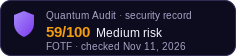
Quantum Audit's risk score for FOTF is 59/100 (Medium risk) as of Nov 11, 2026, computed by a deterministic function from on-chain facts — Contract verified: Verified; Ownership: Retained; Mint: Mintable; Liquidity lock: Not locked; Upgradeability: Fixed code; Honeypot: None found; Buy / sell tax: 0% / 0%. A score is a dated snapshot of those facts, not a guarantee; each one is listed on this page.

Is FOTF liquidity locked?

Liquidity lock: Not locked (as of Nov 11, 2026). Total DEX liquidity: $58.72M.

Who holds FOTF?

As of Nov 11, 2026, the 10 largest holders own 95.5% of the supply across 156 holders. The Holders section on this page shows who they are by holder type.

Would You Like a More Detailed Audit of FOTF?

This token is brand new. Run a deeper AI-powered analysis of the contract code — free and instant.

Get Detailed Audit Is this your token? Add your links and get it Verified