Base · Smart Contract Security · Updated May 29, 2026

Is XMAQUINA Safe? DEUS

On-chain security analysis — is it a scam or legit?

Contract 0x940a…089b DexScreener ↗
High Risk
Volume 24h
$2.09M
Liquidity
$1.32M
Price
$0.06194
Token Age
9d
Top 10 Holders
89.5%

Security Checklist

Contract VerifiedPass
Ownership RenouncedFail
No Mint FunctionPass
Liquidity LockedFail
Not a ProxyPass

Security Analysis

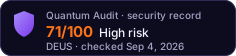
XMAQUINA (DEUS) on Base presents a complex security profile for investors. The contract is verified, offering transparency into its code, and importantly, no mint function exists, preventing arbitrary inflation of the token supply. However, significant red flags emerge concerning ownership and distribution. Ownership of the contract has not been renounced, meaning the deployer retains control and the ability to potentially alter contract parameters. Furthermore, liquidity is not locked, posing a substantial risk as providers could withdraw funds, impacting market stability. Token distribution shows high centralization, with the top 10 holders possessing 89.5% of the total supply, creating vulnerability to market manipulation or large sell-offs. Despite a healthy 24-hour trading volume of over $2 million and $1.3 million in liquidity, the combination of these factors contributes to a high-risk score of 69/100.

The most critical security concerns for XMAQUINA (DEUS) stem from its concentrated ownership and the lack of robust safeguards. The fact that ownership has not been renounced is a primary risk; it allows the contract deployer to potentially modify the contract's functions, including altering fees or even enabling new token creation if not carefully reviewed. Coupled with liquidity not being locked, this creates a significant vulnerability for investors, as funds could be withdrawn, leading to a "rug pull." Additionally, the extremely high concentration, with 89.5% of the supply held by the top 10 addresses, introduces substantial market manipulation risk and potential for sudden, large sell-offs. These factors collectively underscore the token's high-risk assessment.

Frequently Asked Questions

Is XMAQUINA a scam?

Based on the available data, XMAQUINA exhibits several characteristics common in high-risk projects. The owner has not renounced control, and liquidity is not locked, which could enable a malicious actor to remove funds or alter contract behavior. Furthermore, 89.5% of the supply is held by the top 10 addresses, indicating extreme centralization. While contract verification is a positive, these combined factors contribute to its high-risk score, warranting extreme caution.

Is XMAQUINA safe to buy?

XMAQUINA is categorized as high-risk, making it unsafe for many investors. Key concerns include the unrenounced ownership, which gives the contract creator significant control over the token's future. Additionally, the liquidity is not locked, meaning it could be withdrawn, potentially causing a sharp price drop. The highly centralized token distribution among the top 10 holders further exacerbates these risks, making it vulnerable to manipulation.

Has XMAQUINA been audited?

The XMAQUINA contract is verified on Base, meaning its code is publicly visible and matches what's deployed on the blockchain. This transparency allows for community review. However, "contract verified" is not the same as a formal security audit by a third-party firm, which thoroughly assesses for vulnerabilities, exploits, and best practices. Investors should not mistake verification for a comprehensive security audit.

Would You Like a More Detailed Audit of XMAQUINA?

Our AI-powered scanner gives you a deeper, real-time smart contract analysis — free, no signup required.

Get Detailed Audit
Run Free Audit →