Quantum Audit Logo

Is Elsa Safe?

On-chain security analysis — is it a scam or legit?

Elsa ELSA
0x29cc…bdca
Base Not verifiedLast checked 3d ago 1 audit on record
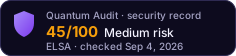
How is this score calculated? → Medium Risk
Executive SummaryAI Copilot

The ELSA token contract implements ERC20, ERC20Permit, and ERC3009 (Transfer With Authorization). It leverages OpenZeppelin libraries for robust and standard-compliant functionality. The primary risks identified relate to the initial centralized token distribution and the inherent front-running potential of EIP-3009's `transferWithAuthorization` function.

1 High1 Medium1 Low1 Informational
Volume 24h
$210.9K
Liquidity
$346.0K
Price
$0.04845
Token Age
6mo
Top 10 Holders
89.0%

Security Findings

High

Centralized Initial Token Distribution

H-01The `ELSA` contract's constructor mints the entire `TOTAL_SUPPLY` (1 billion tokens) to the `msg.sender` (the deployer). This results in a highly centralized initial distribution of all tokens to a single address. This concentration of power can lead to significant economic and governance risks, including potential market manipulation, lack of decentralization, and single point of failure if the deployer's key is compromised (7.4 Economic, 7.5 Governance).
IssueThe `ELSA` contract's constructor mints the entire `TOTAL_SUPPLY` (1 billion tokens) to the `msg.sender` (the deployer). This results in a highly centralized initial distribution of all tokens to a single address. This concentration of power can lead to significant economic and governance risks, including potential market manipulation, lack of decentralization, and single point of failure if the deployer's key is compromised (7.4 Economic, 7.5 Governance).
FixIf a decentralized token distribution is desired, consider implementing a vesting schedule, a multi-signature wallet for the initial supply, or a distribution mechanism (e.g., airdrop, liquidity pool seeding) to spread ownership. Clearly communicate the intended use and security measures for the deployer's address holding the entire supply.
StatusUnresolved
Medium

Front-Running Risk for `transferWithAuthorization`

M-01The `transferWithAuthorization` function, as per EIP-3009 design, allows any third party to execute a valid signed authorization. If a signed `transferWithAuthorization` message is broadcast publicly (e.g., via a relayer or mempool), an attacker could observe it and front-run the intended transaction by submitting their own transaction with a higher gas price, effectively executing the transfer before the intended party (7.2 Code Security). While `receiveWithAuthorization` is protected by a `msg.sender != to` check, `transferWithAuthorization` lacks such a restriction.
IssueThe `transferWithAuthorization` function, as per EIP-3009 design, allows any third party to execute a valid signed authorization. If a signed `transferWithAuthorization` message is broadcast publicly (e.g., via a relayer or mempool), an attacker could observe it and front-run the intended transaction by submitting their own transaction with a higher gas price, effectively executing the transfer before the intended party (7.2 Code Security). While `receiveWithAuthorization` is protected by a `msg.sender != to` check, `transferWithAuthorization` lacks such a restriction.
FixEducate users about the front-running risks associated with `transferWithAuthorization`. For sensitive transactions, advise users to utilize private transaction relays (e.g., Flashbots) to prevent their signed messages from being exposed in the public mempool before execution. Implement monitoring for potential front-running attempts if possible.
StatusUnresolved
Low

Reliance on `block.timestamp` for Authorization Validity

L-01The `_validateAuthorization` function uses `block.timestamp` to check `validAfter` and `validBefore` parameters. While standard practice for time-based validity, `block.timestamp` can be manipulated by miners within a small window (e.g., up to 900 seconds on Ethereum mainnet, though typically less on faster chains). This could potentially allow a miner to slightly extend or shorten the validity window of an authorization (7.2 Code Security).
IssueThe `_validateAuthorization` function uses `block.timestamp` to check `validAfter` and `validBefore` parameters. While standard practice for time-based validity, `block.timestamp` can be manipulated by miners within a small window (e.g., up to 900 seconds on Ethereum mainnet, though typically less on faster chains). This could potentially allow a miner to slightly extend or shorten the validity window of an authorization (7.2 Code Security).
FixAcknowledge that `block.timestamp` is subject to minor miner manipulation. For most use cases, this level of precision is acceptable. If extremely precise time-based validity is critical, consider alternative time sources or design patterns, though this often introduces additional complexity or centralization.
StatusUnresolved
Info

Lack of Emergency Pause Mechanism

I-01The `ELSA` token contract, being a standard ERC20 implementation with EIP-3009 extensions, does not include any emergency pause functionality. In the event of a critical vulnerability discovered in the token itself, or in a protocol that heavily relies on it, there is no mechanism to temporarily halt transfers or other operations (7.8 Operations).
IssueThe `ELSA` token contract, being a standard ERC20 implementation with EIP-3009 extensions, does not include any emergency pause functionality. In the event of a critical vulnerability discovered in the token itself, or in a protocol that heavily relies on it, there is no mechanism to temporarily halt transfers or other operations (7.8 Operations).
FixConsider whether an emergency pause mechanism (e.g., using OpenZeppelin's `Pausable` contract) would be beneficial for the project's risk management strategy. While adding complexity and a point of control, it can provide a crucial safety switch in unforeseen circumstances. If implemented, ensure the pause functionality is controlled by a robust, multi-signature governance mechanism.
StatusUnresolved

Category Ratings

TechnicalLow8/10

The technical implementation of the ELSA token contract is robust, utilizing battle-tested OpenZeppelin libraries for ERC20, ERC20Permit, and EIP712 functionalities. The custom ERC3009 extension correctly implements the 'Transfer With Authorization' standard, including nonce management to prevent replay attacks and `SignatureChecker` for secure signature verification (7.2 Code Security). The `receiveWithAuthorization` function includes a critical check to ensure only the intended recipient can execute the transfer, mitigating a common front-running vector. However, the `transferWithAuthorization` function remains susceptible to front-running by third parties (7.2 Code Security).

GovernanceHigh1/10

The economic model of the ELSA token involves minting the entire `TOTAL_SUPPLY` of 1 billion tokens to the contract deployer during construction (7.4 Economic). This creates a highly centralized initial distribution, granting the deployer significant control over the token supply and potential market manipulation (7.5 Governance). While this may be an intentional design choice, it represents a substantial economic and governance risk due to the concentration of power.

UpgradesMedium6/10

The ELSA token contract is not designed with upgradeability in mind, as it does not implement any proxy patterns (7.7 Upgrades). This means the contract's logic is immutable once deployed, eliminating risks associated with upgrade mechanisms such as proxy admin control, storage collisions, or faulty upgrade implementations. Any future changes to the token's core logic would require a new contract deployment and migration of assets.

Security Checklist

Contract VerifiedPass
Ownership Renounced?
No Mint FunctionPass
Liquidity LockedFail
Not a ProxyPass

Holder Composition

16.6% in wallets72.4% in contracts
Effective Concentration45.6%

Share held by contracts — treasury, vesting, bridge or staking — is discounted against share held by wallets when the score is computed: a contract cannot decide to sell the way an anonymous holder can, though it can still be drained or voted to sell. Effective concentration is the figure the risk score is actually calculated from.

Liquidity Depth

The risk score reads depth across every pair. The volume figure and the volume-to-liquidity ratio elsewhere on this page describe only the pair this audit analysed, so the two are not directly comparable.

LP Distribution

Top-1 Unlocked Holder100.0%
Top-3 Unlocked100.0%

Key Addresses

Deployer
0x82cb…9978
Unlocked LP Held By
0x3b80…2013

No privileged address appears among these holders: the unlocked liquidity sits with independent providers, not with the deployer.

What Raised This Score

  • Ownership status UNKNOWN (owner could not be resolved)
  • Top-10 concentration > 30% (89.0% total → 45.6% effective; 16.6% in EOAs, 72.4% in contracts — moderate)
  • Liquidity not locked, but no owner/deployer address holds LP — market-depth risk, not rug risk
  • LP top1 unlocked holder = 100.0% (independent LP — depth risk, pool = 97% of DEX liquidity)
  • LP top3 unlocked holders = 100.0% (independent LP — depth risk, pool = 97% of DEX liquidity)
  • 1 High finding(s) from audit
  • 1 Medium finding(s) from audit
  • 1 Low finding(s) from audit

Each factor is an on-chain fact recorded at the time of this analysis. The score is computed from them by a deterministic function, so the same contract returns the same score for anyone who runs the audit. How scores are computed

Related Audits

Nockchain (NOCK)Medium RiskSolana (Universal) (USOL)Medium RiskLil Finder Guy (LFG)Medium RiskAerodrome Finance (AERO)Medium RiskaeonHigh RiskSapienMedium Risk

Would You Like a More Detailed Audit of Elsa?

Our AI-powered scanner gives you a deeper, real-time smart contract analysis — free, with every scoring factor shown.

Get Detailed Audit