
Quantum Audit Logo

Is Aerodrome Finance Safe?

On-chain security analysis — is it a scam or legit?

Aerodrome Finance AERO
0x9401…8631
Base Not verifiedLast checked 2d ago 1 audit on record
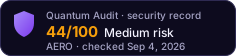
How is this score calculated? → Medium Risk
Executive SummaryAI Copilot

This audit covers the provided Solidity source code, which includes the OpenZeppelin ERC20 base contract and the custom IAero interface. While the full implementation of the 'Aero' token contract was not provided, the analysis assumes the deployed contract at the given address implements the IAero interface, particularly its minting functionality. The contract benefits from using battle-tested OpenZeppelin libraries and Solidity 0.8.19 for robust arithmetic safety. The primary risk identified is the centralized control over token minting, which introduces a single point of failure and potential economic instability if compromised. Operational considerations like an emergency pause mechanism are also noted.

1 High2 Low1 Informational
Volume 24h
$2.66M
Liquidity
$29.21M
Price
$0.4979
Token Age
2y
Top 10 Holders
66.8%

Security Findings

High

Centralized Minting Authority

H-01The `IAero` interface defines a `mint` function that is explicitly stated to be 'Only callable by Minter.sol', implying a single `minter` address or contract controls the token supply. This centralized control over minting allows a single entity to arbitrarily increase the token supply, which can lead to token devaluation and economic instability if the `minter`'s private key is compromised or if the `minter` acts maliciously. This is a significant single point of failure for the token's economic model (7.3 Access Control, 7.4 Economic).
IssueThe `IAero` interface defines a `mint` function that is explicitly stated to be 'Only callable by Minter.sol', implying a single `minter` address or contract controls the token supply. This centralized control over minting allows a single entity to arbitrarily increase the token supply, which can lead to token devaluation and economic instability if the `minter`'s private key is compromised or if the `minter` acts maliciously. This is a significant single point of failure for the token's economic model (7.3 Access Control, 7.4 Economic).
FixImplement a robust access control mechanism for the `minter` role. This could involve a multi-signature wallet (e.g., Gnosis Safe) for the `minter` address, or integrating a decentralized governance system that requires community approval for minting operations. Consider adding a time-lock for minting operations to provide a window for review and reaction. Clearly document the `minter`'s identity and operational procedures.
StatusUnresolved
Low

Lack of Emergency Pause Mechanism

L-01The ERC20 contract does not include an emergency pause mechanism. While not a direct vulnerability, the absence of a pause function means that in the event of a critical bug, exploit, or market manipulation, there is no immediate way to halt token transfers or other critical operations. This can lead to prolonged exposure to risks and potential loss of funds (7.8 Operations).
IssueThe ERC20 contract does not include an emergency pause mechanism. While not a direct vulnerability, the absence of a pause function means that in the event of a critical bug, exploit, or market manipulation, there is no immediate way to halt token transfers or other critical operations. This can lead to prolonged exposure to risks and potential loss of funds (7.8 Operations).
FixConsider implementing a pause mechanism (e.g., using OpenZeppelin's `Pausable` contract) that can be triggered by a trusted role (e.g., a multi-sig owner or governance). This would allow for emergency intervention to prevent further damage during critical situations. Ensure the pause mechanism itself is secured and its activation criteria are well-defined.
StatusUnresolved
Low

ERC20 `approve` Race Condition

L-02The `approve` function in the ERC20 standard has a known race condition where a malicious spender can exploit a change in allowance by front-running the transaction. If a user first approves X amount and then approves Y amount, a malicious actor could execute the first approved transaction before the second approval takes effect, potentially spending more than intended. OpenZeppelin's ERC20 contract includes `increaseAllowance` and `decreaseAllowance` functions to mitigate this, but direct `approve` calls still carry this risk if not used carefully (7.2 Code Security).
IssueThe `approve` function in the ERC20 standard has a known race condition where a malicious spender can exploit a change in allowance by front-running the transaction. If a user first approves X amount and then approves Y amount, a malicious actor could execute the first approved transaction before the second approval takes effect, potentially spending more than intended. OpenZeppelin's ERC20 contract includes `increaseAllowance` and `decreaseAllowance` functions to mitigate this, but direct `approve` calls still carry this risk if not used carefully (7.2 Code Security).
FixEducate users and integrated protocols to prefer `increaseAllowance` and `decreaseAllowance` over direct `approve` calls when modifying existing allowances. If `approve` must be used to change an existing allowance, it is best practice to first set the allowance to zero and then to the desired new value, although this requires two transactions.
StatusUnresolved
Info

Incomplete Source Code for 'Aero' Token

I-01The provided source code primarily consists of the OpenZeppelin `ERC20` base contract and various interfaces, including the custom `IAero` interface. However, the full implementation of the 'Aero' token contract, which would inherit from `ERC20` and implement the `IAero` interface (specifically the `mint` function and `minter` role management), was not provided for a comprehensive review. This limits the ability to audit the specific logic governing the token's supply mechanism and privileged roles (7.1 Architecture).
IssueThe provided source code primarily consists of the OpenZeppelin `ERC20` base contract and various interfaces, including the custom `IAero` interface. However, the full implementation of the 'Aero' token contract, which would inherit from `ERC20` and implement the `IAero` interface (specifically the `mint` function and `minter` role management), was not provided for a comprehensive review. This limits the ability to audit the specific logic governing the token's supply mechanism and privileged roles (7.1 Architecture).
FixFor a complete security assessment, provide the full source code of the deployed 'Aero' token contract, including the implementation of the `mint` function and any associated access control or role management logic. This would allow for a thorough review of the token's specific economic and security mechanisms.
StatusUnresolved

Category Ratings

TechnicalLow7/10

The technical architecture leverages the robust and audited OpenZeppelin ERC20 standard, ensuring a solid foundation for token operations (7.1 Architecture). The use of Solidity 0.8.19 inherently protects against integer overflow/underflow vulnerabilities (7.2 Code Security). However, the implied centralized minting authority, as defined by the IAero interface, represents a significant access control risk (7.3 Access Control). If the minter's key is compromised, it could lead to unauthorized token inflation.

GovernanceHigh3/10

The economic model, as inferred from the IAero interface, relies on a centralized minting mechanism controlled by a single 'minter' address (7.4 Economic). This design introduces a high degree of centralization, as the minter has the unilateral ability to increase the token supply, potentially devaluing existing tokens. While this provides flexibility, it also concentrates power and risk. There is no explicit governance mechanism visible in the provided code to oversee or restrict the minter's actions (7.5 Governance).

UpgradesHigh3/10

The provided contract is not designed with an upgrade mechanism, such as a proxy pattern (7.7 Upgrades). This simplifies the contract's architecture and removes upgrade-related risks like storage collisions or logic errors during upgrades. However, it also means that any critical bugs discovered post-deployment cannot be fixed without deploying a new contract and migrating assets, which can be a complex and costly process.

Security Checklist

Contract VerifiedPass
Ownership Renounced?
No Mint FunctionFail
Liquidity LockedFail
Not a ProxyPass

Holder Composition

15.3% in wallets51.5% in contracts
Effective Concentration35.9%

Share held by contracts — treasury, vesting, bridge or staking — is discounted against share held by wallets when the score is computed: a contract cannot decide to sell the way an anonymous holder can, though it can still be drained or voted to sell. Effective concentration is the figure the risk score is actually calculated from.

Liquidity Depth

Show 4 more pairsShow less

The 20 remaining pairs hold $762.2K between them and are not listed.

The risk score reads depth across every pair. The volume figure and the volume-to-liquidity ratio elsewhere on this page describe only the pair this audit analysed, so the two are not directly comparable.

LP Distribution

Top-1 Unlocked Holder26.3%
Top-3 Unlocked57.6%

Key Addresses

Deployer
0xe83f…2818
Unlocked LP Held By
0x3e13…ce200xb182…69100xc4ec…c7a50xcbf7…aaab0xf4c7…d9880xef68…04260xdca8…6f6a0xcf40…423c0x11d4…d1600xda65…9dab

No privileged address appears among these holders: the unlocked liquidity sits with independent providers, not with the deployer.

What Raised This Score

  • Ownership status UNKNOWN (owner could not be resolved)
  • Mintable supply — no cap found, dilution unbounded
  • Top-10 concentration > 30% (66.8% total → 35.9% effective; 15.3% in EOAs, 51.5% in contracts — moderate)
  • Liquidity not locked, but no owner/deployer address holds LP — market-depth risk, not rug risk
  • 1 High finding(s) from audit
  • 2 Low finding(s) from audit

Each factor is an on-chain fact recorded at the time of this analysis. The score is computed from them by a deterministic function, so the same contract returns the same score for anyone who runs the audit. How scores are computed

Frequently Asked Questions

Is Aerodrome Finance a scam?

Aerodrome Finance has verifiable attributes like a verified contract and renounced ownership, which suggest a degree of transparency and reduced immediate scam risks often associated with unverified or owner-controlled projects. However, its overall risk score of 64/100 is high, indicating significant inherent vulnerabilities. Investors should acknowledge these structural risks rather than solely focusing on general scam indicators.

Is Aerodrome Finance safe to buy?

Investing in Aerodrome Finance carries notable risks. Key concerns include the existence of a mint function, which could increase token supply, and the high concentration of 67.6% of tokens held by the top 10 addresses, posing potential market impact. Additionally, the project's liquidity is not locked, adding another layer of risk. These factors contribute to its high-risk score, advising caution for potential buyers.

Has Aerodrome Finance been audited?

The Aerodrome Finance contract is confirmed as verified, ensuring its deployed code matches the public source. This offers transparency but differs from a formal security audit. An audit is an independent review by experts to identify vulnerabilities and flaws. The provided information does not specify if such a comprehensive audit has been performed on Aerodrome Finance.

Related Audits

SapienMedium RiskRaveDAO (RAVE)Medium RiskNockchain (NOCK)Medium RiskSolana (Universal) (USOL)Medium RiskElsaMedium RiskLil Finder Guy (LFG)Medium Risk

Would You Like a More Detailed Audit of Aerodrome Finance?

Our AI-powered scanner gives you a deeper, real-time smart contract analysis — free, with every scoring factor shown.

Get Detailed Audit