
The MANAToken contract is an ERC-20 token with standard functionalities including minting, burning, and pausing. It utilizes the Ownable pattern for administrative control and SafeMath for arithmetic operations. The primary risks stem from the significant centralized control held by the owner, which is typical for tokens of this era. The contract is not upgradeable, simplifying its architecture.

On-chain security analysis — is it a scam or legit?
Is Decentraland Safe?
Not verified
This record has not gone through deep verification and is not being monitored. The score is a dated snapshot — the token’s risk can change at any time.Own this token? Put it under verification →The MANAToken contract is an ERC-20 token with standard functionalities including minting, burning, and pausing.
Read the full analysis- Owner can pause all transfers
- Mintable supply — no cap found, dilution unbounded
- Liquidity not locked
- Top-10 concentration > 30%
Exact factors
- Owner can pause all transfers
- Mintable supply — no cap found, dilution unbounded
- Liquidity NOT locked (100% of the pool; this pool is 53% of DEX liquidity) — held by independent providers — market-depth risk
- Top-10 concentration > 30% (45.3% total → 38.4% effective; 33.8% in EOAs, 11.5% in contracts)
Security Checklist
as of audit · Oct 3Holders
as of audit · Oct 3, 2026- Contractstreasury, vesting, bridge, staking11.5%
- Walletsanonymous holders, free to sell33.8%
- Everyone else277,558 holders54.7%
How holder types affect the score
Share held by contracts — treasury, vesting, bridge or staking — is discounted against share held by wallets when the score is computed: a contract cannot decide to sell the way an anonymous holder can, though it can still be drained or voted to sell. Effective concentration is the figure the risk score is actually calculated from.
Holder balances as recorded by the audit of Oct 3, 2026
Liquidity
as of audit · Oct 3- Uniswap v2WETHAnalysed$92.3K53.4%
- Uniswap v3WETH$36.3K21.0%
- SushiswapWETH$32.9K19.0%
- Uniswap v4ETH$6.5K3.7%
- ShibaswapWETH$1.5K0.9%
- Uniswap v2SXHC$9370.5%
Show 4 more pairs
The 8 remaining pairs hold $619 between them and are not listed.
The LP tokens of the analysed pool are not locked or burned, so whoever holds them can withdraw that liquidity.
0x6bb2…169b0x7d92…8b6f0xd6fc…85a30xb29f…7d600x7993…e3d50x1575…22a20xa0cf…88140x6030…76780x2e52…ec6a0xb7c0…6e58No privileged address appears among these holders: the unlocked liquidity sits with independent providers, not with the deployer.
Security Findings
HighWhat the token's controller can do
The contract lets its controller — a ProxyAdmin contract — mint new supply; pause all transfers.QA-POWERS
Issue
The contract lets its controller — a ProxyAdmin contract — mint new supply; pause all transfers. Nothing independent vouches for whoever holds them, so each is a live risk to holders.
Fix
Check who holds these powers and whether a timelock or multisig stands between them and holders.
Status
Acknowledged
MediumMissing Event for Ownership Transfer
Not confirmed by static analysis (the model's own reading of the source).M-01
Issue
Not confirmed by static analysis (the model's own reading of the source). The transferOwnership function in the Ownable contract allows the owner to transfer administrative control to a new address, but it does not emit an event to signal this critical change (7.5 Governance). This makes it difficult for off-chain systems, users, or monitoring tools to track ownership changes reliably.
Fix
Add an `event OwnershipTransferred(address indexed previousOwner, address indexed newOwner); and emit it within the transferOwnership function after the owner` is updated.
Status
Unresolved
MediumCentralized Control by Owner
Not confirmed by static analysis (the model's own reading of the source).M-02
Issue
Not confirmed by static analysis (the model's own reading of the source). The owner address has extensive control over the token's core functionalities. This includes the ability to mint an unlimited number of new tokens, which can dilute the value of existing tokens, and the ability to pause all token transfers, effectively freezing the token (7.3 Access Control, 7.4 Economic). This presents a single point of failure and a high centralization risk.
Fix
Implement a multi-signature wallet (e.g., Gnosis Safe) for the owner address to distribute control and require multiple approvals for critical operations like minting or pausing. This significantly reduces the risk of a single point of failure or malicious action.
Status
Unresolved
MediumLiquidity not locked
0.0% of the pool's LP is burned or time-locked. 90.6% is held, unlocked, by 10 address(es) other than the owner/deployer.QA-LIQUIDITY
Issue
0.0% of the pool's LP is burned or time-locked. 90.6% is held, unlocked, by 10 address(es) other than the owner/deployer. No single one holds a majority: their exits thin the market rather than hand anyone the pool. Some pools are concentrated-liquidity (V3/V4) positions; shares above are by position as GoPlus reports them. This assessment covers the main pool, which holds 53% of the token's DEX liquidity; the other pools were not assessed.
Fix
Check the lock's end date and beneficiary on the locker's own page before relying on it.
Status
Acknowledged
LowSafeMath.div Does Not Explicitly Check for Division by Zero
Not confirmed by static analysis (the model's own reading of the source).L-01
Issue
Not confirmed by static analysis (the model's own reading of the source). The div function in the SafeMath library, as implemented, does not explicitly check if the divisor b is zero before performing the division (7.2 Code Security). While Solidity's default behavior would revert on division by zero, an explicit require(b > 0) check would make the intent clearer and provide a more informative error message. In this specific contract, div is not used in a critical path with user-controlled input.
Fix
For robustness, consider adding require(b > 0, "SafeMath: division by zero"); at the beginning of the div function in SafeMath.
Status
Unresolved
InfoOutdated Solidity Compiler Version
Not confirmed by static analysis (the model's own reading of the source).I-01
Issue
Not confirmed by static analysis (the model's own reading of the source). The contract is compiled with Solidity version ^0.4.11. This version is significantly outdated and lacks many security features, optimizations, and bug fixes present in newer compiler versions (e.g., 0.6.x, 0.8.x) (7.2 Code Security). While the code itself might be robust for its era, newer versions offer improved safety and better error handling.
Fix
For any new deployments or significant upgrades, consider migrating to a recent, stable Solidity compiler version (e.g., 0.8.x) to leverage modern security enhancements and best practices.
Status
Unresolved
InfoERC-20 Approve Race Condition Mitigation Trade-off
Not confirmed by static analysis (the model's own reading of the source).I-02
Issue
Not confirmed by static analysis (the model's own reading of the source). The approve function includes a check require((_value == 0) || (allowed[msg.sender][_spender] == 0)); to mitigate the known ERC-20 approve race condition (7.2 Code Security). While this prevents a specific front-running scenario, it also restricts legitimate use cases where a user might want to increase an existing allowance without first setting it to zero, requiring two transactions instead of one.
Fix
Acknowledge this design choice. For future token designs, consider using increaseAllowance and decreaseAllowance functions (as introduced in OpenZeppelin's ERC-20 implementations) which provide a safer way to modify allowances without the need for a zero-value transaction.
Status
Unresolved
InfoWho holds the supply
The ten largest holders own 45.3% of supply. What remains: 33.8% in wallets, 11.5% in other contracts.QA-HOLDERS
Issue
The ten largest holders own 45.3% of supply. What remains: 33.8% in wallets, 11.5% in other contracts. 277,568 holders in total.
Fix
Watch the largest wallets that are not exchanges, pools or locks — those are the ones that can move the price.
Status
Acknowledged
InfoIdentity verified by independent sources
Listed on CoinGecko as Decentraland (MANA), market cap $209M, rank #190. Traded on Binance, Coinbase.QA-IDENTITY
Issue
Listed on CoinGecko as Decentraland (MANA), market cap $209M, rank #190. Traded on Binance, Coinbase. 277,568 holders. Verified by: CoinGecko, exchange listings.
Fix
Match the contract address against the project's official channels before trading.
Status
Acknowledged
InfoThe market for this token
Liquidity $173K (DexScreener, all pools). 24h trading volume $175.4M (CoinGecko, all markets, daily snapshot).QA-MARKET
Issue
Liquidity $173K (DexScreener, all pools). 24h trading volume $175.4M (CoinGecko, all markets, daily snapshot). 24h trading volume $126K (DexScreener, all pools). CoinGecko's record for this coin: all-time high $5.85 on 2021-11-25; the price is now 98.1779% below it.
Fix
Size any position to the liquidity and daily volume shown — they set how much you can sell and at what price.
Status
Acknowledged
InfoAsset class: Project token
A token issued by a project for use, governance or fundraising.QA-PROFILE
Issue
A token issued by a project for use, governance or fundraising. Basis: no class-specific evidence. Tokenomics — Supply: mintable with no on-chain cap found. Control: a ProxyAdmin contract. Code: not upgradeable (no proxy). Fees: no buy or sell tax. Market: $173K of DEX liquidity across 18 pools. Launch: 2328 days of market history.
Fix
Check the project's own documentation for what the token is used for; this report covers what the contract allows.
Status
Acknowledged
Analysis
AI Copilotas of audit · Oct 3The contract employs the SafeMath library to prevent integer overflow/underflow vulnerabilities, a strong practice for Solidity 0.4.x. Standard ERC-20 functions are implemented correctly, and the approve function includes a common mitigation for the ERC-20 race condition (7.2 Code Security). However, the use of Solidity 0.4.11 is outdated, lacking modern security features and optimizations. The SafeMath.div function does not explicitly check for division by zero, though it's not used in a critical path with user-controlled input (7.2 Code Security).
The contract design grants significant centralized control to the owner address (7.3 Access Control). The owner can mint an unlimited supply of new tokens, effectively inflating the total supply, and can pause all token transfers (7.4 Economic). While common for initial token deployments, this presents a high centralization risk if the owner's private key is compromised or misused. The transferOwnership function lacks an event, making off-chain tracking of ownership changes difficult (7.5 Governance).
The MANAToken contract is not designed as an upgradeable proxy (7.7 Upgrades). This eliminates upgrade-related risks such as proxy implementation mismatches or storage collisions. The Ownable pattern allows the current owner to transfer ownership to a new address, providing a mechanism for administrative succession (7.8 Operations).
It is recommended to implement a multi-signature wallet for the owner address to mitigate the high centralization risk associated with minting and pausing capabilities.
Consider emitting an event when ownership is transferred to enhance transparency and off-chain monitoring. For any future token deployments, consider using a more recent Solidity compiler version and audited libraries to benefit from modern security features and best practices.
Contract & Record
Free for any token on the record. It links to this page and always shows the current score and the date it was checked.
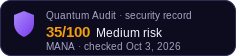
- Oct 3, 202635Medium
Score changes are recorded as dated snapshots — history is append-only and cannot be edited.
Would You Like a More Detailed Audit of Decentraland?
Our AI-powered scanner gives you a deeper, real-time smart contract analysis — free, with every scoring factor shown.
Get Detailed Audit Is this your token? Add your links and get it Verified