

The AUTOS contract is a standard ERC-20 token implementation. The code demonstrates good practices for Solidity 0.8.x, utilizing unchecked blocks with preceding require statements for arithmetic safety. External data indicates that ownership has been renounced and liquidity is locked long-term, significantly mitigating governance and economic risks.
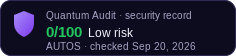

On-chain security analysis — is it a scam or legit?
Is CryptoAutos Safe?
Not verified
This record has not gone through deep verification and is not being monitored. The score is a dated snapshot — the token’s risk can change at any time.Own this token? Put it under verification →The AUTOS contract is a standard ERC-20 token implementation.
Read the full analysisSecurity Checklist
as of audit · Sep 20Holders
as of audit · Sep 20, 2026- Contractstreasury, vesting, bridge, staking33.1%
- Walletsanonymous holders, free to sell5.4%
- Everyone elsethe rest of the supply61.5%
How holder types affect the score
Share held by contracts — treasury, vesting, bridge or staking — is discounted against share held by wallets when the score is computed: a contract cannot decide to sell the way an anonymous holder can, though it can still be drained or voted to sell. Effective concentration is the figure the risk score is actually calculated from.
Holder balances as recorded by the audit of Sep 20, 2026
Liquidity
as of audit · Sep 20The LP tokens of the analysed pool are locked or burned.
Security Findings
LowRedundant SafeMath Library with Potentially Less Secure Functions
Not confirmed by static analysis (the model's own reading of the source).L-01
Issue
Not confirmed by static analysis (the model's own reading of the source). The SafeMath library is included in the codebase, but the ERC20 contract primarily uses native Solidity 0.8.0+ arithmetic operations, often within unchecked blocks that are safely guarded by require statements. This makes the SafeMath library largely redundant. Furthermore, some SafeMath functions (e.g., add, sub, mul, div, mod without try or errorMessage parameters) explicitly use unchecked blocks without adding their own overflow/underflow checks, making them less secure than native operations in Solidity 0.8.0+ where checks are default. While the ERC20 contract does not directly use the
Fix
Consider removing the SafeMath library entirely, as Solidity 0.8.0+ provides native overflow/underflow protection by default, and the contract's current use of unchecked blocks with require statements is a secure and efficient pattern. If SafeMath is intended for specific try* functions, ensure only those are used and the redundant add/sub/mul/div/mod functions are removed.
Status
Unresolved
Analysis
AI Copilotas of audit · Sep 20The contract implements a standard ERC-20 token, utilizing Solidity 0.8.28 features where arithmetic operations within unchecked blocks are safely guarded by require statements, demonstrating robust code security (7.2 Code Security). For example, _transfer ensures fromBalance >= amount before unchecked subtraction. The inclusion of the SafeMath library is largely redundant for Solidity 0.8.0+ and some of its functions are less safe than native operations, though not directly used by the ERC20 logic.
Governance risk is low as external data indicates the contract ownership has been renounced, removing centralized control over administrative functions (7.5 Governance). This decentralization enhances trust. Economic risk is also low due to long-term liquidity locks with UNCX V2 until 2050, which significantly reduces the potential for rug pulls and enhances token stability (7.4 Economic).
The contract is not designed as a proxy and is therefore not upgradeable (7.7 Upgrades). This eliminates upgrade-related risks such as proxy implementation vulnerabilities or administrative key compromise, providing a fixed and immutable contract state.
It is recommended to remove the SafeMath library to reduce contract size and avoid potential confusion, as its functions are either redundant or less secure than native Solidity 0.8.x operations.
Ensure that all necessary initial token supply management, such as minting, was completed prior to the reported ownership renunciation.
Contract & Record
Free for any token on the record. It links to this page and always shows the current score and the date it was checked.
- Sep 20, 20260Low
Score changes are recorded as dated snapshots — history is append-only and cannot be edited.
Frequently Asked Questions
What is the AUTOS contract address?
The CryptoAutos (AUTOS) contract on Ethereum is 0xf477ac7719e2e659001455cdda0cc8f3ad10b604. Compare it with the address the project itself publishes before trading: other contracts can carry the same name and ticker.
Is CryptoAutos a scam?
Quantum Audit's risk score for CryptoAutos is 0/100 (Low risk) as of Sep 20, 2026, computed by a deterministic function from on-chain facts — Contract verified: Verified; Ownership: Renounced; Mint: No mint; Liquidity lock: Locked; Upgradeability: Fixed code; Honeypot: None found; Buy / sell tax: 0% / 0%. A score is a dated snapshot of those facts, not a guarantee; each one is listed on this page.
Is AUTOS liquidity locked?
Liquidity lock: Locked (as of Sep 20, 2026). Total DEX liquidity: $126.5K.
Who holds AUTOS?
As of Sep 20, 2026, the 10 largest holders own 38.5% of the supply. The Holders section on this page shows who they are by holder type.
Would You Like a More Detailed Audit of CryptoAutos?
Our AI-powered scanner gives you a deeper, real-time smart contract analysis — free, with every scoring factor shown.
Get Detailed Audit Is this your token? Add your links and get it Verified