
Quantum Audit Logo

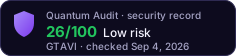
Is Grand Theft Auto VI Safe?

On-chain security analysis — is it a scam or legit?

Is this your token? Publish your own audit on this page →

Grand Theft Auto VI GTAVI
0x2e5e…b6f9
Ethereum Not verifiedLast checked 3d ago 1 audit on record
How is this score calculated? → Medium Risk
Executive SummaryAI Copilot

The `StandardToken` contract implements a basic ERC-20 token with `Ownable` access control and a constructor-based fee mechanism. The audit identified a high centralization risk due to the owner receiving the entire initial token supply, along with medium risks related to external dependencies and constructor-based ETH transfers. Minor informational findings were also noted.

1 High2 Medium1 Low1 Informational
Volume 24h
$8.3K
Liquidity
$256.8K
Price
$0.0000000001
Token Age
23d
Top 10 Holders
49.2%

Security Findings

High

Centralized Control by Owner

H-01The `_mint` function is called in the constructor to mint the entire `totalSupply` to the `owner()`. This means the contract owner holds 100% of the initial token supply, creating a highly centralized distribution. This centralization poses a significant risk as the owner has unilateral control over the token's liquidity and potential market manipulation, and a compromise of the owner's private key would jeopardize the entire token supply (7.4 Economic, 7.3 Access Control).
IssueThe `_mint` function is called in the constructor to mint the entire `totalSupply` to the `owner()`. This means the contract owner holds 100% of the initial token supply, creating a highly centralized distribution. This centralization poses a significant risk as the owner has unilateral control over the token's liquidity and potential market manipulation, and a compromise of the owner's private key would jeopardize the entire token supply (7.4 Economic, 7.3 Access Control).
FixConsider implementing a more decentralized initial distribution mechanism, such as a vesting schedule, a public sale, or distributing tokens to multiple addresses. If the current distribution is intentional, ensure robust security measures are in place for the owner's private key, such as a multi-signature wallet or hardware security module.
StatusUnresolved
Medium

Constructor ETH Transfer Denial-of-Service Risk

M-01The constructor attempts to transfer `args.serviceFee` to `args.serviceFeeReceiver` using a `call` statement. While `require(success)` ensures the transfer succeeds for deployment, a malicious or improperly configured `serviceFeeReceiver` contract could intentionally revert the `call` transaction. This would prevent the `StandardToken` contract from being deployed, leading to a denial-of-service for the token's creation (7.8 Operations).
IssueThe constructor attempts to transfer `args.serviceFee` to `args.serviceFeeReceiver` using a `call` statement. While `require(success)` ensures the transfer succeeds for deployment, a malicious or improperly configured `serviceFeeReceiver` contract could intentionally revert the `call` transaction. This would prevent the `StandardToken` contract from being deployed, leading to a denial-of-service for the token's creation (7.8 Operations).
FixEnsure that the `serviceFeeReceiver` address is a trusted and robust contract or an EOA. If it's a contract, verify its fallback/receive function logic to ensure it does not revert unexpectedly. Consider alternative fee collection mechanisms if this risk is unacceptable, or deploy with a known-good receiver address.
StatusUnresolved
Medium

External Dependency Risk with TokenRegistry

M-02The contract interacts with an external `ITokenRegistry` contract in its constructor by calling `register()`. The security and behavior of this external `ITokenRegistry` are critical to the successful deployment and perceived legitimacy of this token. A malicious or compromised `TokenRegistry` could potentially lead to unexpected behavior during registration or impact the token's standing within the ecosystem (7.6 External).
IssueThe contract interacts with an external `ITokenRegistry` contract in its constructor by calling `register()`. The security and behavior of this external `ITokenRegistry` are critical to the successful deployment and perceived legitimacy of this token. A malicious or compromised `TokenRegistry` could potentially lead to unexpected behavior during registration or impact the token's standing within the ecosystem (7.6 External).
FixThoroughly audit and verify the `ITokenRegistry` contract's code and its operational security. Ensure that the `args.tokenRegistry` address provided during deployment points to a trusted and secure registry. Understand the implications of being registered (or failing to register) with this external contract.
StatusUnresolved
Low

Redundant SafeMath Usage

L-01The contract uses `SafeMath` for arithmetic operations, despite being compiled with Solidity 0.8.4. Solidity versions 0.8.0 and higher include built-in overflow and underflow checks by default, rendering `SafeMath` redundant. While not a vulnerability, its continued use adds unnecessary bytecode size and slightly increased gas costs for arithmetic operations (7.2 Code Security).
IssueThe contract uses `SafeMath` for arithmetic operations, despite being compiled with Solidity 0.8.4. Solidity versions 0.8.0 and higher include built-in overflow and underflow checks by default, rendering `SafeMath` redundant. While not a vulnerability, its continued use adds unnecessary bytecode size and slightly increased gas costs for arithmetic operations (7.2 Code Security).
FixRemove the `using SafeMath for uint256;` statement and all explicit `SafeMath` calls (`.add()`, `.sub()`). Rely on Solidity's native overflow/underflow checks. This will optimize gas usage slightly without compromising security.
StatusUnresolved
Info

ERC-20 `approve` Race Condition

I-01The standard ERC-20 `approve` function is susceptible to a known front-running attack. If a user approves an amount, and then attempts to change that approved amount, a malicious actor could front-run the second transaction, causing the spender to spend the original approved amount, and then also the new approved amount, effectively spending twice. While `increaseAllowance` and `decreaseAllowance` are provided as mitigations, the base `approve` function itself remains vulnerable (7.2 Code Security).
IssueThe standard ERC-20 `approve` function is susceptible to a known front-running attack. If a user approves an amount, and then attempts to change that approved amount, a malicious actor could front-run the second transaction, causing the spender to spend the original approved amount, and then also the new approved amount, effectively spending twice. While `increaseAllowance` and `decreaseAllowance` are provided as mitigations, the base `approve` function itself remains vulnerable (7.2 Code Security).
FixEducate users to primarily use `increaseAllowance` and `decreaseAllowance` instead of directly calling `approve` to modify existing allowances. If `approve` must be used to change an allowance, users should first set the allowance to zero before setting a new non-zero value.
StatusUnresolved

Category Ratings

TechnicalLow9/10

The contract leverages OpenZeppelin's `Ownable` and `SafeMath` libraries, enhancing code security (7.2 Code Security). The implementation of ERC-20 functions is standard, including `increaseAllowance` and `decreaseAllowance` to mitigate `approve` race conditions. However, the constructor's ETH transfer mechanism introduces a potential denial-of-service risk during deployment if the `serviceFeeReceiver` reverts (7.8 Operations). Additionally, the reliance on an external `ITokenRegistry` introduces a dependency risk (7.6 External).

GovernanceLow8/10

The economic model grants the contract owner significant control, as the entire `totalSupply` is minted to the owner's address during deployment (7.4 Economic). This centralization presents a high risk if the owner's key is compromised, potentially leading to market manipulation or loss of funds. While `Ownable` provides basic access control (7.3 Access Control), there are no further governance mechanisms defined within this contract (7.5 Governance) to mitigate this centralized power.

UpgradesLow10/10

The `StandardToken` contract is not designed to be upgradeable, which simplifies its architecture and removes upgrade-related risks (7.7 Upgrades). The presence of a `VERSION` constant suggests potential future iterations or a versioning strategy, but this specific contract is immutable once deployed, ensuring its logic cannot be altered post-deployment.

Security Checklist

Contract VerifiedPass
Ownership RenouncedPass
No Mint FunctionPass
Liquidity LockedPass
Not a ProxyPass

Holder Composition

49.2% in wallets0.0% in contracts
Effective Concentration49.2%

Share held by contracts — treasury, vesting, bridge or staking — is discounted against share held by wallets when the score is computed: a contract cannot decide to sell the way an anonymous holder can, though it can still be drained or voted to sell. Effective concentration is the figure the risk score is actually calculated from.

Liquidity Depth

The risk score reads depth across every pair. The volume figure and the volume-to-liquidity ratio elsewhere on this page describe only the pair this audit analysed, so the two are not directly comparable.

LP Distribution

LP Locked100.0% · Null Address, PinkLock02

Key Addresses

Deployer
0x9bff…fa88

What Raised This Score

  • Top-10 concentration > 30% (49.2% total → 49.2% effective; 49.2% in EOAs, 0.0% in contracts — moderate)
  • Token age < 30 days (still settling)
  • 1 High finding(s) from audit
  • 2 Medium finding(s) from audit
  • 1 Low finding(s) from audit

Each factor is an on-chain fact recorded at the time of this analysis. The score is computed from them by a deterministic function, so the same contract returns the same score for anyone who runs the audit. How scores are computed

Related Audits

Shiba Inu (SHIB)Medium RiskUnipeg (UPEG)Medium RiskMog Coin (MOG)Medium RiskWrapped TAO (WTAO)Medium RiskTelcoin (TEL)Medium RiskStockereum.fun (STOCKER)Medium Risk

Would You Like a More Detailed Audit of Grand Theft Auto VI?

Our AI-powered scanner gives you a deeper, real-time smart contract analysis — free, with every scoring factor shown.

Get Detailed Audit