
Quantum Audit Logo
Ethereum · Meme Token Security · Jul 24, 2026

Is wojak a Scam? WOJAK

Honeypot, rug-pull and ownership checks

Contract 0x8de3…31ef DexScreener ↗
Medium Risk How is this score calculated? →
i Our automated scanner reviewed wojak (WOJAK) on Ethereum. 5 of 5 security checks passed — see the full breakdown below.
Volume 24h
$190.3K
Liquidity
$889.0K
Price
$0.0000000659
Age
3mo
Top 10 Holders
38.8%

Rug Pull Risk Checklist

Contract VerifiedPass
Ownership RenouncedPass
No Mint FunctionPass
Liquidity LockedPass
Not a ProxyPass

Audit History

Jul 2332

Every audit run adds a dated snapshot — history is append-only and cannot be edited.

Audit Summary

The Wojak Token contract is an ERC-20 token implementation with extensive owner-controlled features, including configurable transaction fees, maximum transaction/wallet limits, minting capabilities, and a liquidity generation mechanism. While leveraging OpenZeppelin's secure base contracts, the high degree of centralization introduces significant economic and operational risks. The owner possesses the ability to drastically alter tokenomics, potentially leading to a honeypot scenario or liquidity rug-pull. Technical aspects like unchecked external call return values and lack of slippage protection in swaps also present vulnerabilities.
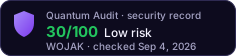

Final Recommendation: Given the extreme centralization, it is crucial for the project to clearly communicate the extent of owner privileges to all potential users and investors. Consider implementing a multi-signature wallet for ownership and introducing time-locks for critical parameter changes to reduce single-point-of-failure risks and increase transparency. For all swap operations, implement a `minAmountOut` parameter to protect against slippage and front-running. Ensure that all external ERC20 calls check their return values to prevent unexpected failures. For enhanced transparency and off-chain monitoring, emit events for all state-changing functions, especially those modifying critical token parameters.

Category Ratings

TechnicalMedium
6/10

The contract utilizes OpenZeppelin's battle-tested ERC20 and Ownable implementations, providing a solid foundation (7.1 Architecture, 7.2 Code Security). A reentrancy guard (`inSwapAndLiquify`) is correctly implemented for the swap and liquify mechanism, mitigating a common vulnerability (7.2 C

GovernanceMedium
6/10

The contract exhibits extreme centralization, with the owner having unilateral control over critical token parameters (7.3 Access Control, 7.5 Governance). The owner can set arbitrary transaction fees (tax and liquidity fees up to 100%), define maximum transaction and wallet amounts, mint new tokens

UpgradesLow
9/10

The contract is not designed with an upgrade mechanism (7.7 Upgrades). This means its logic is immutable after deployment, eliminating upgrade-related risks but also preventing future bug fixes or feature enhancements without a new deployment.

LP Distribution

LP Burned100.0% · ≈ permanent lock
LP Locked100.0% · Null Address

What Raised This Score

Each factor is an on-chain fact recorded at the time of this analysis. The score is computed from them by a deterministic function, so the same contract returns the same score for anyone who runs the audit. How scores are computed

Security Findings

1 Critical 2 High 2 Medium 1 Low
C-01CriticalUnresolved

Extreme Centralization and Honeypot Risk

The contract grants the owner extensive control over critical token parameters, including the ability to set arbitrary transaction and wallet limits, adjust transfer fees (tax and liquidity fees) up to 100%, mint new tokens, pause trading, and exclude specific addresses from all tokenomics. This level of control allows the owner to manipulate the token's economy at will, potentially creating a honeypot scenario where users can buy but are prevented from selling or face prohibitive fees. This impacts 7.3 Access Control, 7.4 Economic, 7.5 Governance, and 7.8 Operations.

Recommendation: Implement a multi-signature wallet for ownership, introduce time-locks for critical parameter changes, or decentralize control through a governance mechanism. Clearly communicate the extent of owner privileges to users and consider capping fees and limits at reasonable, non-exploitable levels.
H-01HighUnresolved

Lack of Minimum Amount Out in Swaps

The `_swapAndLiquify` function, as well as `swapTokensForEth` and `addLiquidity`, use Uniswap's `swapExactTokensForETHSupportingFeeOnTransferTokens` without specifying a `minAmountOut` parameter. This omission exposes the swap operation to sandwich attacks and significant slippage, especially during periods of high volatility or low liquidity, potentially leading to a loss of value for the tokens being swapped. This impacts 7.2 Code Security and 7.4 Economic.

Recommendation: Implement a `minAmountOut` parameter in all swap functions to protect against excessive slippage and front-running. This value should ideally be calculated based on current market conditions or a user-defined tolerance.
H-02HighUnresolved

Owner Can Drain Liquidity Pool Tokens

The `_swapAndLiquify` function adds liquidity to the Uniswap pair, and the resulting LP tokens are sent to the contract itself. The `rescueERC20` function, callable by the owner, allows the owner to withdraw any ERC20 tokens held by the contract. This means the owner can withdraw the LP tokens, effectively removing liquidity from the pool and potentially rug-pulling investors. This impacts 7.3 Access Control and 7.4 Economic.

Recommendation: Implement a mechanism to burn LP tokens or send them to a locked, unspendable address (e.g., the zero address) to ensure liquidity remains permanently locked. If LP tokens are intended to be managed, a transparent and secure governance or time-lock mechanism should be in place for their withdrawal.
M-01MediumUnresolved

Configurable Router and Pair Addresses

The owner can update the `uniswapV2Router` and `uniswapV2Pair` addresses via `updateUniswapV2Router` and `updateUniswapV2Pair` functions. While this offers flexibility, a malicious or compromised owner could redirect token swaps and liquidity additions to a fraudulent router or pair contract, leading to loss of funds or manipulation of the token's market. This impacts 7.3 Access Control and 7.6 External.

Recommendation: Consider making these addresses immutable after deployment or implementing a time-lock for changes to critical external contract addresses. If flexibility is required, ensure robust monitoring and transparency around such changes.
M-02MediumUnresolved

Unchecked Return Values of External Calls

The `_swapAndLiquify` and `swapTokensForEth` functions call `IERC20(token).approve(address(this), type(uint256).max)` without checking the boolean return value. While many ERC20 tokens revert on failure, some older or non-standard implementations might return `false` instead. Ignoring this return value could lead to a false assumption that the approval succeeded, potentially causing subsequent operations to fail unexpectedly. This impacts 7.2 Code Security.

Recommendation: Always check the boolean return value of external ERC20 calls, especially `transfer`, `transferFrom`, and `approve`, to ensure the operation was successful. For example, `require(IERC20(token).approve(...), "ERC20: approve failed");`.
L-01LowUnresolved

Lack of Events for Critical Parameter Changes

Several owner-controlled functions that modify critical parameters, such as `setMaxTxAmount`, `setMaxWalletAmount`, `setSwapAndLiquifyThreshold`, `setNumTokensSellToAddToLiquidity`, `setRouterAddress`, `setPairAddress`, `setTradingOpen`, `excludeFromMaxTx`, `includeInMaxTx`, `excludeFromMaxWallet`, `includeInMaxWallet`, `excludeFromSwap`, `includeInSwap`, do not emit events. This makes it difficult for off-chain monitoring tools and users to track changes to the token's behavior and parameters, reducing transparency. This impacts 7.8 Operations.

Recommendation: Emit explicit events for all functions that modify critical contract state variables. This enhances transparency and allows for easier monitoring and auditing of contract behavior.

Would You Like a More Detailed Audit of wojak?

Paste the contract address into our AI-powered scanner for a deeper real-time report — free, no signup required.

Get Detailed Audit
Check Any Token →