
Quantum Audit Logo

Is ChainGPT Safe?

On-chain security analysis — is it a scam or legit?

Is this your token? Publish your own audit on this page →

ChainGPT CGPT
0x9840…0f98
BNB Chain Not verifiedLast checked 3d ago 1 audit on record
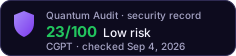
How is this score calculated? → Medium Risk
Executive SummaryAI Copilot

The ChainGPT token contract is a standard ERC20 implementation, inheriting from battle-tested OpenZeppelin libraries for core functionalities, burn capabilities, and ownership management. The contract mints a fixed total supply to the deployer upon creation. Key findings include a highly centralized initial token distribution and the absence of an emergency pause mechanism, which are common considerations for token contracts.

1 High1 Medium1 Low1 Informational
Volume 24h
$126.6K
Liquidity
$935.9K
Price
$0.02
Token Age
2y
Top 10 Holders
59.0%

Security Findings

High

Centralized Initial Token Distribution

H-01The `ChainGPT` contract's constructor mints the entire initial token supply (1,000,000,000 tokens) directly to `msg.sender` (the contract deployer). This design choice results in a highly centralized initial distribution, where a single address holds 100% of the circulating supply. This centralization introduces significant economic risk, as the deployer has complete control over the initial market dynamics and distribution. A compromise of this single address could have a catastrophic impact on the token's ecosystem.
IssueThe `ChainGPT` contract's constructor mints the entire initial token supply (1,000,000,000 tokens) directly to `msg.sender` (the contract deployer). This design choice results in a highly centralized initial distribution, where a single address holds 100% of the circulating supply. This centralization introduces significant economic risk, as the deployer has complete control over the initial market dynamics and distribution. A compromise of this single address could have a catastrophic impact on the token's ecosystem.
FixWhile this is a common design for new tokens, it's crucial to acknowledge the associated risks. Implement a clear, transparent plan for token distribution to mitigate the risks of centralization. Consider using a vesting schedule, multi-signature wallets, or a timelock for large portions of the supply to reduce immediate control by a single entity.
StatusUnresolved
Medium

Lack of Emergency Pause Mechanism

M-01The `ChainGPT` token contract does not include a `Pausable` mechanism. In the event of a critical vulnerability discovery, a major market exploit, or other unforeseen circumstances, the contract owner would not have the ability to temporarily halt token transfers or other critical functions. This absence could lead to unmitigated losses or allow an exploit to propagate without immediate intervention, impacting the protocol's ability to respond to emergencies (7.8 Operations).
IssueThe `ChainGPT` token contract does not include a `Pausable` mechanism. In the event of a critical vulnerability discovery, a major market exploit, or other unforeseen circumstances, the contract owner would not have the ability to temporarily halt token transfers or other critical functions. This absence could lead to unmitigated losses or allow an exploit to propagate without immediate intervention, impacting the protocol's ability to respond to emergencies (7.8 Operations).
FixIntegrate OpenZeppelin's `Pausable` contract or implement a similar mechanism that allows the owner (or a designated multi-signature wallet) to pause and unpause critical functions like `transfer`, `transferFrom`, `approve`, `mint`, and `burn`. This provides a crucial emergency stop-gap measure.
StatusUnresolved
Low

No Recovery for Accidentally Sent Assets

L-01The contract lacks functions to recover accidentally sent ERC20 tokens or native currency (e.g., BNB on BSC) that might be sent directly to the contract address. If users or other contracts mistakenly transfer assets to the `ChainGPT` contract, these assets will become permanently locked and irrecoverable, leading to a loss for the sender.
IssueThe contract lacks functions to recover accidentally sent ERC20 tokens or native currency (e.g., BNB on BSC) that might be sent directly to the contract address. If users or other contracts mistakenly transfer assets to the `ChainGPT` contract, these assets will become permanently locked and irrecoverable, leading to a loss for the sender.
FixImplement a function, callable only by the contract owner, to recover arbitrary ERC20 tokens and native currency accidentally sent to the contract. This function should include checks to prevent the owner from withdrawing the contract's own `CGPT` tokens.
StatusUnresolved
Info

Owner Privileges and Single Point of Control

I-01The contract utilizes the `Ownable` pattern, granting a single address (the owner) exclusive control over administrative functions such as `transferOwnership` and `renounceOwnership`. While this provides a clear administrative structure, it introduces a single point of failure. If the owner's private key is compromised, or if the owner acts maliciously, the integrity of these administrative controls could be jeopardized (7.3 Access Control).
IssueThe contract utilizes the `Ownable` pattern, granting a single address (the owner) exclusive control over administrative functions such as `transferOwnership` and `renounceOwnership`. While this provides a clear administrative structure, it introduces a single point of failure. If the owner's private key is compromised, or if the owner acts maliciously, the integrity of these administrative controls could be jeopardized (7.3 Access Control).
FixFor enhanced security and decentralization, consider transferring ownership to a multi-signature wallet (e.g., Gnosis Safe) or a time-locked contract. This distributes control and adds a layer of protection against a single point of failure or malicious intent.
StatusUnresolved

Category Ratings

TechnicalLow9/10

The ChainGPT token contract leverages battle-tested OpenZeppelin libraries for its ERC20, Ownable, and ERC20Burnable functionalities, ensuring a high standard of code security (7.2 Code Security). Arithmetic operations are protected against overflow/underflow by Solidity 0.8.0+ default checks or explicit `require` statements before `unchecked` blocks. Access control (7.3 Access Control) is managed via the Ownable pattern, restricting administrative functions like `transferOwnership` to the designated owner. A notable technical risk is the absence of a pause mechanism, which could limit emergency response capabilities.

GovernanceMedium5/10

The economic model (7.4 Economic) of the ChainGPT token is characterized by a fixed total supply, with the entire initial supply minted to the deployer, creating a highly centralized distribution at launch (7.1 Architecture). This centralization extends to governance (7.5 Governance) through the `Ownable` pattern, where a single address controls administrative functions, including the ability to transfer ownership. While this provides clear administrative control, it introduces a single point of failure if the owner's key is compromised or misused.

UpgradesLow9/10

The ChainGPT contract is implemented as a standard, non-upgradeable contract (7.7 Upgrades). This design choice eliminates the complexities and potential risks associated with proxy patterns and upgrade mechanisms, such as storage collisions or logic errors during upgrades. However, it also means that any discovered vulnerabilities or desired feature enhancements would require a new contract deployment and a token migration process.

Security Checklist

Contract VerifiedPass
Ownership RenouncedPass
No Mint FunctionPass
Liquidity LockedFail
Not a ProxyPass
HoneypotNoneBuy Tax0.0%Sell Tax0.0%

Holder Composition

30.4% in wallets28.6% in contracts
Effective Concentration41.9%

Share held by contracts — treasury, vesting, bridge or staking — is discounted against share held by wallets when the score is computed: a contract cannot decide to sell the way an anonymous holder can, though it can still be drained or voted to sell. Effective concentration is the figure the risk score is actually calculated from.

Liquidity Depth

Show 4 more pairsShow less

The 7 remaining pairs hold $54 between them and are not listed.

The risk score reads depth across every pair. The volume figure and the volume-to-liquidity ratio elsewhere on this page describe only the pair this audit analysed, so the two are not directly comparable.

LP Distribution

Top-1 Unlocked Holder99.9%
Top-3 Unlocked100.0%

Key Addresses

Deployer
0xd9b4…6cb3
Unlocked LP Held By
0x5930…9fbe0x556b…d59e0x966d…e41a0x2951…29b10x8325…100f0x5f0f…29090xe505…9ae4

No privileged address appears among these holders: the unlocked liquidity sits with independent providers, not with the deployer.

What Raised This Score

  • Top-10 concentration > 30% (59.0% total → 41.9% effective; 30.4% in EOAs, 28.6% in contracts — moderate)
  • Liquidity not locked, but no owner/deployer address holds LP — market-depth risk, not rug risk
  • LP top1 unlocked holder = 99.9% (independent LP — depth risk, pool = 95% of DEX liquidity)
  • LP top3 unlocked holders = 100.0% (independent LP — depth risk, pool = 95% of DEX liquidity)
  • 1 High finding(s) from audit
  • 1 Medium finding(s) from audit
  • 1 Low finding(s) from audit

Each factor is an on-chain fact recorded at the time of this analysis. The score is computed from them by a deterministic function, so the same contract returns the same score for anyone who runs the audit. How scores are computed

Related Audits

MEET48 Token (IDOL)Medium Riskbinanceus doodles (BOODLES)Medium RiskMarsCoinMedium RiskZygoSwap (ZSWAP)Medium RiskThe Final Form Bull (CZ)Medium RiskSIRENMedium Risk

Would You Like a More Detailed Audit of ChainGPT?

Our AI-powered scanner gives you a deeper, real-time smart contract analysis — free, with every scoring factor shown.

Get Detailed Audit