
Quantum Audit Logo

Is SIREN Safe?

On-chain security analysis — is it a scam or legit?

Is this your token? Publish your own audit on this page →

SIREN SIREN
0x997a…18e1
BNB Chain Not verifiedLast checked 3d ago 2 audits on record
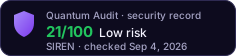
How is this score calculated? → Medium Risk
Executive SummaryAI Copilot

This audit covers an ERC20 token contract deployed on the BSC network. The contract utilizes standard OpenZeppelin implementations for ERC20 and Ownable. A significant finding is that the contract's ownership has been renounced, which permanently disables any owner-restricted functions. The provided source code was truncated, limiting the review of potential custom logic.

1 High2 Informational
Volume 24h
$67.3K
Liquidity
$2.34M
Price
$0.02908
Token Age
1y
Top 10 Holders
81.2%

Security Findings

High

Renounced Ownership Disables Critical Functions

H-01The contract's `Ownable` ownership has been renounced, setting the owner address to `address(0)`. This action permanently disables any functions protected by the `onlyOwner` modifier. If the contract included owner-specific functionalities such as minting, burning, pausing, setting fees, or other administrative controls, these are now irrevocably inaccessible. This can lead to a loss of operational control (7.8) and potentially impact the economic model (7.4) if supply management or emergency actions were intended.
IssueThe contract's `Ownable` ownership has been renounced, setting the owner address to `address(0)`. This action permanently disables any functions protected by the `onlyOwner` modifier. If the contract included owner-specific functionalities such as minting, burning, pausing, setting fees, or other administrative controls, these are now irrevocably inaccessible. This can lead to a loss of operational control (7.8) and potentially impact the economic model (7.4) if supply management or emergency actions were intended.
FixEnsure that all necessary administrative functions are either not protected by `onlyOwner` or that the implications of their permanent disablement are fully understood and accepted. If future administrative actions are required, this contract will be unable to perform them. For future contracts, consider a multi-signature wallet or a time-locked ownership transfer if administrative control is desired but with safeguards.
StatusUnresolved
Info

Missing Custom Functionality (Truncated Code)

I-01The provided source code for the `ERC20` contract is truncated. This prevents a full and comprehensive review of any custom logic, additional functions, or modifications that might have been added beyond the standard OpenZeppelin `ERC20` implementation. While the visible code appears standard, unseen sections could contain vulnerabilities (7.2) or unexpected behavior.
IssueThe provided source code for the `ERC20` contract is truncated. This prevents a full and comprehensive review of any custom logic, additional functions, or modifications that might have been added beyond the standard OpenZeppelin `ERC20` implementation. While the visible code appears standard, unseen sections could contain vulnerabilities (7.2) or unexpected behavior.
FixProvide the complete and untruncated source code for a comprehensive security audit. This ensures all aspects of the contract's functionality can be thoroughly examined for vulnerabilities.
StatusUnresolved
Info

Standard ERC20 Allowance Race Condition

I-02The `approve` function, as defined in the ERC20 standard and implemented here, is susceptible to a known front-running vulnerability. If a user increases an existing allowance, a malicious spender could front-run the transaction, spend the original allowance, and then spend the newly increased allowance before the owner's transaction confirms, effectively spending more than the intended total (7.2).
IssueThe `approve` function, as defined in the ERC20 standard and implemented here, is susceptible to a known front-running vulnerability. If a user increases an existing allowance, a malicious spender could front-run the transaction, spend the original allowance, and then spend the newly increased allowance before the owner's transaction confirms, effectively spending more than the intended total (7.2).
FixUsers should be advised to first set the allowance to zero before increasing it, or to use `increaseAllowance` and `decreaseAllowance` functions if they are available in the full implementation (OpenZeppelin's ERC20 typically includes these). While this is a standard ERC20 behavior, it's important for users to be aware of the risk.
StatusUnresolved

Category Ratings

TechnicalLow9/10

The contract is based on well-vetted OpenZeppelin ERC20 and Ownable libraries, which generally provide robust code security (7.2) and a sound architectural foundation (7.1). Solidity 0.8+ is used, benefiting from default overflow/underflow checks. However, the renounced ownership (7.3) means any owner-only functions, such as potential administrative controls or supply management, are permanently inaccessible, which is a significant technical limitation.

GovernanceMedium4/10

The economic model (7.4) is a standard ERC20 token. The governance (7.5) is effectively decentralized due to the renounced ownership, meaning no single entity can control the contract post-deployment. While this removes centralization risk, it also eliminates any possibility for administrative intervention, such as pausing transfers in an emergency or adjusting token parameters, which could be a significant economic and operational risk (7.8) if such capabilities were ever intended or become necessary.

UpgradesLow9/10

The contract is not designed as an upgradeable proxy (7.7). This means its logic is immutable once deployed, eliminating upgrade-related risks like proxy misconfigurations or malicious upgrade paths. However, it also means that any bugs or desired feature changes cannot be implemented without a new deployment.

Security Checklist

Contract VerifiedPass
Ownership RenouncedPass
No Mint FunctionPass
Liquidity LockedFail
Not a ProxyPass

Holder Composition

33.0% in wallets48.2% in contracts
Effective Concentration52.3%

Share held by contracts — treasury, vesting, bridge or staking — is discounted against share held by wallets when the score is computed: a contract cannot decide to sell the way an anonymous holder can, though it can still be drained or voted to sell. Effective concentration is the figure the risk score is actually calculated from.

Liquidity Depth

Show 4 more pairsShow less

One more pair holds $4 and is not listed.

The risk score reads depth across every pair. The volume figure and the volume-to-liquidity ratio elsewhere on this page describe only the pair this audit analysed, so the two are not directly comparable.

LP Distribution

Top-1 Unlocked Holder71.2%
Top-3 Unlocked84.2%

Key Addresses

Deployer
0x080a…e4ea
Unlocked LP Held By
0xd7ea…9c2e0xabe1…e0bf0x483c…71870xbee9…8e770x3cbc…57330xd379…60d80xd65d…769c0x3f2d…dd0c0xd329…9cec0xecee…ebc4

No privileged address appears among these holders: the unlocked liquidity sits with independent providers, not with the deployer.

What Raised This Score

  • Top-10 concentration > 50% (81.2% total → 52.3% effective; 33.0% in EOAs, 48.2% in contracts — heavy)
  • Liquidity not locked, but no owner/deployer address holds LP — market-depth risk, not rug risk
  • LP top1 unlocked holder = 71.2% (independent LP — depth risk, pool = 99% of DEX liquidity)
  • LP top3 unlocked holders = 84.2% (independent LP — depth risk, pool = 99% of DEX liquidity)
  • 1 High finding(s) from audit

Each factor is an on-chain fact recorded at the time of this analysis. The score is computed from them by a deterministic function, so the same contract returns the same score for anyone who runs the audit. How scores are computed

Frequently Asked Questions

Is SIREN a scam?

Based on automated analysis, SIREN scores 63/100 (High Risk) on our risk scale. No honeypot was detected, but always verify independently before investing.

Is SIREN safe to buy?

Our scanner flagged a risk score of 63/100. Ownership has not been renounced, which is a risk factor. DYOR before purchasing any token.

Has SIREN been audited?

The contract has not been verified on-chain. Verification is not the same as a full security audit. Use Quantum Audit's free tool to run a deeper analysis of the contract code.

Related Audits

ZygoSwap (ZSWAP)Medium RiskANDYMedium RiskIBSLow RiskCZ Terminal Token (CZT)Low RiskMEET48 Token (IDOL)Medium Riskbinanceus doodles (BOODLES)Medium Risk

Would You Like a More Detailed Audit of SIREN?

Our AI-powered scanner gives you a deeper, real-time smart contract analysis — free, with every scoring factor shown.

Get Detailed Audit