
This audit covers a partial implementation of an ERC-20 token contract, FourERC20, which is based on OpenZeppelin standards. The primary concern is the critical lack of a defined token supply mechanism (e.g., minting/burning functions) within the provided code, which is stated to be implemented in a derived contract. Additionally, a significant portion of the _transfer function is truncated, preventing a complete security analysis of core token logic. The contract lacks an emergency pausing mechanism.
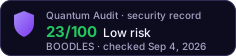

On-chain security analysis — is it a scam or legit?
Is binanceus doodles Safe?
Not verified
This record has not gone through deep verification and is not being monitored. The score is a dated snapshot — the token’s risk can change at any time.Own this token? Put it under verification →This audit covers a partial implementation of an ERC-20 token contract, FourERC20, which is based on OpenZeppelin standards.
- Top-10 concentration > 30%
- Liquidity < $10k
- 1 Critical finding(s) from audit
- 1 Medium finding(s) from audit
- 1 Low finding(s) from audit
Exact factors
- Top-10 concentration > 30% (104.0% total → 42.8% effective; 2.1% in EOAs, 101.9% in contracts — moderate)
- Liquidity < $10k ($6,508 across 1 pairs — easily drained)
- 1 Critical finding(s) from audit
- 1 Medium finding(s) from audit
- 1 Low finding(s) from audit
Each factor is an on-chain fact recorded at the time of this analysis. The score is computed from them by a deterministic function, so the same contract returns the same score for anyone who runs the audit. How scores are computed
Security Checklist
as of audit · Sep 4Holders
as of audit · Sep 4, 2026How the supply is spread across holders could not be read — the indexer's holder list does not add up to the supply. Check the largest holders on a block explorer, which reads current balances.
Liquidity
as of audit · Sep 4The risk score reads depth across every pair.
The LP tokens of the analysed pool are locked or burned.
Security Findings
CriticalUndefined Token Supply Mechanism
The FourERC20 contract explicitly states that a supply mechanism (e.g., _mint) must be added in a derived contract. Without the full implementation of the derived contract, the total supply, minting, and burning capabilities of the token are unknown. This prevents a complete economic and security analysis of the token's fundamental properties, leaving it vulnerable to potential uncontrolled inflation or deflation if the derived contract's implementation is flawed or malicious (7.4 Economic).C-01
Issue
The FourERC20 contract explicitly states that a supply mechanism (e.g., _mint) must be added in a derived contract. Without the full implementation of the derived contract, the total supply, minting, and burning capabilities of the token are unknown. This prevents a complete economic and security analysis of the token's fundamental properties, leaving it vulnerable to potential uncontrolled inflation or deflation if the derived contract's implementation is flawed or malicious (7.4 Economic).
Fix
Provide the complete source code for the derived contract that implements the token supply mechanism. Ensure that minting and burning functions have robust access control (e.g., only callable by a trusted multisig or governance) and clear, auditable logic to prevent unauthorized supply manipulation.
Status
Unresolved
MediumTruncated Code Snippet for Critical Functions
The provided source code for the _transfer function, a core component of ERC-20 token movement, is truncated. This prevents a full and accurate security analysis of the token's transfer logic, including checks for zero addresses, sufficient balances, and potential reentrancy vectors if external calls were introduced (7.2 Code Security).M-01
Issue
The provided source code for the _transfer function, a core component of ERC-20 token movement, is truncated. This prevents a full and accurate security analysis of the token's transfer logic, including checks for zero addresses, sufficient balances, and potential reentrancy vectors if external calls were introduced (7.2 Code Security).
Fix
Provide the complete and untruncated source code for all contracts, especially critical internal functions like _transfer, to enable a thorough security audit.
Status
Unresolved
LowLack of Emergency Pausing Mechanism
The FourERC20 contract does not include a mechanism to pause token transfers or other critical operations. In the event of a critical vulnerability, exploit, or market manipulation, the absence of a pausing mechanism could lead to irreversible damage or loss of funds (7.8 Operations).L-01
Issue
The FourERC20 contract does not include a mechanism to pause token transfers or other critical operations. In the event of a critical vulnerability, exploit, or market manipulation, the absence of a pausing mechanism could lead to irreversible damage or loss of funds (7.8 Operations).
Fix
Consider integrating OpenZeppelin's Pausable module or a similar custom pausing mechanism. This would allow a designated role (e.g., an owner or multisig) to temporarily halt critical functions during emergencies, providing time to address issues.
Status
Unresolved
Info_init Function in Non-Proxy Context
The contract utilizes an _init function for setting _name and _symbol, which is a common pattern in upgradeable proxy contracts for initialization after deployment. However, the contract is marked as is_proxy: false. While the _init function is internal in the provided snippet, if this contract were later used as an implementation contract for a proxy without an initializer modifier, it could lead to reinitialization vulnerabilities (7.7 Upgrades).I-01
_init Function in Non-Proxy ContextIssue
The contract utilizes an _init function for setting _name and _symbol, which is a common pattern in upgradeable proxy contracts for initialization after deployment. However, the contract is marked as is_proxy: false. While the _init function is internal in the provided snippet, if this contract were later used as an implementation contract for a proxy without an initializer modifier, it could lead to reinitialization vulnerabilities (7.7 Upgrades).
Fix
If this contract is not intended for use as an upgradeable proxy implementation, ensure that any constructor or external function calling _init is properly secured. If it is intended for proxy use, ensure the _init function is protected by an initializer modifier to prevent multiple calls.
Status
Unresolved
Analysis
AI Copilotas of audit · Sep 4The contract leverages OpenZeppelin's robust ERC-20 implementation, providing standard token functionalities like transfer, approve, and allowance (7.2 Code Security). The use of unchecked for decreaseAllowance is appropriate for preventing underflow. However, the provided code snippet for the critical _transfer function is truncated, preventing a full assessment of its security (7.2 Code Security). There is no explicit access control beyond standard ERC-20 roles (7.3 Access Control), and the contract lacks an emergency pausing mechanism, which is a common security feature for tokens (7.8 Operations).
The most significant economic risk stems from the explicitly stated absence of a token supply mechanism (e.g., _mint or _burn) within the FourERC20 contract itself, deferring it to a derived contract (7.4 Economic). Without this crucial component, the total supply, inflation/deflation mechanics, and potential for supply manipulation are entirely unknown and unauditable, posing a critical economic vulnerability. No governance mechanisms are present in this base contract (7.5 Governance).
The contract is explicitly marked as is_proxy: false, indicating it is not intended to be upgradeable in its current deployment (7.7 Upgrades). The use of an _init function, typically found in upgradeable contracts for initialization, is noted. As _init is internal, it does not pose a direct reinitialization risk in a non-proxy context, but could be a concern if this contract were later used as an implementation for a proxy without proper initializer protection.
It is critical to provide the complete source code, especially for the derived contract that implements the token supply mechanism, to allow for a comprehensive security assessment.
The design of the minting and burning functions, including their access control, must be thoroughly reviewed to prevent economic manipulation. Additionally, consider implementing an emergency pausing mechanism to mitigate risks during unforeseen events.
Contract & Record
Free for any token on the record. It links to this page and always shows the current score and the date it was checked.
- Sep 4, 202623Low
- Aug 15, 202617Low
Score changes are recorded as dated snapshots — history is append-only and cannot be edited.
Frequently Asked Questions
What is the BOODLES contract address?
The binanceus doodles (BOODLES) contract on BNB Chain is 0xc708c48944600c03227895abda42ca7f38c64444. Compare it with the address the project itself publishes before trading: other contracts can carry the same name and ticker.
Is binanceus doodles a scam?
Quantum Audit's risk score for binanceus doodles is 23/100 (Low risk) as of Sep 4, 2026, computed by a deterministic function from on-chain facts — Contract verified: Verified; Ownership: Renounced; Mint: No mint; Liquidity lock: Locked; Upgradeability: Fixed code. A score is a dated snapshot of those facts, not a guarantee; each one is listed on this page.
Is BOODLES liquidity locked?
Liquidity lock: Locked (as of Sep 4, 2026). Total DEX liquidity: $6.5K.
Would You Like a More Detailed Audit of binanceus doodles?
Our AI-powered scanner gives you a deeper, real-time smart contract analysis — free, with every scoring factor shown.
Get Detailed Audit Is this your token? Publish your own audit on this page