
Quantum Audit Logo

Is Beat Token Safe?

On-chain security analysis — is it a scam or legit?

Is this your token? Publish your own audit on this page →

Beat Token BEAT
0xcf32…3e36
BNB Chain Not verifiedLast checked 2d ago 1 audit on record
How is this score calculated? → Medium Risk
Executive SummaryAI Copilot

The Beat Token contract is a standard ERC20 implementation with an owner-controlled minting function. Based on the provided deployment information, the contract's ownership has been renounced, effectively disabling the minting capability and fixing the total supply at its current level. The contract utilizes Solidity 0.8.0+, benefiting from native overflow/underflow protection.
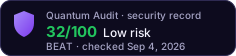

1 Low3 Informational
Volume 24h
$20.1K
Liquidity
$69.9K
Price
$0.1238
Token Age
9mo
Top 10 Holders
57.4%

Security Findings

Low

Lack of Public Burn Mechanism

L-01The `Beat` token contract does not expose a public function to allow token holders or the contract owner to burn tokens. While an internal `_burn` function exists in the inherited `ERC20` contract, it is not callable externally. This limits the flexibility of supply management, as tokens can only be minted (up to `MAX_SUPPLY` before ownership renunciation) and transferred, but never permanently removed from circulation.
IssueThe `Beat` token contract does not expose a public function to allow token holders or the contract owner to burn tokens. While an internal `_burn` function exists in the inherited `ERC20` contract, it is not callable externally. This limits the flexibility of supply management, as tokens can only be minted (up to `MAX_SUPPLY` before ownership renunciation) and transferred, but never permanently removed from circulation.
FixConsider adding an `onlyOwner` or public `burn` function if future supply reduction mechanisms are desired. Document the current fixed supply policy clearly.
StatusUnresolved
Info

Redundant SafeMath Library Usage

I-01The `Beat.sol` contract imports and uses the `SafeMath` library. However, the contract is compiled with Solidity `^0.8.0`, which includes built-in overflow and underflow checks for all arithmetic operations by default. Explicitly using `SafeMath` for `uint256` operations is redundant and adds unnecessary code complexity without providing additional security benefits in this Solidity version.
IssueThe `Beat.sol` contract imports and uses the `SafeMath` library. However, the contract is compiled with Solidity `^0.8.0`, which includes built-in overflow and underflow checks for all arithmetic operations by default. Explicitly using `SafeMath` for `uint256` operations is redundant and adds unnecessary code complexity without providing additional security benefits in this Solidity version.
FixRemove the `SafeMath.sol` import and the `using SafeMath for uint256;` statement. Rely on Solidity 0.8.0's native overflow/underflow protection.

StatusUnresolved
Info

Centralized Initial Token Supply

I-02The `Beat` token contract includes an `onlyOwner` `mint` function, allowing the deployer to mint tokens up to a `MAX_SUPPLY` of 1 billion tokens. While the provided information indicates that ownership has been renounced, implying the `mint` function is no longer callable, the initial distribution of tokens (if any occurred before renunciation) was entirely at the discretion of the contract owner. This represents a centralized point of control for the initial token supply.
IssueThe `Beat` token contract includes an `onlyOwner` `mint` function, allowing the deployer to mint tokens up to a `MAX_SUPPLY` of 1 billion tokens. While the provided information indicates that ownership has been renounced, implying the `mint` function is no longer callable, the initial distribution of tokens (if any occurred before renunciation) was entirely at the discretion of the contract owner. This represents a centralized point of control for the initial token supply.
FixFor future projects, consider implementing decentralized distribution mechanisms or transparent vesting schedules to reduce reliance on a single entity for initial token allocation.
StatusUnresolved
Info

Unchecked Arithmetic Blocks

I-03The `ERC20.sol` contract utilizes `unchecked` blocks in the `transferFrom`, `decreaseAllowance`, and `_burn` functions. While these `unchecked` blocks are preceded by `require` statements that ensure the safety of the arithmetic operations (e.g., `currentAllowance >= amount`), their explicit use can be confusing. In Solidity 0.8.0+, arithmetic operations revert on overflow/underflow by default, making `unchecked` blocks only necessary when intentionally allowing such behavior.
IssueThe `ERC20.sol` contract utilizes `unchecked` blocks in the `transferFrom`, `decreaseAllowance`, and `_burn` functions. While these `unchecked` blocks are preceded by `require` statements that ensure the safety of the arithmetic operations (e.g., `currentAllowance >= amount`), their explicit use can be confusing. In Solidity 0.8.0+, arithmetic operations revert on overflow/underflow by default, making `unchecked` blocks only necessary when intentionally allowing such behavior.
FixReview the necessity of `unchecked` blocks. If the preceding `require` statements guarantee safety, the `unchecked` blocks can be removed, relying on the default 0.8.0 behavior for clarity, or retained if the intent is to explicitly optimize gas by skipping redundant checks. Ensure thorough documentation of the rationale if retained.
StatusUnresolved

Category Ratings

TechnicalLow8/10

The technical architecture is straightforward, implementing a standard ERC20 token with an `Ownable` pattern (7.1 Architecture). The code benefits from Solidity 0.8.0's built-in arithmetic safety checks. However, the explicit use of the `SafeMath` library is redundant given the compiler version (7.2 Code Security). Additionally, some `unchecked` blocks are used in `ERC20.sol`, though they are appropriately guarded by `require` statements (7.2 Code Security).

GovernanceLow7/10

The economic model is based on a fixed maximum supply of 1 billion tokens, with an owner-controlled minting function (7.4 Economic). Crucially, the provided deployment information indicates that ownership has been renounced, which effectively disables further minting and fixes the total supply (7.5 Governance). The absence of a public burn function means the token supply cannot be reduced post-renunciation (7.4 Economic).

UpgradesMedium5/10

The contract is not designed with an upgradeability pattern (7.7 Upgrades). This means its logic is immutable once deployed, providing certainty but preventing future modifications or bug fixes without a new deployment and migration. This design choice inherently carries a low risk for upgrade-related issues.

Security Checklist

Contract VerifiedPass
Ownership RenouncedPass
No Mint FunctionFail
Liquidity LockedFail
Not a ProxyPass

Holder Composition

10.7% in wallets46.7% in contracts
Effective Concentration29.4%

Share held by contracts — treasury, vesting, bridge or staking — is discounted against share held by wallets when the score is computed: a contract cannot decide to sell the way an anonymous holder can, though it can still be drained or voted to sell. Effective concentration is the figure the risk score is actually calculated from.

Liquidity Depth

The risk score reads depth across every pair. The volume figure and the volume-to-liquidity ratio elsewhere on this page describe only the pair this audit analysed, so the two are not directly comparable.

Key Addresses

Deployer
0x2e2b…a04e

What Raised This Score

  • Mintable supply — no cap found, dilution unbounded
  • Top-10 concentration > 20% (57.4% total → 29.4% effective; 10.7% in EOAs, 46.7% in contracts — mild)
  • Liquidity NOT locked (owner can withdraw — rug-pull risk)
  • 1 Low finding(s) from audit

Each factor is an on-chain fact recorded at the time of this analysis. The score is computed from them by a deterministic function, so the same contract returns the same score for anyone who runs the audit. How scores are computed

Related Audits

XPIN Token (XPIN)Medium RiskTRADOORMedium RiskNew BNB Coin (NNB)Medium RiskSpaceXcoinMedium RiskGen Z (Z)Medium RiskARKMedium Risk

Would You Like a More Detailed Audit of Beat Token?

Our AI-powered scanner gives you a deeper, real-time smart contract analysis — free, with every scoring factor shown.

Get Detailed Audit