
Quantum Audit Logo

Is Baby Asteroid Safe?

On-chain security analysis — is it a scam or legit?

Is this your token? Publish your own audit on this page →

Baby Asteroid BABYASTEROID
0xfecb…6666
BNB Chain Not verifiedLast checked 2d ago 1 audit on record
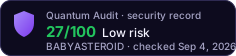
How is this score calculated? → Medium Risk
Executive SummaryAI Copilot

The audit of the BabyAsteroid token contract, an ERC20 implementation, identified a critical functional flaw: the token's total supply is permanently zero, rendering it non-functional. This issue prevents any tokens from being minted or transferred. Other findings include a non-standard decimals value and an informational note regarding the ERC20 approve race condition.

1 Critical1 Low1 Informational
Volume 24h
$23.1K
Liquidity
$93.8K
Price
$0.0000000008
Token Age
3mo
Top 10 Holders
20.0%

Security Findings

Critical

Token Supply Always Zero, Rendering Token Non-Functional

C-01The `ERC20` contract's `_totalSupply` variable is declared but never initialized in the constructor, nor is there any `_mint` function provided within the contract to increase this supply. Consequently, `totalSupply()` will always return 0, and no tokens can ever be created or transferred. This makes the token completely non-functional and unusable.
IssueThe `ERC20` contract's `_totalSupply` variable is declared but never initialized in the constructor, nor is there any `_mint` function provided within the contract to increase this supply. Consequently, `totalSupply()` will always return 0, and no tokens can ever be created or transferred. This makes the token completely non-functional and unusable.
FixImplement a `_mint` function, typically restricted to an owner or deployer, to allow for the creation of new tokens. Alternatively, initialize `_totalSupply` and mint an initial supply to a designated address within the constructor. Ensure that the `_balances` mapping is updated accordingly during minting.
StatusUnresolved
Low

Non-Standard Decimals Value

L-01The `decimals()` function returns a value of 9. While technically valid, the common standard for ERC20 tokens is 18 decimals, mimicking Ethereum's Wei. Deviating from this standard can lead to display inconsistencies or misinterpretations in wallets, exchanges, and DApps that assume 18 decimals.
IssueThe `decimals()` function returns a value of 9. While technically valid, the common standard for ERC20 tokens is 18 decimals, mimicking Ethereum's Wei. Deviating from this standard can lead to display inconsistencies or misinterpretations in wallets, exchanges, and DApps that assume 18 decimals.
FixConsider changing the `decimals()` function to return 18 for better compatibility and user experience across the broader EVM ecosystem. If 9 decimals is an intentional design choice, ensure all front-end applications and integrations are aware of and correctly handle this value.
StatusUnresolved
Info

ERC20 `approve` Race Condition Warning

I-01The contract's comments correctly highlight the known race condition vulnerability associated with the `approve` function, where an attacker might exploit unfortunate transaction ordering to spend both the old and new allowance amounts. The contract provides `increaseAllowance` and `decreaseAllowance` as mitigations.
IssueThe contract's comments correctly highlight the known race condition vulnerability associated with the `approve` function, where an attacker might exploit unfortunate transaction ordering to spend both the old and new allowance amounts. The contract provides `increaseAllowance` and `decreaseAllowance` as mitigations.
FixEducate users and integrated applications to prefer `increaseAllowance` and `decreaseAllowance` over directly calling `approve` when modifying an existing allowance. This helps prevent potential double-spend scenarios related to the `approve` race condition.
StatusUnresolved

Category Ratings

TechnicalLow8/10

The contract is based on a standard ERC20 implementation, demonstrating good code structure and adherence to common patterns (7.1 Architecture, 7.2 Code Security). However, a critical functional flaw exists where the `_totalSupply` is never initialized or increased, and no `_mint` function is provided, making the token non-functional (C-01). The `decimals()` function returns 9, which is non-standard but not a vulnerability (L-01). The contract correctly includes `increaseAllowance` and `decreaseAllowance` to mitigate the `approve` race condition (I-01).

GovernanceLow7/10

The contract implements a standard ERC20 token with no complex economic models or governance mechanisms (7.4 Economic, 7.5 Governance). The prefill indicates ownership is renounced, which eliminates central control risks and enhances decentralization (7.3 Access Control). Due to the critical functional flaw (C-01), the economic impact is currently zero as no tokens can exist or be traded.

UpgradesLow9/10

The contract is not designed as an upgradeable proxy (7.7 Upgrades). It is a standard, non-upgradeable implementation, which simplifies its architecture and removes upgrade-related risks.

Security Checklist

Contract VerifiedPass
Ownership RenouncedPass
No Mint FunctionPass
Liquidity LockedPass
Not a ProxyPass

Holder Composition

2.9% in wallets17.1% in contracts
Effective Concentration9.8%

Share held by contracts — treasury, vesting, bridge or staking — is discounted against share held by wallets when the score is computed: a contract cannot decide to sell the way an anonymous holder can, though it can still be drained or voted to sell. Effective concentration is the figure the risk score is actually calculated from.

Liquidity Depth

The risk score reads depth across every pair. The volume figure and the volume-to-liquidity ratio elsewhere on this page describe only the pair this audit analysed, so the two are not directly comparable.

LP Distribution

Top-1 Unlocked Holder100.0%
Top-3 Unlocked100.0%

Key Addresses

Deployer
0x6c49…8fa4
Unlocked LP Held By
0x1e78…71400x0ed9…9706

No privileged address appears among these holders: the unlocked liquidity sits with independent providers, not with the deployer.

What Raised This Score

  • LP top1 unlocked holder = 100.0% (independent LP — depth risk)
  • LP top3 unlocked holders = 100.0% (independent LP — depth risk)
  • LP claimed locked but only 0.0% actually locked
  • 1 Critical finding(s) from audit
  • 1 Low finding(s) from audit

Each factor is an on-chain fact recorded at the time of this analysis. The score is computed from them by a deterministic function, so the same contract returns the same score for anyone who runs the audit. How scores are computed

Related Audits

Decentrawood (DEOD)Medium RiskLABMedium RiskMatthewCoinMedium RiskKoma Inu (KOMA)Medium RiskBillion Zone Xchange (ZBX)Medium RiskElonCoinMedium Risk

Would You Like a More Detailed Audit of Baby Asteroid?

Our AI-powered scanner gives you a deeper, real-time smart contract analysis — free, with every scoring factor shown.

Get Detailed Audit