

Quantum Audit Logo

Is Billion Zone Xchange Safe?

On-chain security analysis — is it a scam or legit?

Is this your token? Publish your own audit on this page →

Billion Zone Xchange ZBX
0x9672…c81c
BNB Chain Not verifiedLast checked 2d ago 1 audit on record
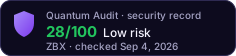
How is this score calculated? → Medium Risk
Executive SummaryAI Copilot

This audit covers the provided Solidity source code for the BillionZoneXchange token. The core contract logic is based on OpenZeppelin's Ownable and ERC20 implementations, which are well-audited and robust. However, the custom `ZBX.sol` contract was truncated, preventing a comprehensive analysis of its specific functionalities and potential custom vulnerabilities. Key findings include the implications of renounced ownership and the absence of emergency pause mechanisms. The contract is not upgradeable.

1 High1 Medium1 Low1 Informational
Volume 24h
$18.2K
Liquidity
$18.2K
Price
$0.2988
Token Age
26d
Top 10 Holders
80.2%

Security Findings

High

Truncated Source Code Prevents Comprehensive Audit

H-01The provided source code for the `ZBX.sol` contract is truncated, specifically after the import statement. This prevents a complete and thorough security audit of any custom logic, state variables, function overrides, or specific tokenomics implemented within the BillionZoneXchange token. Without the full code, it is impossible to identify potential vulnerabilities such as reentrancy, logic errors, access control flaws in custom functions, or economic exploits unique to this contract's design.
IssueThe provided source code for the `ZBX.sol` contract is truncated, specifically after the import statement. This prevents a complete and thorough security audit of any custom logic, state variables, function overrides, or specific tokenomics implemented within the BillionZoneXchange token. Without the full code, it is impossible to identify potential vulnerabilities such as reentrancy, logic errors, access control flaws in custom functions, or economic exploits unique to this contract's design.
FixProvide the complete and untruncated source code for the `ZBX.sol` contract to enable a comprehensive security audit. This is crucial for identifying and mitigating any vulnerabilities specific to the custom implementation.
StatusUnresolved
Medium

Implications of Renounced Ownership

M-01The `Ownable` contract's ownership has been renounced, meaning the `owner` address is now `address(0)`. While this decentralizes control and prevents a single entity from executing owner-only malicious actions (e.g., unauthorized minting if such functions were exposed), it also renders any administrative functions that rely on `onlyOwner` modifier permanently inaccessible. If the contract was designed with any critical owner-controlled features (e.g., pausing, fee adjustments, or emergency upgrades), these are now disabled, potentially limiting the protocol's ability to respond to unforeseen circumstances or future needs.
IssueThe `Ownable` contract's ownership has been renounced, meaning the `owner` address is now `address(0)`. While this decentralizes control and prevents a single entity from executing owner-only malicious actions (e.g., unauthorized minting if such functions were exposed), it also renders any administrative functions that rely on `onlyOwner` modifier permanently inaccessible. If the contract was designed with any critical owner-controlled features (e.g., pausing, fee adjustments, or emergency upgrades), these are now disabled, potentially limiting the protocol's ability to respond to unforeseen circumstances or future needs.
FixEnsure that all necessary administrative functions were either removed, made public, or designed to be self-sufficient before ownership renouncement. For future projects, if administrative control is desired, consider using a multi-signature wallet or a time-locked governance mechanism instead of renouncing ownership, or clearly document the implications of renouncement for all stakeholders.
StatusUnresolved
Low

Lack of Emergency Pausability

L-01The standard ERC20 contract, as implemented, does not include a mechanism to pause token transfers or other critical operations. In the event of a major vulnerability in an integrated DeFi protocol, a market manipulation attack, or other unforeseen emergencies, the inability to pause could lead to cascading losses or further exploitation. Given that ownership is renounced, adding such a mechanism post-deployment is not possible.
IssueThe standard ERC20 contract, as implemented, does not include a mechanism to pause token transfers or other critical operations. In the event of a major vulnerability in an integrated DeFi protocol, a market manipulation attack, or other unforeseen emergencies, the inability to pause could lead to cascading losses or further exploitation. Given that ownership is renounced, adding such a mechanism post-deployment is not possible.
FixFor future token designs, consider integrating a pausable mechanism (e.g., OpenZeppelin's `Pausable` contract) if the token is intended for use in complex DeFi ecosystems where emergency intervention might be necessary. This feature should be carefully designed with appropriate access controls (e.g., multi-signature or governance-controlled) to prevent abuse.
StatusUnresolved
Info

Standard OpenZeppelin Contract Usage

I-01The core functionality of the token, including its ERC20 standard compliance and ownership management, is derived from well-audited and widely used OpenZeppelin contracts (`ERC20.sol` and `Ownable.sol`). These contracts have undergone extensive security reviews and battle-testing, significantly reducing the likelihood of common vulnerabilities such as reentrancy, integer overflows/underflows, or basic access control bypasses within their scope.
IssueThe core functionality of the token, including its ERC20 standard compliance and ownership management, is derived from well-audited and widely used OpenZeppelin contracts (`ERC20.sol` and `Ownable.sol`). These contracts have undergone extensive security reviews and battle-testing, significantly reducing the likelihood of common vulnerabilities such as reentrancy, integer overflows/underflows, or basic access control bypasses within their scope.
FixContinue to leverage established and audited libraries like OpenZeppelin for foundational contract components. Regularly review for updates and security patches to these libraries.
StatusResolved

Category Ratings

TechnicalLow9/10

The technical architecture (7.1) is a standard ERC20 token inheriting from OpenZeppelin's Ownable and ERC20 contracts, which are highly secure and widely adopted. Code security (7.2) benefits from the robust OpenZeppelin base, including safe use of `unchecked` blocks for gas optimization. However, the truncated `ZBX.sol` source code is a significant limitation, preventing a full assessment of any custom logic, potential reentrancy, or integer overflow/underflow vulnerabilities beyond the standard ERC20 implementation. Without the complete code, a thorough review of custom functions and their interactions is impossible.

GovernanceMedium4/10

The contract's access control (7.3) is managed by OpenZeppelin's Ownable pattern. The ownership has been renounced, which decentralizes control and eliminates the risk of a single owner performing malicious actions (e.g., unauthorized minting if such functions were owner-controlled). This design choice, however, means that no administrative functions can be executed post-renouncement, which could be a concern if future governance (7.5) or operational (7.8) changes were ever intended. The economic model (7.4) appears to be a standard ERC20 token, implying simple and predictable tokenomics, though specific details are unknown due to truncated code.

UpgradesLow10/10

The contract is not designed as a proxy (7.7) and is therefore not upgradeable. This eliminates all risks associated with upgrade mechanisms, such as proxy implementation vulnerabilities, storage collisions, or insecure upgrade paths. The immutability provides certainty regarding the contract's code and behavior post-deployment.

Security Checklist

Contract VerifiedPass
Ownership RenouncedPass
No Mint FunctionPass
Liquidity LockedPass
Not a ProxyPass

Holder Composition

67.2% in wallets13.1% in contracts
Effective Concentration72.4%

Share held by contracts — treasury, vesting, bridge or staking — is discounted against share held by wallets when the score is computed: a contract cannot decide to sell the way an anonymous holder can, though it can still be drained or voted to sell. Effective concentration is the figure the risk score is actually calculated from.

Liquidity Depth

The risk score reads depth across every pair. The volume figure and the volume-to-liquidity ratio elsewhere on this page describe only the pair this audit analysed, so the two are not directly comparable.

LP Distribution

LP Burned100.0% · ≈ permanent lock
LP Locked100.0% · Null Address

Key Addresses

Deployer
0xefa4…b25c
Unlocked LP Held By
0x02ad…b9d0

No privileged address appears among these holders: the unlocked liquidity sits with independent providers, not with the deployer.

What Raised This Score

  • Top-10 concentration > 70% (80.2% total → 72.4% effective; 67.2% in EOAs, 13.1% in contracts — extreme)
  • Liquidity < $50k ($18,223 across 1 pairs — thin market)
  • Token age < 30 days (still settling)
  • 1 High finding(s) from audit
  • 1 Medium finding(s) from audit
  • 1 Low finding(s) from audit

Each factor is an on-chain fact recorded at the time of this analysis. The score is computed from them by a deterministic function, so the same contract returns the same score for anyone who runs the audit. How scores are computed

Related Audits

MatthewCoinMedium RiskElonCoinMedium RiskTokenFi (TOKEN)Medium RiskBaby Asteroid (BABYASTEROID)Medium RiskDecentrawood (DEOD)Medium Riskast.fun (AST)Medium Risk

Would You Like a More Detailed Audit of Billion Zone Xchange?

Our AI-powered scanner gives you a deeper, real-time smart contract analysis — free, with every scoring factor shown.

Get Detailed Audit