
Quantum Audit Logo

Is B3 Safe?

On-chain security analysis — is it a scam or legit?

B3 B3
0xb3b3…b3b3
Base Not verifiedLast checked 2d ago 2 audits on record
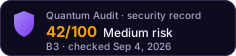
How is this score calculated? → Medium Risk
Executive SummaryAI Copilot

The B3Token contract implements a standard ERC20 token with OpenZeppelin extensions for permit, votes, and access control. The contract defines a fixed maximum supply and specific roles for minting and administration. Key design choices include chain-ID dependent initial minting and hardcoded owner/deployer addresses. The overall technical implementation is robust, leveraging well-audited libraries.

1 Medium1 Low
Volume 24h
$102.4K
Liquidity
$543.3K
Price
$0.0004573
Token Age
1y
Top 10 Holders
62.2%

Security Findings

Medium

Conditional Initial Supply Minting Based on Chain ID

M-01The contract's constructor includes a conditional statement `if (block.chainid == BASE_CHAIN_ID)` to mint the entire `MAX_SUPPLY` to `_DEPLOYER_ADDRESS`. If the contract is deployed on a chain other than `BASE_CHAIN_ID` (8453), this initial minting will not occur. In such a scenario, the `MINTER_ROLE` would then be able to mint up to the `MAX_SUPPLY` to any address, effectively controlling the entire initial distribution. This behavior, while potentially intentional, significantly alters the token's initial supply dynamics based on the deployment environment and could lead to unexpected or undesirable distribution if not fully understood and managed. (7.4 Economic, 7.8 Operations)
IssueThe contract's constructor includes a conditional statement `if (block.chainid == BASE_CHAIN_ID)` to mint the entire `MAX_SUPPLY` to `_DEPLOYER_ADDRESS`. If the contract is deployed on a chain other than `BASE_CHAIN_ID` (8453), this initial minting will not occur. In such a scenario, the `MINTER_ROLE` would then be able to mint up to the `MAX_SUPPLY` to any address, effectively controlling the entire initial distribution. This behavior, while potentially intentional, significantly alters the token's initial supply dynamics based on the deployment environment and could lead to unexpected or undesirable distribution if not fully understood and managed. (7.4 Economic, 7.8 Operations)
FixClearly document the intended deployment strategy and the implications of deploying on chains other than `BASE_CHAIN_ID`. If the token is strictly intended for Base with a fixed initial distribution, consider adding a `require(block.chainid == BASE_CHAIN_ID)` in the constructor to prevent accidental deployment on other chains without the intended initial mint. If multi-chain deployment with varied initial distribution is intended, ensure the `MINTER_ROLE` is appropriately secured and its initia…
StatusUnresolved
Low

Hardcoded Critical Addresses

L-01The `_OWNER_ADDRESS` (assigned `DEFAULT_ADMIN_ROLE`) and `_DEPLOYER_ADDRESS` (recipient of initial supply on Base) are defined as `internal constant` variables. This means these addresses are fixed at deployment and cannot be changed or updated after the contract is live. While common for initial setup, it introduces a single point of failure: if the private keys for these addresses are lost or compromised, the administrative control (`DEFAULT_ADMIN_ROLE`) and the initial token holdings (`_DEPLOYER_ADDRESS`) become permanently inaccessible or vulnerable. (7.3 Access Control, 7.8 Operations)
IssueThe `_OWNER_ADDRESS` (assigned `DEFAULT_ADMIN_ROLE`) and `_DEPLOYER_ADDRESS` (recipient of initial supply on Base) are defined as `internal constant` variables. This means these addresses are fixed at deployment and cannot be changed or updated after the contract is live. While common for initial setup, it introduces a single point of failure: if the private keys for these addresses are lost or compromised, the administrative control (`DEFAULT_ADMIN_ROLE`) and the initial token holdings (`_DEPLOYER_ADDRESS`) become permanently inaccessible or vulnerable. (7.3 Access Control, 7.8 Operations)
FixFor long-term operational security, consider using a proxy pattern or a mechanism to allow the `DEFAULT_ADMIN_ROLE` to be transferred to a new address (e.g., a multi-signature wallet or a governance contract). If hardcoding is desired, ensure that the private keys associated with `_OWNER_ADDRESS` and `_DEPLOYER_ADDRESS` are secured with the highest level of protection (e.g., hardware wallets, multi-sig setups) and that robust recovery procedures are in place.
StatusUnresolved

Category Ratings

TechnicalLow8/10

The B3Token contract utilizes well-audited OpenZeppelin libraries for its ERC20, ERC20Permit, ERC20Votes, and AccessControl implementations, contributing to a robust foundation (7.1 Architecture, 7.2 Code Security). The `burnFrom` function correctly handles allowance checks before an `unchecked` block, preventing underflow. Access control roles (`DEFAULT_ADMIN_ROLE`, `MINTER_ROLE`) are clearly defined and enforced for sensitive operations like minting and burning (7.3 Access Control). No reentrancy or integer overflow/underflow vulnerabilities were identified.

GovernanceMedium4/10

The contract establishes a `MAX_SUPPLY` of 100 billion tokens, enforced by the `ERC20Votes` extension, preventing over-minting (7.4 Economic). The `DEFAULT_ADMIN_ROLE` is assigned to a hardcoded `_OWNER_ADDRESS`, centralizing administrative control (7.5 Governance). A significant design decision is the conditional initial minting of the entire supply to `_DEPLOYER_ADDRESS` only if deployed on the `BASE_CHAIN_ID`. If deployed on other chains, the `MINTER_ROLE` would control the initial distribution up to `MAX_SUPPLY`, which could lead to unexpected tokenomics if not explicitly intended (7.4 Economic, 7.8 Operations).

UpgradesHigh3/10

The B3Token contract is not designed with an upgrade mechanism (e.g., proxy pattern). This simplifies its architecture by removing upgrade-related complexities and risks (7.7 Upgrades). Any future changes to the contract logic would require a new deployment and migration of assets, which is a standard approach for non-upgradeable tokens.

Security Checklist

Contract VerifiedPass
Ownership Renounced?
No Mint FunctionFail
Liquidity LockedFail
Not a ProxyPass

Holder Composition

6.8% in wallets55.4% in contracts
Effective Concentration28.9%

Share held by contracts — treasury, vesting, bridge or staking — is discounted against share held by wallets when the score is computed: a contract cannot decide to sell the way an anonymous holder can, though it can still be drained or voted to sell. Effective concentration is the figure the risk score is actually calculated from.

Liquidity Depth

Show 4 more pairsShow less

The risk score reads depth across every pair. The volume figure and the volume-to-liquidity ratio elsewhere on this page describe only the pair this audit analysed, so the two are not directly comparable.

LP Distribution

Top-1 Unlocked Holder43.4%
Top-3 Unlocked98.9%

Key Addresses

Deployer
0x8d91…a455
Unlocked LP Held By
0xfa2b…52bb0x375f…94910x7234…dece0x5c3b…25af0xb111…055c

No privileged address appears among these holders: the unlocked liquidity sits with independent providers, not with the deployer.

What Raised This Score

  • Ownership status UNKNOWN (owner could not be resolved)
  • Mintable supply — no cap found, dilution unbounded
  • Top-10 concentration > 20% (62.2% total → 28.9% effective; 6.8% in EOAs, 55.4% in contracts — mild)
  • Liquidity not locked, but no owner/deployer address holds LP — market-depth risk, not rug risk
  • LP top3 unlocked holders = 98.9% (independent LP — depth risk, pool = 98% of DEX liquidity)
  • 1 Medium finding(s) from audit
  • 1 Low finding(s) from audit

Each factor is an on-chain fact recorded at the time of this analysis. The score is computed from them by a deterministic function, so the same contract returns the same score for anyone who runs the audit. How scores are computed

Frequently Asked Questions

Is B3 a scam?

Based on automated analysis, B3 scores 63/100 (High Risk) on our risk scale. No honeypot was detected, but always verify independently before investing.

Is B3 safe to buy?

Our scanner flagged a risk score of 63/100. Ownership has not been renounced, which is a risk factor. DYOR before purchasing any token.

Has B3 been audited?

The contract has not been verified on-chain. Verification is not the same as a full security audit. Use Quantum Audit's free tool to run a deeper analysis of the contract code.

Related Audits

LienFi (LFI)Medium RiskMey Network (MEY)Medium RiskDerive (DRV)Medium RiskVenice Deity (VVVEITY)Medium Risktokenbot (CLANKER)Medium RiskAerodrome Finance (AERO)Medium Risk

Would You Like a More Detailed Audit of B3?

Our AI-powered scanner gives you a deeper, real-time smart contract analysis — free, with every scoring factor shown.

Get Detailed Audit