
Quantum Audit Logo

Is Arbitrum Safe?

On-chain security analysis — is it a scam or legit?

Is this your token? Publish your own audit on this page →

Arbitrum ARB
0xb507…4ad1
Ethereum Not verifiedLast checked 2d ago 1 audit on record
Executive SummaryAI Copilot

The L1ArbitrumToken contract serves as the L1 representation of the Arbitrum token, utilizing OpenZeppelin's upgradeable ERC20 standard and integrating with Arbitrum bridge components. The audit identified a critical dependency on the security and integrity of external bridge contracts for token minting, burning, and L2 registration. While the contract adheres to good coding practices and uses a secure upgradeability pattern, the significant trust assumptions on external systems elevate the overall risk. Minor issues related to public function access and design limitations were also noted.
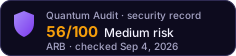

1 Critical1 Medium1 Low1 Informational
Volume 24h
$64.5K
Liquidity
$32.7K
Price
$0.1346
Token Age
3y
Top 10 Holders
61.4%

Security Findings

Critical

Critical Trust Assumptions on External Bridge Contracts

C-01The `L1ArbitrumToken` contract's core functionality, including `bridgeMint` and `bridgeBurn`, is entirely dependent on the `arbOneGateway` contract. Similarly, `registerTokenOnL2` relies on `novaGateway` and `novaRouter`. These external contracts are critical for the token's supply control and L2 integration. A compromise or malfunction of any of these trusted external bridge components would directly lead to unauthorized minting, burning, or manipulation of the token's L2 registration, severely impacting the token's integrity and value (7.6 External).
IssueThe `L1ArbitrumToken` contract's core functionality, including `bridgeMint` and `bridgeBurn`, is entirely dependent on the `arbOneGateway` contract. Similarly, `registerTokenOnL2` relies on `novaGateway` and `novaRouter`. These external contracts are critical for the token's supply control and L2 integration. A compromise or malfunction of any of these trusted external bridge components would directly lead to unauthorized minting, burning, or manipulation of the token's L2 registration, severely impacting the token's integrity and value (7.6 External).
FixEnsure that the `arbOneGateway`, `novaGateway`, and `novaRouter` contracts are rigorously audited, highly secure, and managed with robust access controls (e.g., multisig, time-locks). Implement continuous monitoring for any suspicious activity originating from or targeting these addresses. Consider a multi-layered security approach for these critical components.
StatusUnresolved
Medium

Public `registerTokenOnL2` Allows Arbitrary Registrations

M-01The `registerTokenOnL2` function is public and payable, allowing any external address to call it and initiate a token registration on L2. While this does not directly affect the L1 token balance, a malicious actor could repeatedly call this function with arbitrary or suboptimal `RegistrationParams`, incurring gas costs for the transaction and potentially registering the token with undesirable parameters on L2. This could lead to griefing attacks or inefficient L2 setups, consuming network resources and potentially causing confusion (7.3 Access Control, 7.4 Economic).
IssueThe `registerTokenOnL2` function is public and payable, allowing any external address to call it and initiate a token registration on L2. While this does not directly affect the L1 token balance, a malicious actor could repeatedly call this function with arbitrary or suboptimal `RegistrationParams`, incurring gas costs for the transaction and potentially registering the token with undesirable parameters on L2. This could lead to griefing attacks or inefficient L2 setups, consuming network resources and potentially causing confusion (7.3 Access Control, 7.4 Economic).
FixConsider restricting access to the `registerTokenOnL2` function to a trusted entity, such as a governance contract or a multisig wallet. This would prevent arbitrary calls and ensure that L2 registrations are performed only by authorized parties with carefully chosen parameters.
StatusUnresolved
Low

`isArbitrumEnabled` Function Design Limitation

L-01The `isArbitrumEnabled` function includes a `require(shouldRegisterGateway, "L1ArbitrumToken: not expecting gateway registration");` statement. Since `shouldRegisterGateway` is a private variable that is only temporarily set to `true` within the `registerTokenOnL2` function, `isArbitrumEnabled` will almost always revert when called externally. This design makes the `external view` function effectively unusable as a public informational query, which might be counter-intuitive for integrators or users expecting to check the token's Arbitrum enablement status (7.1 Architecture, 7.2 Code Security).
IssueThe `isArbitrumEnabled` function includes a `require(shouldRegisterGateway, "L1ArbitrumToken: not expecting gateway registration");` statement. Since `shouldRegisterGateway` is a private variable that is only temporarily set to `true` within the `registerTokenOnL2` function, `isArbitrumEnabled` will almost always revert when called externally. This design makes the `external view` function effectively unusable as a public informational query, which might be counter-intuitive for integrators or users expecting to check the token's Arbitrum enablement status (7.1 Architecture, 7.2 Code Security).
FixIf `isArbitrumEnabled` is intended to be a publicly queryable status, consider removing the `shouldRegisterGateway` check or modifying the logic to reflect a persistent state. If its current behavior is intentional for internal bridge logic, consider making it `internal` or adding comments to clarify its specific use case and limitations.
StatusUnresolved
Info

External Call in `transferAndCall` Function

I-01The `transferAndCall` function performs an external call to the `onTokenTransfer` function of the recipient contract if the recipient is a contract. While the token transfer (`super.transfer`) occurs before the external call, adhering to the Checks-Effects-Interactions pattern, any external call introduces a potential reentrancy vector for other functions within the `L1ArbitrumToken` contract or other interacting protocols. This is a standard pattern for `transferAndCall` functionality (7.2 Code Security, 7.6 External).
IssueThe `transferAndCall` function performs an external call to the `onTokenTransfer` function of the recipient contract if the recipient is a contract. While the token transfer (`super.transfer`) occurs before the external call, adhering to the Checks-Effects-Interactions pattern, any external call introduces a potential reentrancy vector for other functions within the `L1ArbitrumToken` contract or other interacting protocols. This is a standard pattern for `transferAndCall` functionality (7.2 Code Security, 7.6 External).
FixNo direct vulnerability is identified, as the pattern is correctly implemented. However, it is crucial for any contract interacting with `L1ArbitrumToken` via `transferAndCall` to be aware of this external call and ensure its own functions are reentrancy-safe, especially if they rely on the `L1ArbitrumToken`'s state after the transfer.
StatusUnresolved

Category Ratings

TechnicalLow7/10

The L1ArbitrumToken contract is an upgradeable ERC20 token leveraging OpenZeppelin's `ERC20Upgradeable` and `ERC20PermitUpgradeable` for robust token functionality and standard upgradeability. It also includes a `TransferAndCallToken` extension, allowing for atomic token transfers and external contract calls. A critical aspect is its reliance on external Arbitrum bridge components (`arbOneGateway`, `novaGateway`, `novaRouter`) for `bridgeMint`, `bridgeBurn`, and L2 token registration, which introduces significant trust assumptions (7.6). The `transferAndCall` function correctly implements a Checks-Effects-Interactions pattern, mitigating reentrancy risks on the token transfer itself (7.2).

GovernanceHigh1/10

The economic model of the `L1ArbitrumToken` is primarily driven by its minting and burning mechanisms, which are exclusively controlled by the `arbOneGateway` contract (7.4). This centralizes control over the token supply to a single external entity, making its security paramount. The `registerTokenOnL2` function, while public, allows anyone to initiate L2 registration processes by paying associated gas and value, potentially leading to inefficient or griefing registrations (7.5). The `initialize` function ensures proper setup of critical bridge addresses upon deployment, preventing re-initialization (7.3).

UpgradesHigh1/10

The contract utilizes the Transparent Upgradeable Proxy pattern with OpenZeppelin's `Initializable` base, ensuring a secure and well-understood upgrade mechanism (7.7). The constructor correctly calls `_disableInitializers()` to prevent re-initialization of the implementation contract. The `initialize` function is properly guarded by the `initializer` modifier, allowing it to be called only once. This setup provides a robust framework for future upgrades without affecting existing state or logic.

Security Checklist

Contract VerifiedPass
Ownership Renounced?
No Mint FunctionPass
Liquidity LockedFail
Not a ProxyFail
HoneypotNoneBuy Tax0.0%Sell Tax0.0%

Proxy Upgrade Controls

Proxy TypeEip1967 Transparent
AdminOZ ProxyAdmin
ImplementationVerified source
Upgrades (30d)0 · stable

Holder Composition

61.4% in wallets0.0% in contracts
Effective Concentration61.4%

Share held by contracts — treasury, vesting, bridge or staking — is discounted against share held by wallets when the score is computed: a contract cannot decide to sell the way an anonymous holder can, though it can still be drained or voted to sell. Effective concentration is the figure the risk score is actually calculated from.

Liquidity Depth

The risk score reads depth across every pair. The volume figure and the volume-to-liquidity ratio elsewhere on this page describe only the pair this audit analysed, so the two are not directly comparable.

LP Distribution

Top-1 Unlocked Holder98.8%
Top-3 Unlocked100.0%

Key Addresses

Deployer
0x1c8d…d72f
Unlocked LP Held By
0xe204…dad50xc08e…10e7

No privileged address appears among these holders: the unlocked liquidity sits with independent providers, not with the deployer.

What Raised This Score

  • Ownership status UNKNOWN (owner could not be resolved)
  • Proxy contract (upgradeable — admin can replace logic)
  • Top-10 concentration > 50% (61.4% total → 61.4% effective; 61.4% in EOAs, 0.0% in contracts — heavy)
  • Liquidity not locked, but no owner/deployer address holds LP — market-depth risk, not rug risk
  • LP top1 unlocked holder = 98.8% (independent LP — depth risk, pool = 48% of DEX liquidity)
  • LP top3 unlocked holders = 100.0% (independent LP — depth risk, pool = 48% of DEX liquidity)
  • 1 Critical finding(s) from audit
  • 1 Medium finding(s) from audit
  • 1 Low finding(s) from audit

Each factor is an on-chain fact recorded at the time of this analysis. The score is computed from them by a deterministic function, so the same contract returns the same score for anyone who runs the audit. How scores are computed

Related Audits

Sustainable Aviation Fuel (SAF)High RiskHelix Token (HLX)High RiskEuler (EUL)High RiskPaxos Gold (PAXG)High RiskIlluvium (ILV)High RiskQuant (QNT)High Risk

Would You Like a More Detailed Audit of Arbitrum?

Our AI-powered scanner gives you a deeper, real-time smart contract analysis — free, with every scoring factor shown.

Get Detailed Audit