
The APYX token implementation contains critical logic flaws regarding fee handling and arithmetic operations. The contract attempts to send the entire contract balance to a fee wallet on every transfer, which is highly dangerous and likely to cause transaction failures or loss of funds. The audit covers 7.1 Architecture, 7.2 Code Security, 7.3 Access Control, 7.4 Economic, 7.5 Governance, 7.6 External, 7.7 Upgrades, 7.8 Operations.
On-chain security analysis — is it a scam or legit?
Is APYX Safe?
Not verified
This record has not gone through deep verification and is not being monitored. The score is a dated snapshot — the token’s risk can change at any time.Own this token? Put it under verification →The APYX token implementation contains critical logic flaws regarding fee handling and arithmetic operations.
Read the full analysis- Ownership status UNKNOWN
- Liquidity not locked
- Liquidity < $50k
- Top-10 concentration > 30%
Exact factors
- Ownership status UNKNOWN (owner could not be resolved)
- Liquidity NOT locked (100% of the pool) — who holds it cannot be verified
- Liquidity < $50k ($49,633 across 1 pairs — thin market)
- Top-10 concentration > 30% (36.0% total → 35.9% effective; 35.9% in EOAs, 0.1% in contracts; deployer/owner holds 35.8%)
Each factor is an on-chain fact recorded at the time of this analysis. The score is computed from them by a deterministic function, so the same contract returns the same score for anyone who runs the audit. How scores are computed
Security Checklist
as of audit · Nov 5Holders
as of audit · Nov 5, 2026- Contractstreasury, vesting, bridge, staking0.1%
- Walletsanonymous holders, free to sell35.9%
- Everyone else9,122 holders64.0%
How holder types affect the score
Share held by contracts — treasury, vesting, bridge or staking — is discounted against share held by wallets when the score is computed: a contract cannot decide to sell the way an anonymous holder can, though it can still be drained or voted to sell. Effective concentration is the figure the risk score is actually calculated from.
Holder balances as recorded by the audit of Nov 5, 2026
Liquidity
as of audit · Nov 5The risk score reads depth across every pair.
The LP tokens of the analysed pool are not locked or burned, so whoever holds them can withdraw that liquidity.
0xe085…faecSecurity Findings
HighWho holds the supply
The ten largest holders own 36.0% of supply. What remains: 35.9% in wallets, 0.1% in other contracts. The deployer/owner wallet itself holds 35.8%. A holder that also controls the contract can sell into its own liquidity. 9,132 holders in total.QA-HOLDERS
Issue
The ten largest holders own 36.0% of supply. What remains: 35.9% in wallets, 0.1% in other contracts. The deployer/owner wallet itself holds 35.8%. A holder that also controls the contract can sell into its own liquidity. 9,132 holders in total.
Fix
Watch the largest wallets that are not exchanges, pools or locks — those are the ones that can move the price.
Status
Acknowledged
MediumRedundant Code
Not confirmed by static analysis (the model's own reading of the source). The functions MultiSum and check are identical and serve no purpose for an ERC-20 token.M-01
Issue
Not confirmed by static analysis (the model's own reading of the source). The functions MultiSum and check are identical and serve no purpose for an ERC-20 token.
Fix
Remove unused and redundant code to reduce gas costs and attack surface.
Status
Unresolved
MediumUnsafe Fee Distribution
Not confirmed by static analysis (the model's own reading of the source). The transfer functions call feeWallet.send(value = self.balance) on every transfer. This will cause all transfers to fail if the contract has insufficient ETH or if the feeWallet is not a payable contract, effectively bricking the token.M-02
Issue
Not confirmed by static analysis (the model's own reading of the source). The transfer functions call feeWallet.send(value = self.balance) on every transfer. This will cause all transfers to fail if the contract has insufficient ETH or if the feeWallet is not a payable contract, effectively bricking the token.
Fix
Remove the fee distribution logic or implement a standard fee-on-transfer mechanism that only transfers a percentage of the token amount, not the contract's ETH balance.
Status
Unresolved
MediumArithmetic Underflow in MultiSum
Not confirmed by static analysis (the model's own reading of the source). The expression 'num1 - num5 / num6' in MultiSum does not check if num1 is greater than the result of the division, leading to potential underflow errors in Vyper.M-03
Issue
Not confirmed by static analysis (the model's own reading of the source). The expression 'num1 - num5 / num6' in MultiSum does not check if num1 is greater than the result of the division, leading to potential underflow errors in Vyper.
Fix
Add explicit checks to ensure num1 >= (num5 / num6) before subtraction.
Status
Unresolved
MediumUnprotected External Call
Not confirmed by static analysis (the model's own reading of the source). The feeWallet address is not restricted, allowing any address to be set if a setter existed, or potentially causing issues if the address is a malicious contract.M-04
Issue
Not confirmed by static analysis (the model's own reading of the source). The feeWallet address is not restricted, allowing any address to be set if a setter existed, or potentially causing issues if the address is a malicious contract.
Fix
Validate the feeWallet address and ensure it implements the expected interface.
Status
Unresolved
MediumLiquidity not locked
0.0% of the pool's LP is burned or time-locked. 100.0% is held, unlocked, by 1 address(es) other than the owner/deployer. One of them — a contract, 0xe085…faec — holds 100.0% and can remove that share at once; who controls it is not visible on-chain, so it is not treated as an independent provider. Some pools are concentrated-liquidity (V3/V4) positions; shares above are by position as GoPlus reports them.QA-LIQUIDITY
Issue
0.0% of the pool's LP is burned or time-locked. 100.0% is held, unlocked, by 1 address(es) other than the owner/deployer. One of them — a contract, 0xe085…faec — holds 100.0% and can remove that share at once; who controls it is not visible on-chain, so it is not treated as an independent provider. Some pools are concentrated-liquidity (V3/V4) positions; shares above are by position as GoPlus reports them.
Fix
Check the lock's end date and beneficiary on the locker's own page before relying on it.
Status
Acknowledged
LowLack of Zero Address Validation
Not confirmed by static analysis (the model's own reading of the source). The transfer functions do not prevent transfers to the zero address.L-01
Issue
Not confirmed by static analysis (the model's own reading of the source). The transfer functions do not prevent transfers to the zero address.
Fix
Add 'assert _to != empty(address)' to prevent accidental burning of tokens.
Status
Unresolved
InfoNot listed by any independent source
9,132 holders. Not listed by CoinGecko or any exchange GoPlus tracks. Nothing independent confirms who is behind this token, so every power its contract grants is scored at face value.QA-IDENTITY
Issue
9,132 holders. Not listed by CoinGecko or any exchange GoPlus tracks. Nothing independent confirms who is behind this token, so every power its contract grants is scored at face value.
Fix
Match the contract address against the project's official channels before trading.
Status
Acknowledged
InfoThe market for this token
Liquidity $50K (DexScreener, all pools). 24h trading volume $486K (DexScreener, all pools).QA-MARKET
Issue
Liquidity $50K (DexScreener, all pools). 24h trading volume $486K (DexScreener, all pools).
Fix
Size any position to the liquidity and daily volume shown — they set how much you can sell and at what price.
Status
Acknowledged
InfoAsset class: Project token
A token issued by a project for use, governance or fundraising. Scored on its contract and market facts. The class itself adds no points; the contract and market facts decide the score. Basis: no class-specific evidence. Tokenomics — Supply: fixed — the contract has no mint function. Control: an owner that could not be resolved. Code: not upgradeable (no proxy). Fees: no buy or sell tax. Market: $50K of DEX liquidity across 1 pools. Launch: 13 days of market history.QA-PROFILE
Issue
A token issued by a project for use, governance or fundraising. Scored on its contract and market facts. The class itself adds no points; the contract and market facts decide the score. Basis: no class-specific evidence. Tokenomics — Supply: fixed — the contract has no mint function. Control: an owner that could not be resolved. Code: not upgradeable (no proxy). Fees: no buy or sell tax. Market: $50K of DEX liquidity across 1 pools. Launch: 13 days of market history.
Fix
Check the project's own documentation for what the token is used for; this report covers what the contract allows.
Status
Acknowledged
InfoRecently launched — 13 days of market history
The token's oldest DEX pool is 13 days old. Age is not part of the risk score — a new token is not a risky one by default — but a short history means fewer trades and holder changes behind the facts in this report.QA-RECENT
Issue
The token's oldest DEX pool is 13 days old. Age is not part of the risk score — a new token is not a risky one by default — but a short history means fewer trades and holder changes behind the facts in this report.
Fix
Re-check ownership, liquidity and holder distribution as the token matures; those are the facts that move early.
Status
Acknowledged
Analysis
AI Copilotas of audit · Nov 5The architecture relies on an external fee wallet call within every transfer, which is prone to reentrancy and gas exhaustion. 7.1 Architecture shows a lack of separation between token logic and fee distribution. 7.2 Code Security identifies dangerous arithmetic in MultiSum. 7.6 External interactions are unconstrained, allowing potential DoS via the feeWallet.
7.4 Economic analysis shows no complex DeFi primitives, but the fee mechanism is fundamentally broken. 7.5 Governance is non-existent as ownership is burned at deployment. No economic incentives or governance structures are present.
7.7 Upgrades: The contract is not upgradeable. The ownership is burned, making the contract immutable. No upgrade risk exists.
The contract should be redeployed after removing the fee-on-transfer mechanism, which currently attempts to send the entire contract balance on every transaction.
The arithmetic functions should be audited for underflow risks and removed if they serve no purpose for the token's core functionality.
Contract & Record
Free for any token on the record. It links to this page and always shows the current score and the date it was checked.
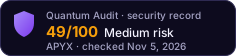
- Nov 5, 202649Medium
Score changes are recorded as dated snapshots — history is append-only and cannot be edited.
Frequently Asked Questions
What is the APYX contract address?
The APYX contract on Base is 0x36d539900653b5d721ecec9ca9d7bacf65f10290. Compare it with the address the project itself publishes before trading: other contracts can carry the same name and ticker.
Is APYX a scam?
Quantum Audit's risk score for APYX is 49/100 (Medium risk) as of Nov 5, 2026, computed by a deterministic function from on-chain facts — Contract verified: Verified; Mint: No mint; Liquidity lock: Not locked; Upgradeability: Fixed code; Honeypot: None found; Buy / sell tax: 0% / 0%. A score is a dated snapshot of those facts, not a guarantee; each one is listed on this page.
Is APYX liquidity locked?
Liquidity lock: Not locked (as of Nov 5, 2026). Total DEX liquidity: $49.6K.
Who holds APYX?
As of Nov 5, 2026, the 10 largest holders own 36.0% of the supply across 9,132 holders. The Holders section on this page shows who they are by holder type.
Would You Like a More Detailed Audit of APYX?
Our AI-powered scanner gives you a deeper, real-time smart contract analysis — free, with every scoring factor shown.
Get Detailed Audit Is this your token? Add your links and get it Verified