
Quantum Audit Logo
Launch App

Early-stage security check — honeypot & rug-pull analysis

Is zkFOL a Scam?

ZKFOLEthereum
Not verified This record has not gone through deep verification and is not being monitored. The score is a dated snapshot — the token’s risk can change at any time.Own this token? Put it under verification →
Last checked Nov 25, 2026 · 1 audit on recordNew Launch · 2d old
SummaryAI Copilot

The zkFOL contract is a standard ERC-20 token with extensive administrative controls over transfer logic, fees, and wallet/transaction limits.

Read the full analysis
What raised the score
  • A privileged address can replace a contract every transfer depends on
  • Owner can pause all transfers
  • A privileged address controls a switch that decides whether transfers go through
  • Owner can change the buy/sell tax
  • A privileged address can change transfer or wallet limits
  • Liquidity not locked
  • Top-10 concentration > 20%
Exact factors
  • A privileged address can replace a contract every transfer depends on
  • Owner can pause all transfers
  • A privileged address controls a switch that decides whether transfers go through
  • Owner can change the buy/sell tax
  • A privileged address can change transfer or wallet limits
  • Liquidity NOT locked (50% of the pool) — held by independent providers — market-depth risk
  • Top-10 concentration > 20% (86.2% total → 23.3% effective; 3.9% in EOAs, 48.4% in contracts; 33.8% burned, locked or in pools excluded; deployer/owner holds 22.4%)

How scores are computed

Early-stage analysis. This token has limited on-chain history (2d old). New tokens carry elevated risk — data may change rapidly. Always verify independently before investing.

Security Checklist

as of audit · Nov 254 of 7 checks passed
Contract verifiedVerified
OwnershipRetained
MintNo mint
Liquidity lockNot locked
UpgradeabilityFixed code
HoneypotNone found
Buy / sell tax4% / 4%

Holders

as of audit · Nov 25, 2026413 holders
48.4%Contracts3.9%28.5%Burned5.3%13.8%Everyone else
48.4%Contracts3.9%28.5%Burned5.3%13.8%
ContractsWalletsBurnedDEX poolsEveryone elseBubble area = share of supply
86.2%of supply sits with the top 10 holders
  • Contractstreasury, vesting, bridge, staking48.4%
  • Walletsanonymous holders, free to sell3.9%
  • Burnedout of circulation28.5%
  • DEX poolsthe pools' own liquidity5.3%
  • Everyone else403 holders13.8%
Effective concentrationwhat the score reads23.3%
How holder types affect the score

Share held by contracts — treasury, vesting, bridge or staking — is discounted against share held by wallets when the score is computed: a contract cannot decide to sell the way an anonymous holder can, though it can still be drained or voted to sell. Effective concentration is the figure the risk score is actually calculated from.

Holder balances as recorded by the audit of Nov 25, 2026

Liquidity

as of audit · Nov 25$179.3K
LP tokensNot locked

The LP tokens of the analysed pool are not locked or burned, so whoever holds them can withdraw that liquidity.

Analysed pool$179.3KShare of depth100.0%
LP Burned49.9%
LP Locked49.9% · Null Address
Top-1 Unlocked Holder49.4%
Top-3 Unlocked50.0%
Unlocked LP held by
0x59d7…c7fb0xd45d…dc1c0xb790…75c90x32d0…c7540xf385…5f85

No privileged address appears among these holders: the unlocked liquidity sits with independent providers, not with the deployer.

Security Findings

2 High3 Medium1 Low4 Info
High

Centralized Control Over Treasury Logic

The owner can change the treasury address via changeTreasury, which dictates where fees are sent.CP-03

Issue

The owner can change the treasury address via changeTreasury, which dictates where fees are sent. This allows the owner to redirect funds to an arbitrary address at any time.

Fix

Implement a timelock for the changeTreasury function or use a multi-signature wallet to manage the treasury address.

Status

Unresolved

High

Who holds the supply

The ten largest holders own 86.2% of supply. Of that, 28.5% burned, 5.3% in DEX pools — not holders that can sell, so excluded from the concentration score.QA-HOLDERS

Issue

The ten largest holders own 86.2% of supply. Of that, 28.5% burned, 5.3% in DEX pools — not holders that can sell, so excluded from the concentration score. What remains: 3.9% in wallets, 48.4% in other contracts. The deployer/owner wallet itself holds 22.4%. A holder that also controls the contract can sell into its own liquidity. 413 holders in total.

Fix

Watch the largest wallets that are not exchanges, pools or locks — those are the ones that can move the price.

Status

Acknowledged

Medium

Administrative Control Over Transfer Functionality

The owner can toggle transfer restrictions (max wallet/transaction limits) and swap functionality.CP-05

Issue

The owner can toggle transfer restrictions (max wallet/transaction limits) and swap functionality. This effectively allows the owner to freeze or restrict user transactions.

Fix

Restrict the ability to toggle these switches or require a governance vote for changes to critical transfer logic.

Status

Unresolved

Medium

Arbitrary Fee Modification

The owner can modify buy and sell fees at any time, potentially setting them to high values that impact user liquidity and trading.CP-07

Issue

The owner can modify buy and sell fees at any time, potentially setting them to high values that impact user liquidity and trading.

Fix

Set a hard-coded maximum fee limit that the owner cannot exceed, and implement a timelock for any fee adjustments.

Status

Unresolved

Medium

Liquidity not locked

49.9% of the pool's LP is burned or time-locked. 49.9% of the LP tokens were sent to a burn address — that liquidity can never be withdrawn by anyone.QA-LIQUIDITY

Issue

49.9% of the pool's LP is burned or time-locked. 49.9% of the LP tokens were sent to a burn address — that liquidity can never be withdrawn by anyone. 50.1% is held, unlocked, by 2 address(es) other than the owner/deployer. No single one holds a majority: their exits thin the market rather than hand anyone the pool.

Fix

Check the lock's end date and beneficiary on the locker's own page before relying on it.

Status

Acknowledged

Low

Centralized Control Over Transaction Limits

The owner can adjust the maximum wallet and transaction amounts, allowing for dynamic control over how much users can hold or trade.CP-08

Issue

The owner can adjust the maximum wallet and transaction amounts, allowing for dynamic control over how much users can hold or trade.

Fix

Define these limits as constants or use a decentralized mechanism to adjust them based on community consensus.

Status

Unresolved

Info

Not listed by any independent source

413 holders. Not listed by CoinGecko or any exchange GoPlus tracks.QA-IDENTITY

Issue

413 holders. Not listed by CoinGecko or any exchange GoPlus tracks.

Fix

Match the contract address against the project's official channels before trading.

Status

Acknowledged

Info

The market for this token

Liquidity $179K (DexScreener, all pools). 24h trading volume $107K (DexScreener, all pools).QA-MARKET

Issue

Liquidity $179K (DexScreener, all pools). 24h trading volume $107K (DexScreener, all pools).

Fix

Size any position to the liquidity and daily volume shown — they set how much you can sell and at what price.

Status

Acknowledged

Info

Asset class: Project token

A token issued by a project for use, governance or fundraising.QA-PROFILE

Issue

A token issued by a project for use, governance or fundraising. Basis: no class-specific evidence. Tokenomics — Supply: fixed — the contract has no mint function. Control: a single wallet (EOA). Code: not upgradeable (no proxy). Fees: 4% on buy, 4% on sell. Market: $179K of DEX liquidity across 1 pools. Launch: 2 days of market history.

Fix

Check the project's own documentation for what the token is used for; this report covers what the contract allows.

Status

Acknowledged

Info

Recently launched — 2 days of market history

The token's oldest DEX pool is 2 days old.QA-RECENT

Issue

The token's oldest DEX pool is 2 days old.

Fix

Re-check ownership, liquidity and holder distribution as the token matures; those are the facts that move early.

Status

Acknowledged

Analysis

AI Copilotas of audit · Nov 25
Executive SummaryWhat the contract is and what the review found

The zkFOL contract is a standard ERC-20 token with extensive administrative controls over transfer logic, fees, and wallet/transaction limits. While the core ERC-20 implementation is standard, the contract grants the owner significant power to modify token economics and restrict user transfers at will. The protocol relies on centralized trust in the owner address.

Technical6/10Medium risk

The contract implements standard ERC-20 functionality with robust internal accounting. 7.1 Architecture follows a monolithic pattern, while 7.2 Code Security is maintained through standard OpenZeppelin-like patterns. 7.3 Access Control is strictly enforced via the Ownable modifier. 7.6 External interactions are limited to the treasury address, which is configurable.

Governance3/10High risk

7.4 Economic and 7.5 Governance aspects are highly centralized. The owner has unilateral control over 7.4 Economic parameters, including buy/sell fees and swap thresholds. This allows for potential rug-pull scenarios or arbitrary economic manipulation. Governance is non-existent, relying entirely on the owner's EOA.

Upgrades6/10Medium risk

7.7 Upgrades are not supported as the contract is not a proxy. 7.8 Operations are limited to the owner's ability to claim stuck tokens and adjust parameters. The lack of upgradeability ensures the logic remains constant, though it prevents fixing issues without a migration.

Final RecommendationWhat to do about this score

The protocol should consider transitioning ownership to a multi-signature wallet or a decentralized governance contract to mitigate the risks associated with a single point of failure.

Implementing a timelock on sensitive administrative functions would provide transparency and protection for token holders against sudden changes to transfer rules or fees.

Contract & Record

1 audit on record
TypeVault, Token
NetworkEthereum
Token age2d
Contract0x660e…e587
Deployer0x254d…f1f5
Badge for your website
zkFOL security record badge

Free for any token on the record. It links to this page and always shows the current score and the date it was checked.

Audit History
  1. Nov 25, 202675High

Score changes are recorded as dated snapshots — history is append-only and cannot be edited.

Frequently Asked Questions

What is the ZKFOL contract address?

The zkFOL contract on Ethereum is 0x660ef3737ca6bf60a192b6561b1d246a98fbe587. Compare it with the address the project itself publishes before trading: other contracts can carry the same name and ticker.

Is zkFOL a scam?

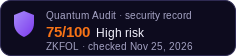
Quantum Audit's risk score for zkFOL is 75/100 (High risk) as of Nov 25, 2026, computed by a deterministic function from on-chain facts — Contract verified: Verified; Ownership: Retained; Mint: No mint; Liquidity lock: Not locked; Upgradeability: Fixed code; Honeypot: None found; Buy / sell tax: 4% / 4%. A score is a dated snapshot of those facts, not a guarantee; each one is listed on this page.

Is ZKFOL liquidity locked?

Liquidity lock: Not locked (as of Nov 25, 2026). Total DEX liquidity: $179.3K.

Who holds ZKFOL?

As of Nov 25, 2026, the 10 largest holders own 86.2% of the supply across 413 holders. The Holders section on this page shows who they are by holder type.

Would You Like a More Detailed Audit of zkFOL?

This token is brand new. Run a deeper AI-powered analysis of the contract code — free and instant.

Get Detailed Audit Is this your token? Add your links and get it Verified