Quantum Audit Logo
BNB Chain · Smart Contract Security · Updated Jul 24, 2026

Is WebKey DAO 2.0 Safe? WKEYDAO2

On-chain security analysis — is it a scam or legit?

Contract 0xe0a2…b82e DexScreener ↗
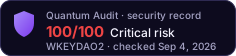
Critical Risk How is this score calculated? →
Volume 24h
$340.4K
Liquidity
$26.59M
Price
$1.0330
Token Age
6mo
Top 10 Holders
99.6%

Security Checklist

Contract VerifiedPass
Ownership RenouncedUnknown
No Mint FunctionFail
Liquidity LockedPass
Not a ProxyPass

Audit History

Jul 2367Jul 23100

Every audit run adds a dated snapshot — history is append-only and cannot be edited.

Audit Summary

The wkeyDAO2 contract implements an ERC20 token with EIP-2612 permit functionality and OpenZeppelin's AccessControl. While it utilizes SafeMath for arithmetic operations and correctly implements the permit mechanism, a critical vulnerability exists due to a truncated access control modifier. Additionally, the contract uses an outdated Solidity compiler version and lacks an upgrade mechanism, posing further risks. Centralized control over administrative roles is also noted.

Final Recommendation: Address the critical issue of the truncated `onlyVault` modifier immediately by completing or removing it, as it poses a severe security risk. Consider upgrading the Solidity compiler to a more recent version (0.8.x or higher) to benefit from native overflow checks and improved security features. Evaluate the need for an upgradeability mechanism to allow for future bug fixes or feature enhancements without requiring a full redeployment. Clearly define and implement the intended access control for all sensitive functions, especially those related to token minting, to ensure proper decentralization or controlled administration.

Category Ratings

TechnicalMedium
4/10

The contract demonstrates a foundational understanding of ERC20 standards and integrates OpenZeppelin's AccessControl and SafeMath libraries, mitigating common integer overflow/underflow risks (7.2 Code Security). The EIP-2612 permit functionality is correctly implemented, enhancing user experi

GovernanceHigh
1/10

The contract utilizes OpenZeppelin's AccessControl, with the deployer assigned the `DEFAULT_ADMIN_ROLE` in the `VaultOwned` constructor, centralizing significant administrative power (7.5 Governance). A `MINT` role is defined, suggesting potential for centralized token issuance, though its appl

UpgradesHigh
3/10

The contract is deployed as a standard, non-upgradeable contract (7.7 Upgrades). This means that once deployed, its logic cannot be modified. Any discovered vulnerabilities, bugs, or desired feature enhancements would necessitate a complete redeployment of the contract and a complex migration of use

LP Distribution

Top-1 Unlocked Holder100.0%
Top-3 Unlocked100.0%

What Raised This Score

Each factor is an on-chain fact recorded at the time of this analysis. The score is computed from them by a deterministic function, so the same contract returns the same score for anyone who runs the audit. How scores are computed

Security Findings

1 Critical 3 Medium 1 Low 1 Info
C-01CriticalUnresolved

Incomplete `onlyVault` Modifier Leads to Critical Access Control Flaw

The `onlyVault` modifier in the `VaultOwned` contract is truncated (`require(ha...`). This incomplete code will either cause any function using this modifier to permanently revert upon deployment (if 'ha' is an undeclared variable or invalid expression) or, more critically, could be interpreted by the compiler in a way that bypasses the intended access control entirely, allowing unauthorized execution of restricted functions. This represents a severe vulnerability, compromising the integrity of any function it protects.

Recommendation: Complete the `onlyVault` modifier with its intended logic. Ensure the `require` statement correctly validates the caller's address against a designated vault address or role. If this modifier is not intended for use, it should be removed to prevent unexpected behavior.
M-01MediumUnresolved

Outdated Solidity Compiler Version

The contract is compiled with Solidity version 0.7.5. While `SafeMath` is used to prevent integer overflows/underflows, newer compiler versions (0.8.x and above) include native overflow/underflow checks, which can simplify code and potentially reduce gas costs by removing the need for `SafeMath` library calls. Additionally, older compiler versions may have undiscovered bugs or lack optimizations and security features present in more recent releases.

Recommendation: Consider upgrading the Solidity compiler to a more recent stable version (e.g., 0.8.x or higher). This would allow for the removal of `SafeMath` and benefit from native overflow checks, improving code readability and potentially security. Thoroughly test the contract after any compiler upgrade.
M-02MediumUnresolved

Centralized Control Over Critical Roles

The `DEFAULT_ADMIN_ROLE` is assigned to the contract deployer in the `VaultOwned` constructor. This grants the deployer significant control over the contract's access control, including the ability to grant and revoke other roles. A `MINT` role is defined but not explicitly used in the provided `ERC20` snippet to restrict the `_mint` function. If minting is intended to be restricted, this centralization of administrative power, especially if the `MINT` role is also controlled by a single entity, introduces a single point of failure and a high degree of trust in the deployer.

Recommendation: Implement a multi-signature wallet or a more decentralized governance mechanism for managing critical roles like `DEFAULT_ADMIN_ROLE` and `MINT`. If the `MINT` role is intended to restrict token minting, ensure it is properly applied to the `_mint` function. Clearly document the responsibilities and powers associated with each role.
M-03MediumUnresolved

Lack of Upgradeability

The contract is deployed as a standard, non-upgradeable contract. This design choice means that the contract's logic is immutable once deployed. Any future bug fixes, security patches, or desired feature enhancements would require deploying an entirely new contract and migrating all existing users and assets, which is a complex, costly, and risky operation. This lack of flexibility can hinder long-term maintenance and responsiveness to unforeseen issues.

Recommendation: For long-lived protocols, consider implementing an upgradeability pattern (e.g., UUPS or Transparent Proxy) to allow for future contract logic updates. If upgradeability is not desired, ensure the contract is thoroughly audited and tested to minimize the risk of needing a redeployment. Clearly communicate the immutability to users.
L-01LowUnresolved

Permit Function Susceptible to Front-Running

The `permit` function, while correctly implemented according to EIP-2612, is inherently susceptible to front-running. A malicious actor could observe a pending `permit` transaction and front-run it. For example, if the `owner` has an existing allowance for the `spender`, the `spender` could front-run with a `transferFrom` call to drain funds before the `permit` transaction updates the allowance. While the `nonces` mechanism prevents replay attacks, it does not fully mitigate front-running risks related to allowance manipulation.

Recommendation: Educate users about the potential for front-running when using the `permit` function. While this is a known characteristic of EIP-2612 and not a specific implementation flaw, users should be aware of the risks, especially when interacting with untrusted or high-latency networks. Consider using transaction relays that can help mitigate some front-running vectors.
I-01InformationalUnresolved

Unused `MINT` Role Definition

The `MINT` role is defined in the `VaultOwned` contract (`bytes32 public constant MINT = keccak256("MINT");`) but is not utilized in the provided `ERC20` contract snippet to restrict the `_mint` function. If the intention is to control who can mint tokens, this role should be enforced on the `_mint` function or a wrapper around it.

Recommendation: If the `MINT` role is intended to restrict token minting, ensure it is applied to the `_mint` function (or a public/external function that calls `_mint`) using `onlyRole(MINT)`. If the role is not intended for use, consider removing its definition to avoid confusion and unnecessary code.

Would You Like a More Detailed Audit of WebKey DAO 2.0?

Our AI-powered scanner gives you a deeper, real-time smart contract analysis — free, no signup required.

Get Detailed Audit
Run Free Audit →