

Quantum Audit Logo

Is GameStop a Scam?

Early-stage security check — honeypot & rug-pull analysis

Is this your token? Publish your own audit on this page →

GameStop GMEB
0x46ce…b15c
BNB Chain Not verifiedLast checked 3d ago 1 audit on record New Launch · 2d old
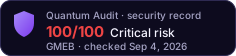
How is this score calculated? → Critical Risk
Executive SummaryAI Copilot

The audit of the SecuritiesToken contract, an upgradeable ERC-20 token, revealed a robust architecture leveraging OpenZeppelin standards for access control and upgradeability. Key strengths include comprehensive role-based access control for critical functions and integration with compliance and pause mechanisms. However, the contract exhibits a high degree of centralization in the DEFAULT_ADMIN_ROLE, critical dependencies on external contracts, and the economic implications of its UI multiplier mechanism. Upgradeability also introduces inherent risks.

2 High2 Medium1 Low1 Informational
! Early-stage analysis. This token has limited on-chain history (2d old). New tokens carry elevated risk — data may change rapidly. Always verify independently before investing.
Volume 24h
$2.42M
Liquidity
$335.7K
Price
$19.3500
Token Age
2d
Top 10 Holders
79.9%

Security Findings

High

Centralized Control and Single Point of Failure

H-01The `DEFAULT_ADMIN_ROLE` holds extensive power, including setting token name/symbol/identifier, enabling/disabling mint/burn, and configuring critical external contracts (`ComplianceClient`, `PauseManagerClient`). This high degree of centralization means a compromise of the admin key could lead to full control over the token's functionality and potentially its economic parameters. While common for security tokens, this presents a significant operational risk (7.3 Access Control, 7.8 Operations).
IssueThe `DEFAULT_ADMIN_ROLE` holds extensive power, including setting token name/symbol/identifier, enabling/disabling mint/burn, and configuring critical external contracts (`ComplianceClient`, `PauseManagerClient`). This high degree of centralization means a compromise of the admin key could lead to full control over the token's functionality and potentially its economic parameters. While common for security tokens, this presents a significant operational risk (7.3 Access Control, 7.8 Operations).
FixConsider implementing a multi-signature wallet or a time-locked governance mechanism for the `DEFAULT_ADMIN_ROLE` to mitigate the risk of a single point of failure.
StatusUnresolved
High

Critical External Dependencies

H-02The contract relies on external `ComplianceClient` and `PauseManagerClient` contracts, whose addresses can be set by the `DEFAULT_ADMIN_ROLE`. A malicious or compromised external contract, or an incorrectly set address, could lead to a complete halt of token operations (via `PauseManagerClient`) or arbitrary restrictions on transfers (via `ComplianceClient`). This introduces significant external dependency risks (7.6 External, 7.8 Operations).
IssueThe contract relies on external `ComplianceClient` and `PauseManagerClient` contracts, whose addresses can be set by the `DEFAULT_ADMIN_ROLE`. A malicious or compromised external contract, or an incorrectly set address, could lead to a complete halt of token operations (via `PauseManagerClient`) or arbitrary restrictions on transfers (via `ComplianceClient`). This introduces significant external dependency risks (7.6 External, 7.8 Operations).
FixThoroughly vet and secure the external `ComplianceClient` and `PauseManagerClient` contracts. Implement robust monitoring for changes to these addresses and consider a timelock for `setCompliance` and `setPauseManager` functions.
StatusUnresolved
Medium

Economic Impact of UI Multiplier

M-01The `ERC8056BaseUpgradeable` introduces a UI multiplier that can significantly alter the perceived value of tokens. The `_setUIMultiplier` function, callable by `onlyAdminOrIssuer` (after `_authorizeMultiplierUpdate`), allows changing this multiplier within defined bounds. While bounds are present, an unexpected or frequent change in the multiplier could confuse users, impact integrations, or lead to economic instability if not communicated clearly and managed carefully (7.4 Economic).
IssueThe `ERC8056BaseUpgradeable` introduces a UI multiplier that can significantly alter the perceived value of tokens. The `_setUIMultiplier` function, callable by `onlyAdminOrIssuer` (after `_authorizeMultiplierUpdate`), allows changing this multiplier within defined bounds. While bounds are present, an unexpected or frequent change in the multiplier could confuse users, impact integrations, or lead to economic instability if not communicated clearly and managed carefully (7.4 Economic).
FixEstablish clear policies and procedures for managing the UI multiplier. Ensure transparent communication with users and integrated platforms regarding any planned multiplier changes. Consider adding a timelock for multiplier updates to allow users to react.
StatusUnresolved
Medium

Upgradeability Risks

M-02The contract is deployed as an implementation behind a BeaconProxy, allowing its logic to be upgraded by the BeaconProxy's admin. While OpenZeppelin's upgradeable patterns are used correctly (e.g., `__gap` storage, `initializer` functions), the ability to upgrade introduces a trust assumption. A malicious upgrade could introduce new vulnerabilities or change contract behavior unexpectedly (7.7 Upgrades).
IssueThe contract is deployed as an implementation behind a BeaconProxy, allowing its logic to be upgraded by the BeaconProxy's admin. While OpenZeppelin's upgradeable patterns are used correctly (e.g., `__gap` storage, `initializer` functions), the ability to upgrade introduces a trust assumption. A malicious upgrade could introduce new vulnerabilities or change contract behavior unexpectedly (7.7 Upgrades).
FixSecure the admin key of the BeaconProxy with a multi-signature wallet or a robust governance mechanism. Implement a transparent upgrade process, including public announcements and audit reports for new implementations, to maintain user trust.
StatusUnresolved
Low

Missing Zero Address Check for Admin in Initialization

L-01In the `__securitiesToken_init` function, the `admin_` address passed to `_grantRole(DEFAULT_ADMIN_ROLE, admin_)` is not checked for being `address(0)`. While the `issuers_` array elements are checked, a `DEFAULT_ADMIN_ROLE` assigned to `address(0)` would effectively lock out administrative control, rendering the contract unmanageable (7.2 Code Security).
IssueIn the `__securitiesToken_init` function, the `admin_` address passed to `_grantRole(DEFAULT_ADMIN_ROLE, admin_)` is not checked for being `address(0)`. While the `issuers_` array elements are checked, a `DEFAULT_ADMIN_ROLE` assigned to `address(0)` would effectively lock out administrative control, rendering the contract unmanageable (7.2 Code Security).
FixAdd a check `if (admin_ == address(0)) revert ZeroAddress();` at the beginning of the `__securitiesToken_init` function to prevent accidental assignment of the admin role to the zero address.
StatusUnresolved
Info

Role Definition via keccak256

I-01The `ISSUER_ROLE` is defined using `keccak256("ISSUER_ROLE")`. While this is a standard and secure practice for defining roles in OpenZeppelin's `AccessControl`, it's important to ensure that the string literal used is unique and consistent across all related contracts and off-chain systems to prevent role collision or misinterpretation (7.2 Code Security).
IssueThe `ISSUER_ROLE` is defined using `keccak256("ISSUER_ROLE")`. While this is a standard and secure practice for defining roles in OpenZeppelin's `AccessControl`, it's important to ensure that the string literal used is unique and consistent across all related contracts and off-chain systems to prevent role collision or misinterpretation (7.2 Code Security).
FixDocument all role definitions and their corresponding string literals clearly. Ensure that any external systems interacting with these roles use the exact same string literals for `keccak256` hashing.
StatusUnresolved

Category Ratings

TechnicalMedium4/10

The contract demonstrates good technical practices, utilizing OpenZeppelin's upgradeable patterns and access control. The `_update` function correctly integrates compliance and pause checks (7.2 Code Security). However, the reliance on external `ComplianceClient` and `PauseManagerClient` introduces significant external dependency risks (7.6 External), and the `DEFAULT_ADMIN_ROLE` has extensive control over critical functions, posing a single point of failure (7.3 Access Control).

GovernanceHigh1/10

The economic model includes a UI multiplier that can be adjusted by authorized roles, which could lead to user confusion or economic instability if not managed transparently (7.4 Economic). The `DEFAULT_ADMIN_ROLE` has centralized control over key parameters like minting, burning, and external contract addresses, which is a significant governance risk (7.5 Governance). While `ISSUER_ROLE` allows for distributed minting/burning, the overall control remains centralized.

UpgradesHigh1/10

The contract is designed for upgradeability using the BeaconProxy pattern and OpenZeppelin's upgradeable contracts, including `__gap` storage for future compatibility (7.7 Upgrades). This allows for future enhancements and bug fixes. However, the upgrade mechanism itself introduces a trust assumption, as the BeaconProxy admin can change the contract logic, which requires robust operational security (7.8 Operations).

Security Checklist

Contract VerifiedPass
Ownership Renounced?
No Mint FunctionFail
Liquidity LockedFail
Not a ProxyFail

Proxy Upgrade Controls

Proxy TypeBeacon
ImplementationVerified source

Holder Composition

64.9% in wallets15.0% in contracts
Effective Concentration70.9%

Share held by contracts — treasury, vesting, bridge or staking — is discounted against share held by wallets when the score is computed: a contract cannot decide to sell the way an anonymous holder can, though it can still be drained or voted to sell. Effective concentration is the figure the risk score is actually calculated from.

Liquidity Depth

The risk score reads depth across every pair. The volume figure and the volume-to-liquidity ratio elsewhere on this page describe only the pair this audit analysed, so the two are not directly comparable.

LP Distribution

Top-1 Unlocked Holder26.8%
Top-3 Unlocked55.9%

Key Addresses

Deployer
0x64fd…8d53
Unlocked LP Held By
0x670f…f0440x93af…631b0x6c14…85660xb7b7…49430xbd53…10650xac3c…bd910xe37c…5a8a0x00cf…27b70x36a4…5ed60x65b7…a990

No privileged address appears among these holders: the unlocked liquidity sits with independent providers, not with the deployer.

What Raised This Score

  • Ownership status UNKNOWN (owner could not be resolved)
  • Mintable supply — no cap found, dilution unbounded
  • Proxy contract (upgradeable — admin can replace logic)
  • Complex proxy pattern (BEACON)
  • Top-10 concentration > 70% (79.9% total → 70.9% effective; 64.9% in EOAs, 15.0% in contracts — extreme)
  • Liquidity not locked, but no owner/deployer address holds LP — market-depth risk, not rug risk
  • Token age < 7 days (early, volatile)
  • 2 High finding(s) from audit
  • 2 Medium finding(s) from audit
  • 1 Low finding(s) from audit

Each factor is an on-chain fact recorded at the time of this analysis. The score is computed from them by a deterministic function, so the same contract returns the same score for anyone who runs the audit. How scores are computed

Related Audits

WebKey DAO 2.0 (WKEYDAO2)Critical RiskPieverse Token (PIEVERSE)Critical RiskSnapCoinCritical RiskSK Hynix (SKHYB)Critical RiskApple (AAPLB)Critical RiskSandisk Corporation (SNDKB)Critical Risk

Would You Like a More Detailed Audit of GameStop?

This token is brand new. Run a deeper AI-powered analysis of the contract code — free and instant.

Get Detailed Audit