

Quantum Audit Logo
Arbitrum · Smart Contract Security · Updated Jul 24, 2026

Is Vision Safe? VSN

On-chain security analysis — is it a scam or legit?

Contract 0x6fbb…b74b DexScreener ↗
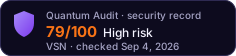
Critical Risk How is this score calculated? →
Volume 24h
$573.0K
Liquidity
$710.6K
Price
$0.0392
Token Age
8mo
Top 10 Holders
96.3%

Security Checklist

Contract VerifiedPass
Ownership RenouncedUnknown
No Mint FunctionFail
Liquidity LockedFail
Not a ProxyFail

Audit History

Jul 2366Jul 2379

Every audit run adds a dated snapshot — history is append-only and cannot be edited.

Audit Summary

The VisionToken contract is an upgradeable ERC20 token utilizing OpenZeppelin's battle-tested libraries for core functionalities, including pausing, role-based access control, and UUPS upgradeability. While the technical implementation is robust and follows best practices for upgradeable contracts, the primary risks stem from the highly centralized control over critical functions such as minting, pausing, and upgrades. These roles, if compromised or misused, could lead to significant economic and operational issues for the protocol. Recommendations focus on decentralizing control and implementing timelocks for sensitive operations.
Final Recommendation: To mitigate the identified risks, it is strongly recommended to implement a robust multi-signature wallet or a decentralized autonomous organization (DAO) for managing all critical roles, including `DEFAULT_ADMIN_ROLE`, `PAUSER_ROLE`, `MINTER_ROLE`, and `UPGRADER_ROLE`. Additionally, consider integrating a timelock mechanism for sensitive operations such as contract upgrades and significant role changes. This would introduce a delay before execution, allowing for community review and providing a window for intervention in case of malicious or erroneous actions, thereby enhancing the overall security and decentralization of the protocol.

Category Ratings

TechnicalMedium
6/10

The VisionToken contract demonstrates strong technical security by inheriting from OpenZeppelin's upgradeable contracts (ERC20, Pausable, AccessControl, Permit, UUPS). This approach leverages well-audited and widely adopted code, significantly reducing the likelihood of common vulnerabilities (

GovernanceHigh
1/10

The economic model (7.4 Economic) relies on a `MINTER_ROLE` with the ability to mint an arbitrary amount of tokens, posing a significant risk of supply inflation if compromised. Governance (7.5 Governance) is highly centralized, with the `DEFAULT_ADMIN_ROLE` having ultimate control over all other ro

UpgradesHigh
1/10

The contract utilizes the UUPS proxy pattern for upgradeability (7.7 Upgrades), which is a secure and widely accepted standard. The `_authorizeUpgrade` function correctly restricts upgrade permissions to the `UPGRADER_ROLE`. However, the absence of a timelock for upgrade operations means that an ent

Proxy Upgrade Controls

Proxy TypeEip1967 Uups
ImplementationVerified source
Upgrades (30d)0 · stable

LP Distribution

Top-1 Unlocked Holder100.0%
Top-3 Unlocked100.0%

What Raised This Score

Each factor is an on-chain fact recorded at the time of this analysis. The score is computed from them by a deterministic function, so the same contract returns the same score for anyone who runs the audit. How scores are computed

Security Findings

1 High 1 Medium 1 Low 3 Info
H-01HighUnresolved

Centralized Control of Critical Roles

The `DEFAULT_ADMIN_ROLE`, `PAUSER_ROLE`, `MINTER_ROLE`, and `UPGRADER_ROLE` are assigned to single addresses during initialization. If these addresses are externally owned accounts (EOAs), they represent single points of failure. A compromise of any of these keys would grant an attacker the ability to pause the contract, mint/burn tokens, or upgrade the contract logic, leading to severe economic or operational consequences. This impacts 7.3 Access Control, 7.4 Economic, 7.5 Governance, 7.7 Upgrades, and 7.8 Operations.

Recommendation: Transition control of all critical roles (`DEFAULT_ADMIN_ROLE`, `PAUSER_ROLE`, `MINTER_ROLE`, `UPGRADER_ROLE`) to a robust multi-signature wallet (e.g., Gnosis Safe) or a decentralized autonomous organization (DAO) to distribute control and reduce the risk of a single point of failure.
M-01MediumUnresolved

Potential for Supply Inflation by MINTER_ROLE

The `MINTER_ROLE` has the unrestricted ability to mint an arbitrary amount of new tokens to any address. While this is an intended feature for a token with a minting mechanism, it introduces a significant economic risk (7.4 Economic). If the `MINTER_ROLE` is compromised or misused, it could lead to uncontrolled token supply inflation, devaluing existing tokens and harming holders.

Recommendation: Implement strict policies and procedures for the `MINTER_ROLE`'s operation. Consider adding rate limits or caps on minting amounts, or requiring additional governance approval for large minting operations. Ensure the `MINTER_ROLE` is controlled by a secure, multi-signature wallet or DAO.
L-01LowUnresolved

Lack of Timelock for Critical Operations

Critical operations such as contract upgrades, role changes, and pausing/unpausing are not subject to a timelock. This means that an entity controlling the `UPGRADER_ROLE`, `DEFAULT_ADMIN_ROLE`, or `PAUSER_ROLE` can execute these actions immediately (7.3 Access Control, 7.5 Governance, 7.7 Upgrades, 7.8 Operations). This lack of a delay period prevents users from reacting to potentially malicious or erroneous changes and reduces transparency.

Recommendation: Introduce a timelock mechanism for all critical administrative functions, especially contract upgrades and significant role modifications. A timelock would enforce a delay between the proposal and execution of a change, providing a window for review and community response.
I-01InformationalResolved

`_disableInitializers()` in Constructor

The contract correctly calls `_disableInitializers()` in its constructor. This is a crucial security measure for upgradeable contracts, preventing the `initialize` function from being called multiple times on the implementation contract, which could lead to state corruption or re-initialization vulnerabilities. This demonstrates good practice in 7.2 Code Security.

Recommendation: No action required; this is a best practice.
I-02InformationalResolved

Extensive Use of OpenZeppelin Upgradeable Contracts

The `VisionToken` contract extensively utilizes OpenZeppelin's battle-tested upgradeable contracts (ERC20Upgradeable, ERC20PausableUpgradeable, AccessControlUpgradeable, ERC20PermitUpgradeable, UUPSUpgradeable). This approach significantly reduces the risk of common vulnerabilities and improves overall code quality, reliability, and security (7.2 Code Security).

Recommendation: No action required; this is a best practice.
I-03InformationalResolved

Clear and Gas-Efficient Error Handling

The contract defines and uses custom error types `ZeroAmount()` and `ZeroAddress()` for specific failure conditions. This practice improves code clarity, provides more specific error messages to users, and is generally more gas-efficient than using generic `require` statements with string messages (7.2 Code Security).

Recommendation: No action required; this is a best practice.

Would You Like a More Detailed Audit of Vision?

Our AI-powered scanner gives you a deeper, real-time smart contract analysis — free, no signup required.

Get Detailed Audit
Run Free Audit →