
Quantum Audit Logo

Is Vibestarter Safe?

On-chain security analysis — is it a scam or legit?

Vibestarter VIBES
0xeffc…1acb
Base Not verifiedLast checked 3d ago 1 audit on record
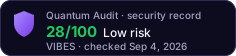
How is this score calculated? → Medium Risk
Executive SummaryAI Copilot

The VibesToken contract is a straightforward ERC-20-like implementation. It utilizes Solidity 0.8.20+, benefiting from automatic overflow/underflow checks. The contract features a fixed total supply and no administrative roles, promoting decentralization. Identified issues are primarily informational or low-severity, relating to common ERC-20 considerations and missing optional features rather than critical vulnerabilities.

3 Low1 Informational
Volume 24h
$53.1K
Liquidity
$87.4K
Price
$0.0004725
Token Age
2mo
Top 10 Holders
64.2%

Security Findings

Low

Centralized Initial Supply Distribution

L-01The entire `totalSupply` is minted to a single `_recipient` address in the constructor. This centralizes the initial distribution of tokens, potentially creating a single point of control or failure for the token's initial liquidity and ecosystem development. If this recipient's private key is compromised, the entire supply could be at risk.
IssueThe entire `totalSupply` is minted to a single `_recipient` address in the constructor. This centralizes the initial distribution of tokens, potentially creating a single point of control or failure for the token's initial liquidity and ecosystem development. If this recipient's private key is compromised, the entire supply could be at risk.
FixFor enhanced decentralization and security, consider distributing the initial supply across multiple addresses, a multi-signature wallet, or a vesting contract. This reduces the risk associated with a single point of failure.
StatusUnresolved
Low

Lack of Emergency Pause Mechanism

L-02The contract lacks a mechanism to pause transfers or other critical functions in case of an emergency, such as a major vulnerability discovery, market manipulation, or regulatory requirement. This could leave the protocol vulnerable to rapid exploitation without a way to mitigate damage or halt operations temporarily.
IssueThe contract lacks a mechanism to pause transfers or other critical functions in case of an emergency, such as a major vulnerability discovery, market manipulation, or regulatory requirement. This could leave the protocol vulnerable to rapid exploitation without a way to mitigate damage or halt operations temporarily.
FixEvaluate the need for an emergency pause mechanism, typically controlled by a trusted entity (e.g., a multi-signature wallet). While adding centralization, it provides a crucial safety net for unforeseen circumstances. If implemented, ensure the pause mechanism has clear conditions for activation and deactivation.
StatusUnresolved
Low

No Token Burn Functionality

L-03The contract does not include a function to burn tokens, meaning tokens cannot be permanently removed from circulation by users or administrators. While not a direct vulnerability, this limits flexibility for managing token supply, such as reducing total supply, implementing deflationary mechanisms, or allowing users to burn tokens for specific purposes.
IssueThe contract does not include a function to burn tokens, meaning tokens cannot be permanently removed from circulation by users or administrators. While not a direct vulnerability, this limits flexibility for managing token supply, such as reducing total supply, implementing deflationary mechanisms, or allowing users to burn tokens for specific purposes.
FixConsider adding a `burn` function, either for users to burn their own tokens or for an authorized entity to burn tokens from specific addresses. This can provide greater flexibility in tokenomics and supply management.
StatusUnresolved
Info

ERC-20 `approve` Race Condition

I-01The standard ERC-20 `approve` function is susceptible to a known front-running attack. If a user approves an amount `X` to a spender and then wishes to change it to `Y`, an attacker could front-run the transaction changing `X` to `Y` by spending the original `X` amount. This results in the spender having `X + Y` allowance instead of just `Y`.
IssueThe standard ERC-20 `approve` function is susceptible to a known front-running attack. If a user approves an amount `X` to a spender and then wishes to change it to `Y`, an attacker could front-run the transaction changing `X` to `Y` by spending the original `X` amount. This results in the spender having `X + Y` allowance instead of just `Y`.
FixWhile this is an inherent design flaw of the ERC-20 standard and not an implementation bug, users should be advised to first set the allowance to zero before approving a new, non-zero amount to mitigate this risk. Alternatively, consider using `increaseAllowance` and `decreaseAllowance` functions (not implemented in this contract) which are less prone to this specific race condition.
StatusUnresolved

Category Ratings

TechnicalLow10/10

The contract implements a standard ERC-20-like token with robust internal transfer logic (7.1 Architecture). It leverages Solidity 0.8.20+, which provides automatic overflow/underflow checks, enhancing code security (7.2 Code Security). Access control is decentralized, relying on `msg.sender` for transfers and approvals, with no privileged roles (7.3 Access Control). However, the inherent ERC-20 `approve` function is susceptible to a known front-running race condition (7.2 Code Security).

GovernanceMedium4/10

The token features a fixed `totalSupply` set at deployment, preventing inflation or deflation through minting/burning (7.4 Economic). All initial tokens are minted to a single `_recipient` address, which represents a point of centralization for initial distribution (7.4 Economic). There are no governance mechanisms or administrative roles implemented, making the token fully decentralized in its operation post-deployment (7.5 Governance).

UpgradesMedium6/10

The `VibesToken` contract is implemented as a standard, non-upgradeable contract (7.7 Upgrades). This design choice eliminates risks associated with upgrade mechanisms, such as proxy misconfigurations or logic bugs introduced during upgrades. However, it also means that the contract's logic cannot be modified or patched after deployment, requiring a new deployment for any changes.

Security Checklist

Contract VerifiedPass
Ownership Renounced?
No Mint FunctionPass
Liquidity LockedFail
Not a ProxyPass
HoneypotNoneBuy Tax0.0%Sell Tax0.0%

Holder Composition

4.7% in wallets59.5% in contracts
Effective Concentration28.5%

Share held by contracts — treasury, vesting, bridge or staking — is discounted against share held by wallets when the score is computed: a contract cannot decide to sell the way an anonymous holder can, though it can still be drained or voted to sell. Effective concentration is the figure the risk score is actually calculated from.

Liquidity Depth

The risk score reads depth across every pair. The volume figure and the volume-to-liquidity ratio elsewhere on this page describe only the pair this audit analysed, so the two are not directly comparable.

LP Distribution

Top-1 Unlocked Holder41.0%
Top-3 Unlocked86.2%

Key Addresses

Deployer
0x940a…74ec
Unlocked LP Held By
0x3dd5…599d0x3662…ba860x1e16…81430xcbbb…5835

No privileged address appears among these holders: the unlocked liquidity sits with independent providers, not with the deployer.

What Raised This Score

  • Ownership status UNKNOWN (owner could not be resolved)
  • Top-10 concentration > 20% (64.2% total → 28.5% effective; 4.7% in EOAs, 59.5% in contracts — mild)
  • Liquidity not locked, but no owner/deployer address holds LP — market-depth risk, not rug risk
  • LP top3 unlocked holders = 86.2% (independent LP — depth risk)
  • 3 Low finding(s) from audit

Each factor is an on-chain fact recorded at the time of this analysis. The score is computed from them by a deterministic function, so the same contract returns the same score for anyone who runs the audit. How scores are computed

Related Audits

Meta Platforms Inc. (METAC)Medium RiskOlivia AI 2.0 ($OLIVIA2.0)Medium RiskPORTALMedium RiskBaselineMedium RiskSurplus Intelligence (SURPLUS)Medium RiskCoinbase Man (BRIAN)Medium Risk

Would You Like a More Detailed Audit of Vibestarter?

Our AI-powered scanner gives you a deeper, real-time smart contract analysis — free, with every scoring factor shown.

Get Detailed Audit