
The UpscreenerToken contract is an ERC-20 token implementation. A key security characteristic is that the contract's ownership has been renounced on-chain. This means all functions previously restricted to the owner are now permanently disabled, including those that could modify transfer fees, limits, or initiate token swaps. While some minor historical code patterns were identified, they are within these dormant functions and pose no active risk.
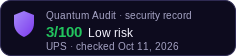

On-chain security analysis — is it a scam or legit?
Is Upscreener Safe?
Not verified
This record has not gone through deep verification and is not being monitored. The score is a dated snapshot — the token’s risk can change at any time.Own this token? Put it under verification →The UpscreenerToken contract is an ERC-20 token implementation.
Read the full analysis- Code: Minor Rounding Loss in Dormant Internal Distribution
Exact factors
- Code: Minor Rounding Loss in Dormant Internal Distribution (Low, static analysis)
Security Checklist
as of audit · Oct 11Holders
as of audit · Oct 11, 2026- Contractstreasury, vesting, bridge, staking3.6%
- Walletsanonymous holders, free to sell12.4%
- Burnedout of circulation50.0%
- DEX poolsthe pools' own liquidity9.2%
- Everyone else8,771 holders24.7%
How holder types affect the score
Share held by contracts — treasury, vesting, bridge or staking — is discounted against share held by wallets when the score is computed: a contract cannot decide to sell the way an anonymous holder can, though it can still be drained or voted to sell. Effective concentration is the figure the risk score is actually calculated from.
Holder balances as recorded by the audit of Oct 11, 2026
Liquidity
as of audit · Oct 11The LP tokens of the analysed pool are locked or burned.
0x49bf…48e20x0ed9…9706A privileged address — the deployer, the owner, or the token contract itself — is among these holders, so that party can withdraw liquidity.
Security Findings
LowMinor Rounding Loss in Dormant Internal Distribution
The internal _swapAndDistribute function, which handles the distribution of tokens, performs a division operation before a multiplication.CD-01
Issue
The internal _swapAndDistribute function, which handles the distribution of tokens, performs a division operation before a multiplication. This common Solidity pattern can lead to very small, negligible rounding losses during calculations. However, this function is only callable indirectly via manualDistribute, which is an owner-restricted function. Since ownership is renounced, this function is dormant and cannot be executed, meaning this potential rounding loss poses no active risk.
Fix
While this issue is currently inactive due to renounced ownership, for future smart contract development, it is a best practice to perform multiplication operations before division to minimize potential rounding errors and ensure maximum precision in calculations.
Status
Unresolved
InfoDormant Control Over Transfer Switches
The contract previously contained functions like setSwapEnabled and manualDistribute that could enable or disable certain transfer mechanisms or initiate internal token swaps.CP-05
Issue
The contract previously contained functions like setSwapEnabled and manualDistribute that could enable or disable certain transfer mechanisms or initiate internal token swaps. However, because the contract's ownership has been permanently renounced, these functions are now inactive and cannot be called by anyone, meaning they pose no current risk to token transfers.
Fix
No action is required for token holders, as the renounced ownership ensures these control switches are permanently disabled and cannot be manipulated.
Status
Unresolved
InfoDormant Control Over Transfer Fees
Functions such as setTaxes and setShares were designed to allow the contract owner to adjust the fees applied to token transfers.CP-07
Issue
Functions such as setTaxes and setShares were designed to allow the contract owner to adjust the fees applied to token transfers. With the contract's ownership renounced, these functions are now permanently disabled. This means that the current transfer fees are fixed and cannot be changed by any external party.
Fix
No action is required for token holders, as the renounced ownership ensures that transfer fees cannot be altered.
Status
Unresolved
InfoDormant Control Over Transfer and Wallet Limits
The contract included functions like setSwapThreshold and setMaxSwapAmount which could modify limits on how many tokens could be swapped or transferred at once.CP-08
Issue
The contract included functions like setSwapThreshold and setMaxSwapAmount which could modify limits on how many tokens could be swapped or transferred at once. Since ownership is renounced, these limits are now fixed and cannot be changed by any external party, providing stability to the token's operational parameters.
Fix
No action is required for token holders, as the renounced ownership ensures these limits are permanently fixed and cannot be changed.
Status
Unresolved
InfoWho holds the supply
The ten largest holders own 75.3% of supply. Of that, 50.0% burned, 9.2% in DEX pools — not holders that can sell, so excluded from the concentration score.QA-HOLDERS
Issue
The ten largest holders own 75.3% of supply. Of that, 50.0% burned, 9.2% in DEX pools — not holders that can sell, so excluded from the concentration score. What remains: 12.4% in wallets, 3.6% in other contracts. 8,781 holders in total.
Fix
Watch the largest wallets that are not exchanges, pools or locks — those are the ones that can move the price.
Status
Acknowledged
InfoListed, but not independently verified
Listed on CoinGecko as Upscreener (UPS), rank #4996. 8,781 holders.QA-IDENTITY
Issue
Listed on CoinGecko as Upscreener (UPS), rank #4996. 8,781 holders.
Fix
Match the contract address against the project's official channels before trading.
Status
Acknowledged
InfoLiquidity time-locked
98.9% of the pool's LP is burned or time-locked. 28.0% of the LP tokens were sent to a burn address — that liquidity can never be withdrawn by anyone.QA-LIQUIDITY
Issue
98.9% of the pool's LP is burned or time-locked. 28.0% of the LP tokens were sent to a burn address — that liquidity can never be withdrawn by anyone. 70.9% is locked in PinkLock02 until 04 Apr 2027 (175 days). Until then nobody — the project included — can withdraw it unless the locker contract itself is flawed; after that date the lock's owner can. 1.0% is held, unlocked, by the token's owner/deployer (0x49bf…48e2) — they can pull that liquidity at any moment. This is the rug-pull path. Some pools are concentrated-liquidity (V3/V4) positions; shares above are by position as GoPlus reports them.
Fix
Check the lock's end date and beneficiary on the locker's own page before relying on it.
Status
Acknowledged
InfoThe market for this token
Liquidity $81K (DexScreener, all pools). 24h trading volume $44K (CoinGecko, all markets, daily snapshot).QA-MARKET
Issue
Liquidity $81K (DexScreener, all pools). 24h trading volume $44K (CoinGecko, all markets, daily snapshot). 24h trading volume $49K (DexScreener, all pools).
Fix
Size any position to the liquidity and daily volume shown — they set how much you can sell and at what price.
Status
Acknowledged
InfoAsset class: Project token
A token issued by a project for use, governance or fundraising.QA-PROFILE
Issue
A token issued by a project for use, governance or fundraising. Basis: no class-specific evidence. Tokenomics — Supply: fixed — the contract has no mint function. Control: nobody (ownership renounced). Code: not upgradeable (no proxy). Fees: 3% on buy, 3% on sell. Market: $81K of DEX liquidity across 4 pools. Launch: 190 days of market history.
Fix
Check the project's own documentation for what the token is used for; this report covers what the contract allows.
Status
Acknowledged
Analysis
AI Copilotas of audit · Oct 11The UpscreenerToken contract implements the ERC-20 standard with a ReentrancyGuard, demonstrating a solid foundation for token operations (7.1 Architecture). The core transfer logic (_transfer) is protected by a reentrancy guard. All standard ERC-20 functions are present and correctly implemented. A minor issue of division before multiplication was noted in the _swapAndDistribute function (7.2 Code Security), which could lead to negligible rounding losses; however, this function is part of a set of owner-restricted functions that are now dormant due to renounced ownership, posing no active technical risk.
A significant strength of the UpscreenerToken contract is its renounced ownership (7.3 Access Control). This means that all privileged functions, such as setTaxes, setShares, setSwapEnabled, setSwapThreshold, setMaxSwapAmount, excludeFromFees, setAMMPair, manualDistribute, recoverBNB, and recoverTokens, are permanently disabled. While these functions previously allowed an owner to control economic parameters like transfer fees and limits (7.4 Economic) or perform administrative actions (7.5 Governance), their dormancy eliminates potential risks associated with centralized control. There are no active governance or economic risks from these previously powerful functions.
The UpscreenerToken contract is a standard, non-upgradeable ERC-20 implementation (7.7 Upgrades). There are no proxy patterns or upgrade mechanisms present, which simplifies the contract's lifecycle and removes the risks associated with upgradeability, such as upgradeability proxy misconfigurations or malicious upgrade paths. This design choice ensures immutability post-deployment.
The UpscreenerToken contract exhibits a strong security posture primarily due to its renounced ownership, which has permanently disabled all privileged administrative and economic control functions.
Token holders can be confident that parameters such as transfer fees and limits cannot be altered. While a minor rounding issue was identified in a dormant internal function, it poses no active threat. For future contract development, always prioritize multiplication before division to prevent potential rounding errors, and ensure comprehensive testing of all mathematical operations.
Contract & Record
Free for any token on the record. It links to this page and always shows the current score and the date it was checked.
- Oct 11, 20263Low
Score changes are recorded as dated snapshots — history is append-only and cannot be edited.
Frequently Asked Questions
What is the UPS contract address?
The Upscreener (UPS) contract on BNB Chain is 0xae5a409773b9a7dd0ae94ff437ac213d8fafba01. Compare it with the address the project itself publishes before trading: other contracts can carry the same name and ticker.
Is Upscreener a scam?
Quantum Audit's risk score for Upscreener is 3/100 (Low risk) as of Oct 11, 2026, computed by a deterministic function from on-chain facts — Contract verified: Verified; Ownership: Renounced; Mint: No mint; Liquidity lock: Locked; Upgradeability: Fixed code; Honeypot: None found; Buy / sell tax: 3% / 3%. A score is a dated snapshot of those facts, not a guarantee; each one is listed on this page.
Is UPS liquidity locked?
Liquidity lock: Locked (as of Oct 11, 2026). Total DEX liquidity: $80.7K.
Who holds UPS?
As of Oct 11, 2026, the 10 largest holders own 75.3% of the supply across 8,781 holders. The Holders section on this page shows who they are by holder type.
Would You Like a More Detailed Audit of Upscreener?
Our AI-powered scanner gives you a deeper, real-time smart contract analysis — free, with every scoring factor shown.
Get Detailed Audit Is this your token? Add your links and get it Verified