
Quantum Audit Logo

Is 孙小圣 a Scam?

Early-stage security check — honeypot & rug-pull analysis

Is this your token? Publish your own audit on this page →

孙小圣 孙小圣
0x0185…7777
BNB Chain Not verifiedLast checked 3d ago 1 audit on record New Launch · 5d old
Executive SummaryAI Copilot

The FlapTaxTokenV3 contract implements an upgradeable ERC20 token with a complex, multi-state tax mechanism. The contract utilizes OpenZeppelin's upgradeable standards and `SafeERC20` for secure token interactions. A significant portion of the core tax liquidation logic in `_liquidateTax` was truncated in the provided source, preventing a full security assessment of this critical component. Identified issues include centralization risks, potential time-based manipulation, and minor economic inflexibilities.
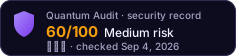

1 High2 Medium2 Low1 Informational
! Early-stage analysis. This token has limited on-chain history (5d old). New tokens carry elevated risk — data may change rapidly. Always verify independently before investing.
Volume 24h
$463.3K
Liquidity
$108.7K
Price
$0.0006888
Token Age
5d
Top 10 Holders
30.3%

Security Findings

High

Truncated `_liquidateTax` Function Logic

H-01The provided source code for the `_liquidateTax` function is incomplete. This function contains critical logic for state transitions, tax processing, and potentially external calls to `ITaxProcessor`. Without the full code, a comprehensive security assessment of this core mechanism, including potential reentrancy vulnerabilities, gas consumption, and correct handling of tax funds, is impossible.
IssueThe provided source code for the `_liquidateTax` function is incomplete. This function contains critical logic for state transitions, tax processing, and potentially external calls to `ITaxProcessor`. Without the full code, a comprehensive security assessment of this core mechanism, including potential reentrancy vulnerabilities, gas consumption, and correct handling of tax funds, is impossible.
FixProvide the complete and verified source code for the `_liquidateTax` function to allow for a full security audit. Pay particular attention to external calls within this function and implement reentrancy guards if necessary.
StatusUnresolved
Medium

Centralization Risk with Owner Privileges

M-01The `startMigration` and `finalizeMigration` functions, which control critical `PoolState` transitions, are restricted to `onlyOwner`. This grants significant power to a single address. A compromised owner key or a malicious owner could lead to unauthorized and disruptive state changes, potentially impacting the token's economic model and user trust (7.3 Access Control, 7.5 Governance).
IssueThe `startMigration` and `finalizeMigration` functions, which control critical `PoolState` transitions, are restricted to `onlyOwner`. This grants significant power to a single address. A compromised owner key or a malicious owner could lead to unauthorized and disruptive state changes, potentially impacting the token's economic model and user trust (7.3 Access Control, 7.5 Governance).
FixConsider implementing a multi-signature wallet (e.g., Gnosis Safe) for the owner address to require multiple approvals for critical operations. Alternatively, explore a time-locked governance mechanism for highly sensitive state changes to provide a window for community review and reaction.
StatusUnresolved
Medium

Time-Based State Transitions and Potential for Manipulation

M-02The `_liquidateTax` function triggers `PoolState` changes (e.g., to `TaxFree` or `TaxEnforced`) based on `block.timestamp` exceeding `taxExpirationTime` or `antiFarmerExpirationTime`. While `block.timestamp` is generally reliable, miners have a limited ability to manipulate it within a certain range (up to 900 seconds deviation from median). This could allow for minor manipulation of when state transitions occur, potentially impacting users who are sensitive to tax rate changes (7.2 Code Security).
IssueThe `_liquidateTax` function triggers `PoolState` changes (e.g., to `TaxFree` or `TaxEnforced`) based on `block.timestamp` exceeding `taxExpirationTime` or `antiFarmerExpirationTime`. While `block.timestamp` is generally reliable, miners have a limited ability to manipulate it within a certain range (up to 900 seconds deviation from median). This could allow for minor manipulation of when state transitions occur, potentially impacting users who are sensitive to tax rate changes (7.2 Code Security).
FixWhile this is a common pattern, be aware of the inherent limitations of `block.timestamp`. For highly critical, time-sensitive events, consider using a decentralized oracle for time if precise, unmanipulable timing is paramount, or implement a grace period around state transitions.
StatusUnresolved
Low

Fixed `liqExpectedOutputAmount`

L-01The `liqExpectedOutputAmount` is set only once during initialization and is immutable thereafter. In a dynamic market, a fixed expected output amount for tax liquidation might become suboptimal or even detrimental over time, potentially leading to inefficient tax processing or missed opportunities for the protocol (7.4 Economic).
IssueThe `liqExpectedOutputAmount` is set only once during initialization and is immutable thereafter. In a dynamic market, a fixed expected output amount for tax liquidation might become suboptimal or even detrimental over time, potentially leading to inefficient tax processing or missed opportunities for the protocol (7.4 Economic).
FixConsider making `liqExpectedOutputAmount` a configurable parameter, allowing the owner or a governance mechanism to update it as market conditions evolve. This would provide greater flexibility and optimize the tax processing mechanism.
StatusUnresolved
Low

`uint48` and `uint64` for Expiration Times

L-02The `antiFarmerExpirationTime` is stored as `uint48` and `taxExpirationTime` as `uint64`. While `block.timestamp` is currently well within these limits, using smaller types for time-related variables that store `block.timestamp` values introduces a theoretical, albeit distant, risk of overflow/truncation in the very long term (e.g., `uint48` overflows in ~8900 years, `uint64` in ~580 billion years). It's generally safer to use `uint256` for `block.timestamp` values unless gas savings are critical and the lifespan of the contract is well-understood (7.2 Code Security).
IssueThe `antiFarmerExpirationTime` is stored as `uint48` and `taxExpirationTime` as `uint64`. While `block.timestamp` is currently well within these limits, using smaller types for time-related variables that store `block.timestamp` values introduces a theoretical, albeit distant, risk of overflow/truncation in the very long term (e.g., `uint48` overflows in ~8900 years, `uint64` in ~580 billion years). It's generally safer to use `uint256` for `block.timestamp` values unless gas savings are critical and the lifespan of the contract is well-understood (7.2 Code Security).
FixFor maximum future-proofing, consider using `uint256` for time-related variables that store `block.timestamp` values. If gas optimization is a primary concern, ensure the expected lifespan of the contract is well within the limits of `uint48` and `uint64`.
StatusUnresolved
Info

`_liquidateTax` Called on Every Transfer

I-01The `_liquidateTax` function is called on every `_transfer` operation. While this ensures timely state updates and tax processing, if the logic within `_liquidateTax` becomes complex or involves multiple external calls (as hinted by the truncation), it could lead to increased gas costs for every token transfer, potentially impacting user experience or transaction throughput (7.8 Operations).
IssueThe `_liquidateTax` function is called on every `_transfer` operation. While this ensures timely state updates and tax processing, if the logic within `_liquidateTax` becomes complex or involves multiple external calls (as hinted by the truncation), it could lead to increased gas costs for every token transfer, potentially impacting user experience or transaction throughput (7.8 Operations).
FixMonitor the gas consumption of `_liquidateTax` once the full implementation is available. Optimize its logic to minimize gas costs, especially if it involves external calls. Consider if there are scenarios where liquidation can be batched or triggered less frequently without compromising the protocol's economic model.
StatusUnresolved

Category Ratings

TechnicalLow8/10

The contract leverages OpenZeppelin's upgradeable ERC20, Ownable, and Permit standards, ensuring a robust foundation (7.1 Architecture, 7.2 Code Security). The use of `SafeERC20` for external token interactions is a strong security practice. However, the provided source code for the critical `_liquidateTax` function is truncated, preventing a complete assessment of its security and potential reentrancy vectors (7.2 Code Security). Time-based state transitions in `_liquidateTax` introduce a minor risk of manipulation (7.2 Code Security).

GovernanceMedium5/10

The contract defines immutable liquidation thresholds and a constant `maxSupply`, contributing to economic stability (7.4 Economic). The `initialize` function includes important sanity checks for parameters. However, the owner possesses significant control over critical `PoolState` transitions via `startMigration` and `finalizeMigration`, introducing centralization risk (7.3 Access Control, 7.5 Governance). The `liqExpectedOutputAmount` is fixed at initialization, which might become economically suboptimal over time (7.4 Economic).

UpgradesMedium4/10

The contract is built on OpenZeppelin's upgradeable patterns, correctly using `Initializable` and `_disableInitializers()` in the constructor, which is a strong practice for upgrade safety (7.7 Upgrades). The `initializer` modifier is correctly applied. The use of a `PackedPoolState` struct requires careful consideration for future upgrades to avoid storage collisions if fields are reordered or new fields are inserted mid-struct (7.7 Upgrades).

Security Checklist

Contract VerifiedPass
Ownership RenouncedPass
No Mint FunctionPass
Liquidity LockedFail
Not a ProxyFail
HoneypotNoneBuy Tax0.0%Sell Tax0.0%

Proxy Upgrade Controls

Proxy TypeEtherscan Detected Custom
ImplementationVerified source

Holder Composition

16.8% in wallets13.5% in contracts
Effective Concentration22.2%

Share held by contracts — treasury, vesting, bridge or staking — is discounted against share held by wallets when the score is computed: a contract cannot decide to sell the way an anonymous holder can, though it can still be drained or voted to sell. Effective concentration is the figure the risk score is actually calculated from.

Liquidity Depth

The risk score reads depth across every pair. The volume figure and the volume-to-liquidity ratio elsewhere on this page describe only the pair this audit analysed, so the two are not directly comparable.

LP Distribution

Top-1 Unlocked Holder93.1%
Top-3 Unlocked100.0%

Key Addresses

Deployer
0xd190…db9b
Unlocked LP Held By
0x0b98…91310x5810…8eaf0x7b30…6412

No privileged address appears among these holders: the unlocked liquidity sits with independent providers, not with the deployer.

What Raised This Score

  • Proxy contract (upgradeable — admin can replace logic)
  • Non-standard proxy storage (Etherscan-confirmed)
  • Top-10 concentration > 20% (30.3% total → 22.2% effective; 16.8% in EOAs, 13.5% in contracts — mild)
  • Liquidity not locked, but no owner/deployer address holds LP — market-depth risk, not rug risk
  • LP top1 unlocked holder = 93.1% (independent LP — depth risk)
  • LP top3 unlocked holders = 100.0% (independent LP — depth risk)
  • Token age < 7 days (early, volatile)
  • 1 High finding(s) from audit
  • 2 Medium finding(s) from audit
  • 2 Low finding(s) from audit

Each factor is an on-chain fact recorded at the time of this analysis. The score is computed from them by a deterministic function, so the same contract returns the same score for anyone who runs the audit. How scores are computed

Related Audits

BTCB Token (BTCB)High RiskSlap Cat (SLAP)High RiskUnitas (UP)High RiskniulaiHigh RiskBNB Attestation (BAS)High RiskRICE AI (RICE)High Risk

Would You Like a More Detailed Audit of 孙小圣?

This token is brand new. Run a deeper AI-powered analysis of the contract code — free and instant.

Get Detailed Audit