
This audit covers an ERC-20 token contract. The contract implements standard token functionalities and includes several privileged functions. Ownership of the contract has been renounced, making some administrative functions dormant. However, a designated taxwallet address retains significant control over transfer mechanisms, including the ability to halt transfers, modify transaction fees, and rescue ERC-20 tokens.
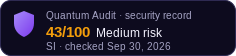

On-chain security analysis — is it a scam or legit?
Is Superior Intelligence Safe?
Not verified
This record has not gone through deep verification and is not being monitored. The score is a dated snapshot — the token’s risk can change at any time.Own this token? Put it under verification →This audit covers an ERC-20 token contract. The contract implements standard token functionalities and includes several privileged functions.
Read the full analysis- A privileged address controls a switch that decides whether transfers go through
- Owner can change the buy/sell tax
- Liquidity < $50k
Exact factors
- A privileged address controls a switch that decides whether transfers go through
- Owner can change the buy/sell tax
- Liquidity < $50k ($20,052 across 2 pairs — thin market)
Security Checklist
as of audit · Sep 30Holders
as of audit · Sep 30, 2026- Contractstreasury, vesting, bridge, staking11.5%
- Walletsanonymous holders, free to sell11.1%
- DEX poolsthe pools' own liquidity29.7%
- Everyone else764 holders47.8%
How holder types affect the score
Share held by contracts — treasury, vesting, bridge or staking — is discounted against share held by wallets when the score is computed: a contract cannot decide to sell the way an anonymous holder can, though it can still be drained or voted to sell. Effective concentration is the figure the risk score is actually calculated from.
Holder balances as recorded by the audit of Sep 30, 2026
Liquidity
as of audit · Sep 30The LP tokens of the analysed pool are locked or burned.
0xf385…5f85No privileged address appears among these holders: the unlocked liquidity sits with independent providers, not with the deployer.
Security Findings
MediumA privileged address controls a switch that decides whether transfers go through
An on/off setting checked in the transfer path can be changed by a privileged function; depending on its value, transfers or sales are allowed or refused.CP-05
Issue
An on/off setting checked in the transfer path can be changed by a privileged function; depending on its value, transfers or sales are allowed or refused. Functions: manualSwap. Restricted to: taxwallet.
Fix
Check who holds these functions and whether a timelock or multisig stands between them and holders.
Status
Unresolved
MediumA privileged address can change the transfer fee
The fee taken from transfers is a setting a privileged function can change.CP-07
Issue
The fee taken from transfers is a setting a privileged function can change. Functions: removeTransferTax, reduceFee. Restricted to: owner, taxwallet.
Fix
Check who holds these functions and whether a timelock or multisig stands between them and holders.
Status
Unresolved
InfoA privileged address can change transfer or wallet limits
Numeric limits checked in the transfer path (maximum transaction or wallet size, thresholds) can be changed by a privileged function.CP-08
Issue
Numeric limits checked in the transfer path (maximum transaction or wallet size, thresholds) can be changed by a privileged function. Ownership is renounced, so no one can call these functions now. Functions: removeLimits. Restricted to: owner.
Fix
Check who holds these functions and whether a timelock or multisig stands between them and holders.
Status
Unresolved
InfoWho holds the supply
The ten largest holders own 52.2% of supply. Of that, 29.7% in DEX pools — not holders that can sell, so excluded from the concentration score.QA-HOLDERS
Issue
The ten largest holders own 52.2% of supply. Of that, 29.7% in DEX pools — not holders that can sell, so excluded from the concentration score. What remains: 11.1% in wallets, 11.5% in other contracts. 774 holders in total.
Fix
Watch the largest wallets that are not exchanges, pools or locks — those are the ones that can move the price.
Status
Acknowledged
InfoListed, but not independently verified
Listed on CoinGecko as Superior Intelligence (SI), rank #7609. 774 holders.QA-IDENTITY
Issue
Listed on CoinGecko as Superior Intelligence (SI), rank #7609. 774 holders.
Fix
Match the contract address against the project's official channels before trading.
Status
Acknowledged
InfoLiquidity burned — cannot be withdrawn
99.2% of the pool's LP is burned or time-locked. 99.2% of the LP tokens were sent to a burn address — that liquidity can never be withdrawn by anyone.QA-LIQUIDITY
Issue
99.2% of the pool's LP is burned or time-locked. 99.2% of the LP tokens were sent to a burn address — that liquidity can never be withdrawn by anyone. 0.8% is held, unlocked, by 1 address(es) other than the owner/deployer. No single one holds a majority: their exits thin the market rather than hand anyone the pool. Some pools are concentrated-liquidity (V3/V4) positions; shares above are by position as GoPlus reports them.
Status
Acknowledged
InfoThe market for this token
Liquidity $20K (DexScreener, all pools). 24h trading volume $43K (CoinGecko, all markets, daily snapshot).QA-MARKET
Issue
Liquidity $20K (DexScreener, all pools). 24h trading volume $43K (CoinGecko, all markets, daily snapshot). 24h trading volume $54K (DexScreener, all pools).
Fix
Size any position to the liquidity and daily volume shown — they set how much you can sell and at what price.
Status
Acknowledged
InfoAsset class: Meme token
A community token whose value comes from attention rather than a product.QA-PROFILE
Issue
A community token whose value comes from attention rather than a product. Basis: CoinGecko category: AI Meme. Tokenomics — Supply: fixed — the contract has no mint function. Control: nobody (ownership renounced). Code: not upgradeable (no proxy). Fees: no buy or sell tax. Market: $20K of DEX liquidity across 2 pools. Launch: 157 days of market history.
Fix
Expect attention-driven volatility; the facts in this report say whether the contract itself can be used against holders.
Status
Acknowledged
Analysis
AI Copilotas of audit · Sep 30The contract is an ERC-20 token with standard functionalities (7.2 Code Security). It includes several administrative functions, some of which were restricted to the owner and are now dormant due to renounced ownership (7.3 Access Control). The taxwallet address, however, retains control over critical functions like manualSwap() which can affect transferability, and reduceFee() which modifies transaction taxes. The transfer and transferFrom functions correctly implement the ERC-20 standard, incorporating checks for allowances and internal transfer logic.
The economic parameters of the token, such as transfer taxes (_transferTax, _finalBuyTax, _finalSellTax) and transfer limits (_maxTxAmount, _maxWalletSize), are present (7.4 Economic). While the owner could initially modify some of these, renounced ownership has made those controls dormant. Critically, the taxwallet maintains the ability to adjust buy and sell taxes via reduceFee() and can influence transfer flow via manualSwap() (7.5 Governance). The taxwallet also has the power to rescueERC20 tokens and withdrawETH from the contract, posing a centralization risk (7.6 External, 7.8 Operations).
The contract is a standard, non-proxy implementation of an ERC-20 token (7.1 Architecture). It does not incorporate any upgradeability patterns (7.7 Upgrades), meaning its logic is immutable once deployed. This provides certainty regarding the contract's behavior but prevents future modifications or bug fixes without a full redeployment and migration.
Token holders should be fully aware of the significant control vested in the taxwallet address.
It is strongly recommended that the taxwallet be secured by a multi-signature wallet or a robust governance mechanism to prevent single-point-of-failure risks and ensure transparency. Consider implementing a timelock for critical taxwallet functions to provide users with advance notice of changes. Regular communication from the project team regarding the taxwallet's operations and any planned changes to fees or transfer rules is advisable.
Contract & Record
Free for any token on the record. It links to this page and always shows the current score and the date it was checked.
- Sep 30, 202643Medium
Score changes are recorded as dated snapshots — history is append-only and cannot be edited.
Frequently Asked Questions
What is the SI contract address?
The Superior Intelligence (SI) contract on Ethereum is 0x91139d452c144486d49b388509e459ab8748d07b. Compare it with the address the project itself publishes before trading: other contracts can carry the same name and ticker.
Is Superior Intelligence a scam?
Quantum Audit's risk score for Superior Intelligence is 43/100 (Medium risk) as of Sep 30, 2026, computed by a deterministic function from on-chain facts — Contract verified: Verified; Ownership: Renounced; Mint: No mint; Liquidity lock: Locked; Upgradeability: Fixed code; Honeypot: None found; Buy / sell tax: 0% / 0%. A score is a dated snapshot of those facts, not a guarantee; each one is listed on this page.
Is SI liquidity locked?
Liquidity lock: Locked (as of Sep 30, 2026). Total DEX liquidity: $20.1K.
Who holds SI?
As of Sep 30, 2026, the 10 largest holders own 52.2% of the supply across 774 holders. The Holders section on this page shows who they are by holder type.
Would You Like a More Detailed Audit of Superior Intelligence?
Our AI-powered scanner gives you a deeper, real-time smart contract analysis — free, with every scoring factor shown.
Get Detailed Audit Is this your token? Add your links and get it Verified