
Quantum Audit Logo

Is Superform Safe?

On-chain security analysis — is it a scam or legit?

Superform UP
0x5b21…c86b
Base Not verifiedLast checked 3d ago 1 audit on record
Executive SummaryAI Copilot

The audit of the UpOFT contract, an Omni-chain Fungible Token (OFT) implementation by Superform, reveals a well-structured and generally secure codebase. The contract inherits from LayerZero's OFT and OpenZeppelin's Ownable, providing standard cross-chain token functionality and access control. Key functions like `sweepNative` are properly secured with `onlyOwner` and robust error handling. The primary risks identified are inherent to centralized ownership (mitigated by a multisig) and reliance on external protocols like LayerZero. The contract is not upgradeable, which implies a higher operational risk for bug fixes or feature enhancements.
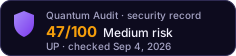

1 Low2 Informational
Volume 24h
$29.8K
Liquidity
$472.3K
Price
$0.05255
Token Age
1y
Top 10 Holders
84.0%

Security Findings

Low

Centralized Ownership (Mitigated by Multisig)

L-01The `UpOFT` contract utilizes the `Ownable` pattern, granting a single address (the `_delegate` passed in the constructor) exclusive control over sensitive functions such as `sweepNative` and potentially other administrative functions inherited from the `OFT` base contract. While this pattern is common, it introduces a single point of failure if the owner's private key is compromised.
IssueThe `UpOFT` contract utilizes the `Ownable` pattern, granting a single address (the `_delegate` passed in the constructor) exclusive control over sensitive functions such as `sweepNative` and potentially other administrative functions inherited from the `OFT` base contract. While this pattern is common, it introduces a single point of failure if the owner's private key is compromised.
FixThe provided information indicates the owner address is a multisig with a 2/4 threshold. This significantly mitigates the risk of a single point of failure. Ensure the multisig signers are distinct, trusted individuals and that the multisig itself is securely managed through robust operational security practices.
StatusUnresolved
Info

Reliance on LayerZero Protocol Security

I-01The `UpOFT` contract heavily relies on the security and correct functioning of the LayerZero v2 protocol and its endpoint. As an Omni-chain Fungible Token (OFT), its core cross-chain transfer capabilities are entirely dependent on the LayerZero infrastructure. Any vulnerabilities, misconfigurations, or operational issues within the LayerZero protocol could directly impact the `UpOFT` token's cross-chain functionality, integrity, and overall economic stability.
IssueThe `UpOFT` contract heavily relies on the security and correct functioning of the LayerZero v2 protocol and its endpoint. As an Omni-chain Fungible Token (OFT), its core cross-chain transfer capabilities are entirely dependent on the LayerZero infrastructure. Any vulnerabilities, misconfigurations, or operational issues within the LayerZero protocol could directly impact the `UpOFT` token's cross-chain functionality, integrity, and overall economic stability.
FixIt is crucial to continuously monitor LayerZero security announcements, audits, and operational status. Ensure that the configured `_lzEndpoint` address is the official, verified, and most secure endpoint for the respective network. Maintain a robust incident response plan for potential issues originating from external dependencies.
StatusUnresolved
Info

Non-Upgradeable Contract Design

I-02The `UpOFT` contract is deployed as a standard, non-upgradeable contract. This design choice means that once deployed, its code cannot be modified. While this simplifies the contract's architecture and eliminates risks associated with upgrade mechanisms (e.g., proxy vulnerabilities), it also implies that any discovered bugs, security vulnerabilities, or desired feature enhancements would necessitate a complete redeployment of the contract. Such a redeployment would require users to migrate their tokens to the new contract, which can be a complex, costly, and disruptive process.
IssueThe `UpOFT` contract is deployed as a standard, non-upgradeable contract. This design choice means that once deployed, its code cannot be modified. While this simplifies the contract's architecture and eliminates risks associated with upgrade mechanisms (e.g., proxy vulnerabilities), it also implies that any discovered bugs, security vulnerabilities, or desired feature enhancements would necessitate a complete redeployment of the contract. Such a redeployment would require users to migrate their tokens to the new contract, which can be a complex, costly, and disruptive process.
FixFor contracts intended for long-term use or those with evolving feature sets, consider implementing an upgradeable proxy pattern (e.g., UUPS, Transparent). If immutability is a deliberate design choice, ensure thorough testing and auditing to minimize the likelihood of critical bugs, and have a clear migration strategy in place should a redeployment become necessary.
StatusUnresolved

Category Ratings

TechnicalLow8/10

The UpOFT contract demonstrates strong technical security. It correctly inherits from LayerZero's OFT and OpenZeppelin's Ownable, ensuring standard and audited base functionalities (7.1 Architecture). The constructor includes a necessary check for a valid LayerZero endpoint address, preventing deployment with a zero address. The `sweepNative` function, designed to recover accidentally sent native tokens, is secured with `onlyOwner` and uses a low-level `call` with a success check, effectively preventing reentrancy and ensuring robust error handling (7.2 Code Security). Access control is appropriately enforced via the `onlyOwner` modifier for administrative functions (7.3 Access Control).

GovernanceHigh1/10

The contract's governance model relies on the `Ownable` pattern, where a single address (the `_delegate` from the constructor) holds administrative control (7.5 Governance). This centralized control is mitigated by the owner being a multisig wallet, reducing the risk of a single point of failure. Economically, the contract's primary function as an OFT means its value and cross-chain functionality are directly tied to the security and operational integrity of the underlying LayerZero v2 protocol (7.4 Economic). Any issues with LayerZero's messaging or bridging mechanisms could impact the token's utility and value (7.6 External).

UpgradesLow7/10

The UpOFT contract is not designed to be upgradeable (7.7 Upgrades). This design choice simplifies the contract's architecture and reduces the attack surface associated with proxy patterns. However, it also means that any discovered vulnerabilities, critical bugs, or desired feature enhancements would necessitate a complete redeployment of the contract and a migration of assets, which can be a complex and costly operational undertaking (7.8 Operations).

Security Checklist

Contract VerifiedPass
Ownership RenouncedFail
No Mint FunctionPass
Liquidity LockedFail
Not a ProxyPass

Holder Composition

76.0% in wallets8.0% in contracts
Effective Concentration79.2%

Share held by contracts — treasury, vesting, bridge or staking — is discounted against share held by wallets when the score is computed: a contract cannot decide to sell the way an anonymous holder can, though it can still be drained or voted to sell. Effective concentration is the figure the risk score is actually calculated from.

Liquidity Depth

Show 4 more pairsShow less

The risk score reads depth across every pair. The volume figure and the volume-to-liquidity ratio elsewhere on this page describe only the pair this audit analysed, so the two are not directly comparable.

LP Distribution

Top-1 Unlocked Holder100.0%
Top-3 Unlocked100.0%

Key Addresses

Deployer
0x6e3d…8df8
Unlocked LP Held By
0x3b80…2013

No privileged address appears among these holders: the unlocked liquidity sits with independent providers, not with the deployer.

What Raised This Score

  • Ownership NOT renounced — Multisig (2-of-4)
  • Top-10 concentration > 70% (84.0% total → 79.2% effective; 76.0% in EOAs, 8.0% in contracts — extreme)
  • Liquidity not locked, but no owner/deployer address holds LP — market-depth risk, not rug risk
  • LP top1 unlocked holder = 100.0% (independent LP — depth risk, pool = 95% of DEX liquidity)
  • LP top3 unlocked holders = 100.0% (independent LP — depth risk, pool = 95% of DEX liquidity)
  • 1 Low finding(s) from audit

Each factor is an on-chain fact recorded at the time of this analysis. The score is computed from them by a deterministic function, so the same contract returns the same score for anyone who runs the audit. How scores are computed

Related Audits

ViciCoin (VCNT)High RiskgitlawbHigh RiskWrapped liquid staked Ether 2.0 (WSTETH)High RiskaeonHigh RiskCoinbase Wrapped Staked ETH (CBETH)High RiskThe Innovation Game (TIG)High Risk

Would You Like a More Detailed Audit of Superform?

Our AI-powered scanner gives you a deeper, real-time smart contract analysis — free, with every scoring factor shown.

Get Detailed Audit