Quantum Audit Logo

Is Smart Solve Token Safe?

On-chain security analysis — is it a scam or legit?

Is this your token? Publish your own audit on this page →

Smart Solve Token SST
0x8db2…2469
BNB Chain Not verifiedLast checked 3d ago 1 audit on record
Executive SummaryAI Copilot

The provided source code for the SmartSolveToken contract is incomplete, significantly hindering a comprehensive security assessment. While the contract utilizes standard OpenZeppelin ERC20, ERC20Burnable, and Ownable implementations, the custom logic, including the constructor and any unique tokenomics, is truncated. This prevents a thorough analysis of potential vulnerabilities such as reentrancy, access control flaws in custom functions, or economic exploits related to the token's specific mechanisms. A full audit requires the complete and deployable source code.
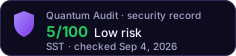

1 Critical2 Low3 Informational
Volume 24h
$21.7K
Liquidity
$1.34M
Price
$441.0860
Token Age
1mo
Top 10 Holders
99.9%

Security Findings

Critical

Incomplete Source Code Provided

C-01The provided Solidity source code for the `SmartSolveToken` contract is truncated, specifically at the `constructor` declaration and potentially other custom functions. This prevents a complete and accurate security assessment of the contract's unique logic, initialization, and any custom tokenomics or external interactions. Critical vulnerabilities could exist in the missing code that cannot be identified or verified.
IssueThe provided Solidity source code for the `SmartSolveToken` contract is truncated, specifically at the `constructor` declaration and potentially other custom functions. This prevents a complete and accurate security assessment of the contract's unique logic, initialization, and any custom tokenomics or external interactions. Critical vulnerabilities could exist in the missing code that cannot be identified or verified.
FixProvide the complete and deployable source code for the `SmartSolveToken` contract, including all custom functions, constructor logic, and any other relevant contract files. A full audit cannot be performed without this information.
StatusUnresolved
Low

Centralized Control by Owner

L-01The contract inherits `Ownable`, granting a single address (the owner) exclusive control over critical functions, such as `renounceOwnership` and `transferOwnership`. While standard for many tokens, this introduces a single point of failure. If the owner's private key is compromised, malicious actions could be performed.
IssueThe contract inherits `Ownable`, granting a single address (the owner) exclusive control over critical functions, such as `renounceOwnership` and `transferOwnership`. While standard for many tokens, this introduces a single point of failure. If the owner's private key is compromised, malicious actions could be performed.
FixConsider implementing a multi-signature wallet for ownership to distribute control and reduce the risk associated with a single point of failure. Alternatively, ensure robust security practices for the owner's private key.
StatusUnresolved
Low

Potential for Oracle Manipulation or Staleness (athPrice)

L-02The contract declares a public `athPrice` variable and interacts with `IPancakePair`. Without the full code, it's unclear how `athPrice` is set or updated. If it relies on a single, unaudited oracle, manual input, or a simple DEX price feed without proper safeguards (e.g., TWAP, sanity checks), it could be susceptible to manipulation or become stale, impacting any dependent logic.
IssueThe contract declares a public `athPrice` variable and interacts with `IPancakePair`. Without the full code, it's unclear how `athPrice` is set or updated. If it relies on a single, unaudited oracle, manual input, or a simple DEX price feed without proper safeguards (e.g., TWAP, sanity checks), it could be susceptible to manipulation or become stale, impacting any dependent logic.
FixIf `athPrice` is used for critical operations, ensure its value is derived from a robust, decentralized oracle solution (e.g., Chainlink) or a time-weighted average price (TWAP) from a reliable DEX, with appropriate deviation checks and circuit breakers. Document the oracle mechanism clearly.
StatusUnresolved
Info

Use of Unchecked Blocks in ERC20 Operations

I-01The `_update` function within the `ERC20` base contract uses `unchecked` blocks for `_balances` and `_totalSupply` arithmetic. This is a standard optimization in OpenZeppelin contracts, relying on prior checks (e.g., `fromBalance < value` for insufficient balance) to prevent underflows and overflows.
IssueThe `_update` function within the `ERC20` base contract uses `unchecked` blocks for `_balances` and `_totalSupply` arithmetic. This is a standard optimization in OpenZeppelin contracts, relying on prior checks (e.g., `fromBalance < value` for insufficient balance) to prevent underflows and overflows.
FixThis is standard and generally safe due to preceding checks. No direct action is required for the OpenZeppelin implementation. However, any custom logic interacting with these `_update` calls or performing similar arithmetic should ensure robust checks are in place before `unchecked` blocks are used.
StatusUnresolved
Info

Complex Tokenomics Indicated by Variables

I-02The contract includes variables such as `liquidityProvider`, `stakingContract`, `pancakePair`, and `taxPhase`. These suggest the implementation of complex tokenomics, potentially involving transaction taxes, liquidity provision, and staking mechanisms. Such features often introduce intricate logic that requires careful design and auditing.
IssueThe contract includes variables such as `liquidityProvider`, `stakingContract`, `pancakePair`, and `taxPhase`. These suggest the implementation of complex tokenomics, potentially involving transaction taxes, liquidity provision, and staking mechanisms. Such features often introduce intricate logic that requires careful design and auditing.
FixOnce the complete code is available, thoroughly review all custom logic related to these variables. Pay close attention to tax calculations, fee distribution, interactions with external protocols (like PancakeSwap), and potential edge cases that could lead to unexpected behavior or economic exploits.
StatusUnresolved
Info

Typo in Constructor Declaration

I-03The provided code snippet shows `construct` instead of `constructor` for the contract's initialization function. This is a syntax error that would prevent compilation.
IssueThe provided code snippet shows `construct` instead of `constructor` for the contract's initialization function. This is a syntax error that would prevent compilation.
FixCorrect the typo from `construct` to `constructor` to ensure the contract compiles successfully.
StatusUnresolved

Category Ratings

TechnicalLow8/10

The contract leverages well-audited OpenZeppelin libraries for ERC20, ERC20Burnable, and Ownable functionalities (7.2 Code Security). These provide a strong foundation for standard token operations. However, the custom implementation details, including the constructor and any unique transfer logic, are missing from the provided source code. This critical omission prevents a thorough assessment of potential technical vulnerabilities such as reentrancy, integer overflows in custom calculations, or logic errors (7.1 Architecture).

GovernanceLow8/10

The contract uses the Ownable pattern, granting significant control to a single owner address (7.3 Access Control). This is a common design choice but introduces centralization risk. Variables like `athPrice` and `taxPhase` suggest complex tokenomics and potential interactions with external protocols like PancakeSwap (7.4 Economic, 7.6 External). Without the full implementation, the economic stability, potential for oracle manipulation, or specific tax mechanisms cannot be fully evaluated (7.5 Governance).

UpgradesLow9/10

The SmartSolveToken contract is not designed as an upgradeable proxy (7.7 Upgrades). This simplifies the architecture by removing upgrade-related complexities and risks. However, it means that any discovered vulnerabilities or desired feature changes would necessitate a new contract deployment and migration of assets, which can be a complex and costly process (7.8 Operations).

Security Checklist

Contract VerifiedPass
Ownership RenouncedPass
No Mint FunctionPass
Liquidity LockedPass
Not a ProxyPass

Holder Composition

0.0% in wallets99.9% in contracts
Effective Concentration40.0%

Share held by contracts — treasury, vesting, bridge or staking — is discounted against share held by wallets when the score is computed: a contract cannot decide to sell the way an anonymous holder can, though it can still be drained or voted to sell. Effective concentration is the figure the risk score is actually calculated from.

Liquidity Depth

The risk score reads depth across every pair. The volume figure and the volume-to-liquidity ratio elsewhere on this page describe only the pair this audit analysed, so the two are not directly comparable.

LP Distribution

LP Burned100.0% · ≈ permanent lock
LP Locked100.0% · Null Address

Key Addresses

Deployer
0x0abb…ff2b

What Raised This Score

  • Top-10 concentration > 30% (99.9% total → 40.0% effective; 0.0% in EOAs, 99.9% in contracts — moderate)
  • 1 Critical finding(s) from audit
  • 2 Low finding(s) from audit

Each factor is an on-chain fact recorded at the time of this analysis. The score is computed from them by a deterministic function, so the same contract returns the same score for anyone who runs the audit. How scores are computed

Related Audits

Tagger (TAG)Low RiskMarscoin (MARS)Low RiskBanana For Scale (BANANAS31)Low RiskBroccoliLow RiskPaluLow Risk哈基米Low Risk

Would You Like a More Detailed Audit of Smart Solve Token?

Our AI-powered scanner gives you a deeper, real-time smart contract analysis — free, with every scoring factor shown.

Get Detailed Audit