The Roba token contract is a standard ERC20 implementation, inheriting functionalities from OpenZeppelin's ERC20, ERC20Burnable, and ERC20Permit. It features a fixed total supply minted at deployment to a specified recipient. The contract contains no custom logic beyond the constructor, relying entirely on battle-tested OpenZeppelin libraries. This design choice results in a highly secure and predictable token with minimal attack surface.
On-chain security analysis — is it a scam or legit?
Is Roba Safe?
Not verified
This record has not gone through deep verification and is not being monitored. The score is a dated snapshot — the token’s risk can change at any time.Own this token? Put it under verification →The Roba token contract is a standard ERC20 implementation, inheriting functionalities from OpenZeppelin's ERC20, ERC20Burnable, and ERC20Permit.
Read the full analysis- Ownership status UNKNOWN
- Top-10 concentration > 20%
- Liquidity not locked, but no owner/deployer address holds LP — market-depth risk, not rug risk
Exact factors
- Ownership status UNKNOWN (owner could not be resolved)
- Top-10 concentration > 20% (32.6% total → 20.2% effective; 12.0% in EOAs, 20.5% in contracts — mild)
- Liquidity not locked, but no owner/deployer address holds LP — market-depth risk, not rug risk
Security Checklist
as of audit · Sep 22Holders
as of audit · Sep 22, 2026- Contractstreasury, vesting, bridge, staking20.5%
- Walletsanonymous holders, free to sell12.0%
- Everyone elsethe rest of the supply67.4%
How holder types affect the score
Share held by contracts — treasury, vesting, bridge or staking — is discounted against share held by wallets when the score is computed: a contract cannot decide to sell the way an anonymous holder can, though it can still be drained or voted to sell. Effective concentration is the figure the risk score is actually calculated from.
Holder balances as recorded by the audit of Sep 22, 2026
Liquidity
as of audit · Sep 22The LP tokens of the analysed pool are not locked or burned, so whoever holds them can withdraw that liquidity.
0x9b05…520a0xaaed…6d6e0x57d5…eb050x3662…ba860xc43a…d5160xaf84…53150x0762…a2140xfa8b…bca70xb714…7caf0xda5b…f984No privileged address appears among these holders: the unlocked liquidity sits with independent providers, not with the deployer.
Security Findings
LowImmutability and Fixed Supply
Not confirmed by static analysis (the model's own reading of the source).L-01
Issue
Not confirmed by static analysis (the model's own reading of the source). The token's total supply is fixed at deployment (1,000,000,000 ROBA) and minted entirely to a single recipient. There are no functions to mint additional tokens or modify the supply post-deployment. While this ensures a predictable token economy and prevents inflationary attacks, it also limits any future flexibility for tokenomics adjustments or ecosystem incentives.
Fix
This is a design choice. Ensure that the fixed supply and initial distribution strategy align with the long-term vision and economic model of the project. If future flexibility is desired, a different token design with controlled minting/burning mechanisms would be required.
Status
Unresolved
LowAbsence of Administrative Roles
Not confirmed by static analysis (the model's own reading of the source).L-02
Issue
Not confirmed by static analysis (the model's own reading of the source). The contract does not implement any administrative roles such as an owner, pauser, minter, or blacklister. This design choice enhances decentralization by removing central points of control and potential attack vectors associated with privileged roles. However, it also means that no emergency actions (e.g., pausing transfers in case of a critical vulnerability or blacklisting malicious addresses) can be taken post-deployment.
Fix
This is a deliberate design choice for decentralization. Projects should be fully aware of the implications: the contract is immutable and unmanageable after deployment. If emergency control or future administrative capabilities are deemed necessary, a different contract architecture with appropriate access control mechanisms should be considered.
Status
Unresolved
InfoStandard OpenZeppelin Implementation
Not confirmed by static analysis (the model's own reading of the source).I-01
Issue
Not confirmed by static analysis (the model's own reading of the source). The Roba contract is a direct implementation of ERC20, ERC20Burnable, and ERC20Permit using battle-tested OpenZeppelin libraries. This approach significantly reduces the risk of common smart contract vulnerabilities, as the underlying components have undergone extensive audits and community review.
Fix
No specific recommendation is needed for this finding, as it highlights a strength. Continue to monitor OpenZeppelin updates for any critical security patches, although direct contract updates are not possible for this immutable contract.
Status
Unresolved
InfoERC20Permit Feature for Gasless Approvals
Not confirmed by static analysis (the model's own reading of the source).I-02
Issue
Not confirmed by static analysis (the model's own reading of the source). The inclusion of the ERC20Permit extension allows users to approve token spending by signing an off-chain message, enabling gasless approvals. This improves user experience by separating the approval action from the on-chain transaction. OpenZeppelin's implementation correctly uses nonces to prevent replay attacks, but users must still handle signed messages securely.
Fix
Educate users about the permit function, its benefits, and the importance of securing their private keys and being cautious about signing messages. Ensure any front-end interfaces interacting with permit clearly explain the implications of signing such transactions.
Status
Unresolved
Analysis
AI Copilotas of audit · Sep 22The technical architecture (7.1) of the Roba token is robust, leveraging well-audited OpenZeppelin contracts for its core ERC20, burnable, and permit functionalities. The code security (7.2) is high due to the minimal custom logic and reliance on battle-tested libraries, mitigating common vulnerabilities like reentrancy and integer overflows. Access control (7.3) is decentralized, as the token has no administrative roles, ensuring no single entity can control token transfers or supply. External interactions (7.6) are limited to standard ERC20 interfaces, reducing attack vectors.
The economic model (7.4) of the Roba token is straightforward: a fixed supply is minted at creation, with no provisions for future minting or burning by an administrator. This ensures predictability but limits flexibility for future tokenomics adjustments. Governance (7.5) is entirely decentralized, as the contract lacks any administrative roles or upgrade mechanisms. This design choice eliminates central points of failure but also means no emergency actions (e.g., pausing transfers, blacklisting) can be taken in unforeseen circumstances.
The Roba token contract is not designed to be upgradeable (7.7). It does not implement any proxy patterns or upgrade mechanisms. This eliminates all risks associated with upgradeability, such as proxy implementation bugs, upgrade path vulnerabilities, or administrative key compromises related to upgrades. The contract's immutability ensures its code remains unchanged post-deployment.
The Roba token contract is a secure and straightforward implementation of an ERC20 token using OpenZeppelin standards.
Users should be educated on the implications of the ERC20Permit function, particularly regarding signature security. While the lack of administrative control enhances decentralization, the project team should be aware that no emergency actions can be taken post-deployment. Thorough testing of all integrated systems interacting with this token is recommended.
Contract & Record
Free for any token on the record. It links to this page and always shows the current score and the date it was checked.
- Sep 22, 202616Low
Score changes are recorded as dated snapshots — history is append-only and cannot be edited.
Frequently Asked Questions
What is the ROBA contract address?
The Roba contract on Base is 0xe88419a3fc78364cfe3de88080ee4853fab754c6. Compare it with the address the project itself publishes before trading: other contracts can carry the same name and ticker.
Is Roba a scam?
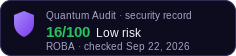
Quantum Audit's risk score for Roba is 16/100 (Low risk) as of Sep 22, 2026, computed by a deterministic function from on-chain facts — Contract verified: Verified; Mint: No mint; Liquidity lock: Not locked; Upgradeability: Fixed code; Honeypot: None found; Buy / sell tax: 0% / 0%. A score is a dated snapshot of those facts, not a guarantee; each one is listed on this page.
Is ROBA liquidity locked?
Liquidity lock: Not locked (as of Sep 22, 2026). Total DEX liquidity: $95.8K.
Who holds ROBA?
As of Sep 22, 2026, the 10 largest holders own 32.6% of the supply. The Holders section on this page shows who they are by holder type.
Would You Like a More Detailed Audit of Roba?
Our AI-powered scanner gives you a deeper, real-time smart contract analysis — free, with every scoring factor shown.
Get Detailed Audit Is this your token? Add your links and get it Verified