
Quantum Audit Logo

Is NVIDIA Corporation Safe?

On-chain security analysis — is it a scam or legit?

NVIDIA Corporation NVDAC
0xb200…108c
Base Not verifiedLast checked 3d ago 1 audit on record
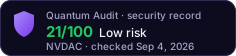
How is this score calculated? → Medium Risk
Executive SummaryAI Copilot

This audit report is based on the analysis of a contract address on the Base network without access to its verified source code. Consequently, a comprehensive security assessment of the contract's logic, architecture, and potential vulnerabilities could not be performed. The risk levels assigned reflect the inherent uncertainty and lack of transparency due to the absence of source code.

3 Informational
Volume 24h
$8.82M
Liquidity
$1.91M
Price
$230.1900
Token Age
1y
Top 10 Holders
58.1%

Security Findings

Info

Lack of Verified Source Code

I-01The source code for the contract at 0xb200…108c is not verified on the block explorer. This prevents any form of security analysis, architectural review (7.1 Architecture), or code security assessment (7.2 Code Security). Users cannot independently verify the contract's intended functionality or identify potential vulnerabilities.
IssueThe source code for the contract at is not verified on the block explorer. This prevents any form of security analysis, architectural review (7.1 Architecture), or code security assessment (7.2 Code Security). Users cannot independently verify the contract's intended functionality or identify potential vulnerabilities.
FixVerify the contract's source code on the block explorer. This is a fundamental step for transparency and allows for proper security auditing and community trust.
StatusUnresolved
Info

Undetermined Access Control Mechanisms

I-02Without source code, the access control mechanisms (7.3 Access Control) governing critical functions are unknown. It is impossible to ascertain if administrative privileges are properly secured, if a multi-signature wallet is used, or if there are any single points of failure. This lack of visibility poses a significant risk, as an attacker could potentially exploit weak access controls if they exist.
IssueWithout source code, the access control mechanisms (7.3 Access Control) governing critical functions are unknown. It is impossible to ascertain if administrative privileges are properly secured, if a multi-signature wallet is used, or if there are any single points of failure. This lack of visibility poses a significant risk, as an attacker could potentially exploit weak access controls if they exist.
FixImplement robust access control mechanisms, preferably using a multi-signature wallet for critical operations. Clearly document and verify these controls within the source code to ensure transparency and security.
StatusUnresolved
Info

Unverifiable Economic Model and Tokenomics

I-03The economic model, fee structures, and tokenomics (7.4 Economic) of the contract cannot be verified without source code. This includes understanding how value is accrued, distributed, or if there are any mechanisms for inflation/deflation. The absence of this information makes it impossible to assess potential economic exploits or long-term sustainability, impacting user trust and investment decisions.
IssueThe economic model, fee structures, and tokenomics (7.4 Economic) of the contract cannot be verified without source code. This includes understanding how value is accrued, distributed, or if there are any mechanisms for inflation/deflation. The absence of this information makes it impossible to assess potential economic exploits or long-term sustainability, impacting user trust and investment decisions.
FixClearly define and document the economic model and tokenomics within the contract's source code and external documentation. Ensure that all financial flows and asset management logic are transparent and auditable.
StatusUnresolved

Category Ratings

TechnicalLow10/10

Without access to the contract's source code, a detailed technical analysis (7.1 Architecture, 7.2 Code Security) is impossible. The contract's internal logic, state variables, and function implementations remain unknown, preventing any assessment of common vulnerabilities like reentrancy, integer overflows, or access control flaws (7.3 Access Control). For example, it is impossible to determine if critical functions are properly protected or if external calls are handled securely (7.6 External). This lack of transparency introduces significant technical risk.

GovernanceHigh3/10

The economic model and governance mechanisms (7.4 Economic, 7.5 Governance) of the contract cannot be determined without source code. It is unknown how assets are managed, if there are any fees, or if the contract interacts with oracles (7.6 External) that could be manipulated. The absence of a clear governance structure means that critical decisions or parameter changes could be made without community oversight, posing a high risk to users. For instance, potential backdoors or privileged functions cannot be identified.

UpgradesMedium6/10

The upgradeability status of the contract (7.7 Upgrades) is unknown without source code. It is impossible to determine if the contract employs a proxy pattern (e.g., UUPS, Transparent) or if it is immutable. If it is upgradeable, the mechanisms for upgrades, such as multi-signature requirements or time locks, are not verifiable. This introduces a high risk, as an unverified upgrade mechanism could allow malicious changes to the contract's logic, impacting user funds and trust. The operational procedures (7.8 Operations) for any potential upgrades are also entirely opaque.

Security Checklist

Contract VerifiedPass
Ownership Renounced?
No Mint Function?
Liquidity LockedFail
Not a ProxyPass
HoneypotNoneBuy Tax0.0%Sell Tax0.0%

Holder Composition

2.2% in wallets56.0% in contracts
Effective Concentration24.6%

Share held by contracts — treasury, vesting, bridge or staking — is discounted against share held by wallets when the score is computed: a contract cannot decide to sell the way an anonymous holder can, though it can still be drained or voted to sell. Effective concentration is the figure the risk score is actually calculated from.

Liquidity Depth

Show 4 more pairsShow less

The 15 remaining pairs hold $13.2K between them and are not listed.

The risk score reads depth across every pair. The volume figure and the volume-to-liquidity ratio elsewhere on this page describe only the pair this audit analysed, so the two are not directly comparable.

LP Distribution

Top-1 Unlocked Holder58.2%
Top-3 Unlocked80.9%

Key Addresses

Unlocked LP Held By
0x39a3…98c10xa928…faea0x24dc…0cbe0xa19f…7b6a0x603b…b3a30x3a8b…6e860x62ce…5c8a0x4a4c…9cc70x31f9…9eda0x5810…8eaf

No privileged address appears among these holders: the unlocked liquidity sits with independent providers, not with the deployer.

What Raised This Score

  • Ownership status UNKNOWN (owner could not be resolved)
  • Mint capability UNKNOWN (implementation ABI unreadable)
  • Top-10 concentration > 20% (58.1% total → 24.6% effective; 2.2% in EOAs, 56.0% in contracts — mild)
  • Liquidity not locked, but no owner/deployer address holds LP — market-depth risk, not rug risk
  • LP top1 unlocked holder = 58.2% (independent LP — depth risk, pool = 70% of DEX liquidity)
  • LP top3 unlocked holders = 80.9% (independent LP — depth risk, pool = 70% of DEX liquidity)

Each factor is an on-chain fact recorded at the time of this analysis. The score is computed from them by a deterministic function, so the same contract returns the same score for anyone who runs the audit. How scores are computed

Related Audits

BLUE CHIP (BLUECHIP)Low RiskAlphabet Inc. (GOOGLC)Medium RiskFAILow RiskCLAWNCHMedium RiskKittehCoin (MEOW)Medium RiskSAIRILow Risk

Would You Like a More Detailed Audit of NVIDIA Corporation?

Our AI-powered scanner gives you a deeper, real-time smart contract analysis — free, with every scoring factor shown.

Get Detailed Audit