
Quantum Audit Logo

Is PancakeSwap Token Safe?

On-chain security analysis — is it a scam or legit?

Is this your token? Publish your own audit on this page →

PancakeSwap Token CAKE
0x0e09…ce82
BNB Chain Not verifiedLast checked 3d ago 1 audit on record
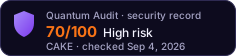
How is this score calculated? → Critical Risk
Executive SummaryAI Copilot

The audit of the provided BEP20 token contract identified a critical functional flaw: the token's total supply is uninitialized and there is no mechanism to mint new tokens, rendering the contract unusable for transfers. Additionally, the contract employs a standard Ownable pattern, centralizing administrative control, and exhibits a low-severity front-running risk common to ERC-20 allowance mechanisms. The contract otherwise demonstrates good code quality and utilizes established libraries for secure arithmetic and address interactions.

1 Critical1 Medium1 Low
Volume 24h
$1.11M
Liquidity
$5.05M
Price
$2.0140
Token Age
3y
Top 10 Holders
97.0%

Security Findings

Critical

Uninitialized Total Supply and No Minting Mechanism

C-01The `_totalSupply` state variable is initialized to 0 in the contract and there are no functions (e.g., `_mint` or an initial supply in the constructor) provided in the code to increase it. Consequently, the `totalSupply()` function will always return 0, and the `_balances` mapping will remain empty. This renders the token untransferable and completely unusable, as no tokens can ever exist or be moved.
IssueThe `_totalSupply` state variable is initialized to 0 in the contract and there are no functions (e.g., `_mint` or an initial supply in the constructor) provided in the code to increase it. Consequently, the `totalSupply()` function will always return 0, and the `_balances` mapping will remain empty. This renders the token untransferable and completely unusable, as no tokens can ever exist or be moved.
FixImplement a mechanism to initialize and/or increase the `_totalSupply`. This could involve minting an initial supply in the constructor or adding an owner-controlled `mint` function to create new tokens and assign them to specific addresses.
StatusUnresolved
Medium

Centralized Control by Owner

M-01The contract utilizes the `Ownable` pattern, granting a single `owner` address exclusive control over critical administrative functions such as `transferOwnership` and `renounceOwnership`. While common, this introduces a single point of failure. If the owner's private key is compromised, an attacker could gain full administrative control over the contract. The prefill indicates the owner is an 'OZ_ProxyAdmin', which suggests a more robust external governance mechanism might be in place, but from the contract's perspective, it's a single address.
IssueThe contract utilizes the `Ownable` pattern, granting a single `owner` address exclusive control over critical administrative functions such as `transferOwnership` and `renounceOwnership`. While common, this introduces a single point of failure. If the owner's private key is compromised, an attacker could gain full administrative control over the contract. The prefill indicates the owner is an 'OZ_ProxyAdmin', which suggests a more robust external governance mechanism might be in place, but from the contract's perspective, it's a single address.
FixConsider implementing a multi-signature wallet for the owner address or integrating a time-locked governance mechanism for critical operations. This would distribute control and add a delay to sensitive actions, enhancing security and decentralization.
StatusUnresolved
Low

Front-Running Risk in `decreaseAllowance`

L-01The `decreaseAllowance` function, while an improvement over directly setting allowance to zero, is still susceptible to front-running. If a user broadcasts a transaction to `decreaseAllowance`, an attacker monitoring the mempool could front-run this transaction by quickly spending the remaining allowance before the decrease takes effect. This is a known pattern in ERC-20 tokens.
IssueThe `decreaseAllowance` function, while an improvement over directly setting allowance to zero, is still susceptible to front-running. If a user broadcasts a transaction to `decreaseAllowance`, an attacker monitoring the mempool could front-run this transaction by quickly spending the remaining allowance before the decrease takes effect. This is a known pattern in ERC-20 tokens.
FixUsers should be aware of this inherent risk when interacting with allowance mechanisms. While no direct code change is typically made for this, users can mitigate risk by approving only necessary amounts or by using a transaction relay service that obscures transaction details until confirmation.
StatusUnresolved

Category Ratings

TechnicalMedium6/10

The contract demonstrates strong technical foundations by utilizing the SafeMath library (7.2 Code Security) to prevent integer overflows/underflows and the Address library for secure external interactions. The architecture (7.1 Architecture) follows standard ERC-20 patterns. However, a critical technical flaw exists where the token's total supply is never initialized or increased, making all transfer functions effectively non-functional (7.2 Code Security).

GovernanceHigh1/10

The contract implements the Ownable pattern (7.3 Access Control), centralizing administrative control to a single owner address, which is noted to be an OZ_ProxyAdmin externally. This introduces a single point of failure for critical operations like ownership transfer (7.5 Governance). Economically (7.4 Economic), the contract is critically flawed as the total supply is zero and no minting mechanism is present, preventing any token circulation or value.

UpgradesHigh2/10

The provided contract is not designed as an upgradeable proxy (7.7 Upgrades) and does not contain any upgrade-specific logic. Therefore, direct upgrade safety concerns for this specific contract are not applicable. Any upgradeability would be managed by an external proxy contract pointing to this implementation.

Security Checklist

Contract VerifiedPass
Ownership RenouncedFail
No Mint FunctionFail
Liquidity LockedFail
Not a ProxyPass

Holder Composition

96.0% in wallets0.9% in contracts
Effective Concentration96.4%

Share held by contracts — treasury, vesting, bridge or staking — is discounted against share held by wallets when the score is computed: a contract cannot decide to sell the way an anonymous holder can, though it can still be drained or voted to sell. Effective concentration is the figure the risk score is actually calculated from.

Liquidity Depth

Show 4 more pairsShow less

The 20 remaining pairs hold $442.7K between them and are not listed.

The risk score reads depth across every pair. The volume figure and the volume-to-liquidity ratio elsewhere on this page describe only the pair this audit analysed, so the two are not directly comparable.

Key Addresses

Deployer
0x0f93…3373

What Raised This Score

  • Ownership NOT renounced — owner is a contract (governance/executor, not an EOA)
  • Mintable supply — no cap found, dilution unbounded
  • Top-10 concentration > 70% (97.0% total → 96.4% effective; 96.0% in EOAs, 0.9% in contracts — extreme)
  • Liquidity NOT locked (owner can withdraw — rug-pull risk)
  • 1 Critical finding(s) from audit
  • 1 Medium finding(s) from audit
  • 1 Low finding(s) from audit

Each factor is an on-chain fact recorded at the time of this analysis. The score is computed from them by a deterministic function, so the same contract returns the same score for anyone who runs the audit. How scores are computed

Related Audits

Subsquid (SQD)Critical RiskBOBCritical RiskAnoma (XAN)Critical RiskelizaOSCritical RiskPlasma (XPL)Critical RiskMirex (MRX)Critical Risk

Would You Like a More Detailed Audit of PancakeSwap Token?

Our AI-powered scanner gives you a deeper, real-time smart contract analysis — free, with every scoring factor shown.

Get Detailed Audit