
Quantum Audit Logo

Is Orderly Network Safe?

On-chain security analysis — is it a scam or legit?

Orderly Network ORDER
0x4e20…97b8
Arbitrum Not verifiedLast checked 3d ago 1 audit on record
Executive SummaryAI Copilot

The OrderOFT contract serves as an Omnichain Fungible Token (OFT) for the Orderly Network, leveraging LayerZero V2 for cross-chain functionality. The contract utilizes standard OpenZeppelin upgradeable patterns (UUPS, Ownable, Pausable) and LayerZero's OApp framework. While the architecture is robust, the high degree of centralized control by the owner (a multisig) over critical functions such as upgrades, pausing, and LayerZero peer/delegate configuration introduces significant operational and security risks. Proper management of the owner's private keys and careful execution of administrative functions are paramount.
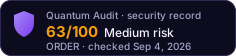

1 High2 Medium1 Low1 Informational
Volume 24h
$20.1K
Liquidity
$167.3K
Price
$0.03387
Token Age
1y
Top 10 Holders
89.0%

Security Findings

High

Centralized Control by Owner

H-01The contract grants extensive administrative privileges to a single owner address (a 2/3 multisig). This owner can pause the contract, initiate upgrades, set LayerZero peers, and configure the LayerZero delegate. While a multisig provides some resilience against a single point of failure, a compromise of the multisig's keys would allow an attacker to take full control of the OFT's operations, potentially leading to asset loss or system disruption.
IssueThe contract grants extensive administrative privileges to a single owner address (a 2/3 multisig). This owner can pause the contract, initiate upgrades, set LayerZero peers, and configure the LayerZero delegate. While a multisig provides some resilience against a single point of failure, a compromise of the multisig's keys would allow an attacker to take full control of the OFT's operations, potentially leading to asset loss or system disruption.
FixEnsure the multisig owner's operational security is paramount. Consider implementing a time-lock for critical administrative functions (e.g., upgrades, `setPeer`, `setDelegate`, `pause`) to introduce a delay between the transaction initiation and execution. This delay provides a window for detection and potential intervention, reducing the immediate impact of a compromised owner.
StatusUnresolved
Medium

Critical Initialization Parameters

M-01The `initialize` function takes `_lzEndpoint` and `_delegate` as critical parameters. The `_delegate` address is used to set both the contract's `Ownable` owner and the LayerZero endpoint's delegate. An incorrect or malicious address provided during initialization could lead to loss of ownership, misconfiguration of the LayerZero delegate, or unintended control over the contract.
IssueThe `initialize` function takes `_lzEndpoint` and `_delegate` as critical parameters. The `_delegate` address is used to set both the contract's `Ownable` owner and the LayerZero endpoint's delegate. An incorrect or malicious address provided during initialization could lead to loss of ownership, misconfiguration of the LayerZero delegate, or unintended control over the contract.
FixThoroughly verify all initialization parameters before deployment and execution. Implement a robust deployment process that includes multiple reviews of the initialization arguments. For production deployments, consider a multi-step initialization or a 'dry run' on a testnet to confirm correct setup.
StatusUnresolved
Medium

Reliance on LayerZero Endpoint Security

M-02The contract heavily relies on the security and correct functioning of the external LayerZero V2 endpoint. All cross-chain messaging, fee quoting, and token transfers (for LZ tokens) are routed through this endpoint. Any vulnerability, exploit, or misconfiguration within the LayerZero protocol or its endpoint could directly impact the security and functionality of the OrderOFT contract, potentially leading to frozen funds or unauthorized operations.
IssueThe contract heavily relies on the security and correct functioning of the external LayerZero V2 endpoint. All cross-chain messaging, fee quoting, and token transfers (for LZ tokens) are routed through this endpoint. Any vulnerability, exploit, or misconfiguration within the LayerZero protocol or its endpoint could directly impact the security and functionality of the OrderOFT contract, potentially leading to frozen funds or unauthorized operations.
FixMaintain continuous monitoring of LayerZero's security announcements and updates. Establish a robust incident response plan for scenarios involving LayerZero protocol vulnerabilities. While direct control over the LayerZero endpoint is not possible, understanding its security posture is crucial for the OFT's overall security.
StatusUnresolved
Low

Potential for Peer Misconfiguration

L-01The `setPeer` and `setPeers` functions, callable only by the owner, are responsible for configuring valid cross-chain communication paths by mapping `eid` (endpoint ID) to `peer` (remote OApp address). An incorrect peer configuration could lead to legitimate cross-chain messages being sent to unintended or malicious contracts, or prevent valid messages from being processed, disrupting cross-chain functionality.
IssueThe `setPeer` and `setPeers` functions, callable only by the owner, are responsible for configuring valid cross-chain communication paths by mapping `eid` (endpoint ID) to `peer` (remote OApp address). An incorrect peer configuration could lead to legitimate cross-chain messages being sent to unintended or malicious contracts, or prevent valid messages from being processed, disrupting cross-chain functionality.
FixImplement strict internal procedures for verifying LayerZero peer addresses before setting them. Consider adding an event listener or monitoring system to alert on any changes to peer configurations, allowing for quick detection of unauthorized or erroneous updates.
StatusUnresolved
Info

Gas Optimization for `setPeers` Function

I-01The `setPeers` function iterates through arrays (`_eids` and `_peers`) to set multiple peers in a single transaction. While functional, processing very large arrays in a single transaction could lead to high gas costs, potentially making the function expensive or even unusable if the array size exceeds block gas limits.
IssueThe `setPeers` function iterates through arrays (`_eids` and `_peers`) to set multiple peers in a single transaction. While functional, processing very large arrays in a single transaction could lead to high gas costs, potentially making the function expensive or even unusable if the array size exceeds block gas limits.
FixFor practical purposes, ensure that the expected number of peers to be set in a single call to `setPeers` remains within reasonable gas limits. If a very large number of peers needs to be configured, consider batching the operations into smaller transactions or optimizing the loop if possible, though the current implementation is standard for this pattern.
StatusUnresolved

Category Ratings

TechnicalLow8/10

The contract implements LayerZero's OFTUpgradeable standard, providing robust cross-chain token transfer capabilities (7.1 Architecture). It correctly uses OpenZeppelin's `SafeERC20` for token interactions and adheres to Solidity 0.8.20, mitigating common integer issues (7.2 Code Security). Access control for critical functions like `setPeer` and `setDelegate` is appropriately restricted to the owner (7.3 Access Control). However, the contract's heavy reliance on the LayerZero V2 endpoint means any vulnerabilities or misconfigurations within the external LayerZero protocol could directly impact the OFT's functionality and security (7.6 External).

GovernanceHigh2/10

The contract exhibits a high degree of centralized control, with the owner (a 2/3 multisig) possessing exclusive rights to critical administrative functions such as pausing the contract, upgrading its logic, and configuring LayerZero peers and delegates (7.5 Governance). While a multisig mitigates single-point-of-failure risks, compromise of the multisig's keys would grant an attacker full control over the OFT's operations and potentially the underlying token's cross-chain bridge. The economic model is primarily driven by LayerZero fees for cross-chain transfers, with no complex internal economic mechanisms (7.4 Economic).

UpgradesHigh2/10

The contract correctly implements the UUPS proxy pattern, allowing for future upgrades of its logic (7.7 Upgrades). The `_authorizeUpgrade` function is restricted to the `onlyOwner` modifier, ensuring that only the designated multisig can initiate upgrades. Storage gaps (`__gap`) are appropriately included in all upgradeable contracts to prevent storage collisions during upgrades. The primary risk associated with upgrades stems from the centralized control by the owner, as a compromised owner could deploy malicious logic.

Security Checklist

Contract VerifiedPass
Ownership RenouncedFail
No Mint FunctionPass
Liquidity LockedFail
Not a ProxyFail

Proxy Upgrade Controls

Proxy TypeEip1967 Uups
ImplementationVerified source
Upgrades (30d)0 · stable

Holder Composition

46.6% in wallets42.4% in contracts
Effective Concentration63.5%

Share held by contracts — treasury, vesting, bridge or staking — is discounted against share held by wallets when the score is computed: a contract cannot decide to sell the way an anonymous holder can, though it can still be drained or voted to sell. Effective concentration is the figure the risk score is actually calculated from.

Liquidity Depth

The risk score reads depth across every pair. The volume figure and the volume-to-liquidity ratio elsewhere on this page describe only the pair this audit analysed, so the two are not directly comparable.

LP Distribution

Top-1 Unlocked Holder75.5%
Top-3 Unlocked100.0%

Key Addresses

Deployer
0x4a82…d7f5
Unlocked LP Held By
0x745b…d37f0x2537…dfab

No privileged address appears among these holders: the unlocked liquidity sits with independent providers, not with the deployer.

What Raised This Score

  • Ownership NOT renounced — Multisig (2-of-3)
  • Proxy contract (upgradeable — admin can replace logic)
  • Top-10 concentration > 50% (89.0% total → 63.5% effective; 46.6% in EOAs, 42.4% in contracts — heavy)
  • Liquidity not locked, but no owner/deployer address holds LP — market-depth risk, not rug risk
  • LP top1 unlocked holder = 75.5% (independent LP — depth risk)
  • LP top3 unlocked holders = 100.0% (independent LP — depth risk)
  • 1 High finding(s) from audit
  • 2 Medium finding(s) from audit
  • 1 Low finding(s) from audit

Each factor is an on-chain fact recorded at the time of this analysis. The score is computed from them by a deterministic function, so the same contract returns the same score for anyone who runs the audit. How scores are computed

Related Audits

Espresso (ESP)High RiskLivepeer Token (LPT)High RiskGraph Token (GRT)High RiskCurve DAO Token (CRV)High RiskODYSHigh RiskNolaHigh Risk

Would You Like a More Detailed Audit of Orderly Network?

Our AI-powered scanner gives you a deeper, real-time smart contract analysis — free, with every scoring factor shown.

Get Detailed Audit