
Quantum Audit Logo

Is Livepeer Token Safe?

On-chain security analysis — is it a scam or legit?

Livepeer Token LPT
0x289b…a839
Arbitrum Not verifiedLast checked 3d ago 2 audits on record
Executive SummaryAI Copilot

The LivepeerToken contract is an ERC20 token implementation leveraging OpenZeppelin's battle-tested libraries for core functionality, including access control, burning, and permit functionality. The contract introduces specific roles for minting and burning tokens, managed by a `DEFAULT_ADMIN_ROLE`. While the code quality is high and standard vulnerabilities are mitigated by the Solidity version and library usage, the centralized control over token supply via these roles presents a significant operational and economic risk if the administrative keys are compromised. The contract is not upgradeable, ensuring immutability but requiring new deployments for any future changes.

1 High1 Medium1 Low1 Informational
Volume 24h
$376.3K
Liquidity
$239.1K
Price
$1.4700
Token Age
4y
Top 10 Holders
98.7%

Security Findings

High

Centralized Control over Token Supply

H-01The `DEFAULT_ADMIN_ROLE` has ultimate control over the token's supply by being able to grant and revoke both `MINTER_ROLE` and `BURNER_ROLE`. A compromise of the `DEFAULT_ADMIN_ROLE` would allow an attacker to mint an arbitrary amount of tokens, leading to hyperinflation, or burn all tokens, causing a denial of service for the token's utility. This centralization is a significant single point of failure for the token's economic stability (7.3 Access Control, 7.4 Economic, 7.5 Governance).
IssueThe `DEFAULT_ADMIN_ROLE` has ultimate control over the token's supply by being able to grant and revoke both `MINTER_ROLE` and `BURNER_ROLE`. A compromise of the `DEFAULT_ADMIN_ROLE` would allow an attacker to mint an arbitrary amount of tokens, leading to hyperinflation, or burn all tokens, causing a denial of service for the token's utility. This centralization is a significant single point of failure for the token's economic stability (7.3 Access Control, 7.4 Economic, 7.5 Governance).
FixImplement a robust multi-signature wallet for the `DEFAULT_ADMIN_ROLE` with a high number of required confirmations. Consider distributing the signers across different trusted entities. Explore decentralized governance mechanisms for critical role management in the long term.
StatusUnresolved
Medium

Single Point of Failure for Admin Role Management

M-01If the `DEFAULT_ADMIN_ROLE` is controlled by a single External Owned Account (EOA), it represents a single point of failure. The compromise of this EOA's private key would grant an attacker full control over the token's administrative functions, including the ability to assign themselves `MINTER_ROLE` or `BURNER_ROLE` (7.8 Operations).
IssueIf the `DEFAULT_ADMIN_ROLE` is controlled by a single External Owned Account (EOA), it represents a single point of failure. The compromise of this EOA's private key would grant an attacker full control over the token's administrative functions, including the ability to assign themselves `MINTER_ROLE` or `BURNER_ROLE` (7.8 Operations).
FixEnsure that the `DEFAULT_ADMIN_ROLE` is controlled by a multi-signature wallet (e.g., Gnosis Safe) rather than a single EOA. This significantly increases the security posture by requiring multiple approvals for critical operations.
StatusUnresolved
Low

Lack of Time-Locks for Critical Operations

L-01The contract does not implement time-locks for critical administrative actions, such as granting or revoking roles, or for large minting operations. While not a direct vulnerability, the absence of time-locks means that administrative changes or significant supply alterations can be executed immediately, leaving no window for community review or emergency intervention in case of a compromised key (7.8 Operations).
IssueThe contract does not implement time-locks for critical administrative actions, such as granting or revoking roles, or for large minting operations. While not a direct vulnerability, the absence of time-locks means that administrative changes or significant supply alterations can be executed immediately, leaving no window for community review or emergency intervention in case of a compromised key (7.8 Operations).
FixConsider integrating a time-lock mechanism for sensitive administrative functions. This would introduce a delay between the initiation and execution of critical operations, allowing for detection and potential mitigation of malicious actions.
StatusUnresolved
Info

Non-Upgradeability of Contract

I-01The LivepeerToken contract is deployed as a standard, non-upgradeable contract. This means its logic cannot be modified after deployment. While this provides immutability and reduces the risk of malicious upgrades, it also implies that any future bug fixes, feature enhancements, or protocol changes would require deploying a new contract and migrating all existing token holders, which can be a complex and disruptive process (7.7 Upgrades).
IssueThe LivepeerToken contract is deployed as a standard, non-upgradeable contract. This means its logic cannot be modified after deployment. While this provides immutability and reduces the risk of malicious upgrades, it also implies that any future bug fixes, feature enhancements, or protocol changes would require deploying a new contract and migrating all existing token holders, which can be a complex and disruptive process (7.7 Upgrades).
FixAcknowledge the implications of non-upgradeability. For future contracts, if flexibility is desired, consider implementing an upgradeable proxy pattern (e.g., UUPS or Transparent Proxy) from OpenZeppelin. For this contract, ensure robust testing and a clear migration plan if changes become necessary.
StatusUnresolved

Category Ratings

TechnicalLow7/10

The LivepeerToken contract demonstrates strong technical foundations (7.1 Architecture, 7.2 Code Security). It utilizes OpenZeppelin's `AccessControl`, `ERC20Burnable`, and `ERC20Permit` modules, which are well-audited and industry-standard. The use of Solidity 0.8.9 inherently protects against integer overflow/underflow vulnerabilities. The code is concise, readable, and follows common Solidity best practices, with clear role definitions for `MINTER_ROLE` and `BURNER_ROLE`. No reentrancy or other common EVM-specific vulnerabilities were identified.

GovernanceHigh1/10

The contract's economic model (7.4 Economic) and governance structure (7.5 Governance) are highly centralized. The `DEFAULT_ADMIN_ROLE` has the power to grant and revoke `MINTER_ROLE` and `BURNER_ROLE`, effectively controlling the token's total supply. While this is a common pattern for managed tokens, it introduces a significant centralization risk. A compromise of the `DEFAULT_ADMIN_ROLE` could lead to arbitrary token minting or burning, severely impacting the token's value and ecosystem integrity. Operational security (7.8 Operations) around the `DEFAULT_ADMIN_ROLE` is paramount.

UpgradesHigh3/10

The LivepeerToken contract is not designed with upgradeability in mind (7.7 Upgrades). It is a standard, immutable contract deployment. This design choice ensures that the contract's logic cannot be altered post-deployment, providing certainty and reducing the risk of malicious upgrades. However, it also means that any future bug fixes, feature enhancements, or changes to the token's logic would necessitate deploying an entirely new contract and migrating existing token holders, which can be a complex and costly process.

Security Checklist

Contract VerifiedPass
Ownership Renounced?
No Mint FunctionFail
Liquidity LockedFail
Not a ProxyPass

Holder Composition

16.1% in wallets82.7% in contracts
Effective Concentration49.1%

Share held by contracts — treasury, vesting, bridge or staking — is discounted against share held by wallets when the score is computed: a contract cannot decide to sell the way an anonymous holder can, though it can still be drained or voted to sell. Effective concentration is the figure the risk score is actually calculated from.

Liquidity Depth

The risk score reads depth across every pair. The volume figure and the volume-to-liquidity ratio elsewhere on this page describe only the pair this audit analysed, so the two are not directly comparable.

LP Distribution

Top-1 Unlocked Holder99.6%
Top-3 Unlocked100.0%

Key Addresses

Deployer
0xb5af…5fb5
Unlocked LP Held By
0xdfa8…b8e00xd84b…44a10xf502…fc230xeb2e…acbe

No privileged address appears among these holders: the unlocked liquidity sits with independent providers, not with the deployer.

What Raised This Score

  • Ownership status UNKNOWN (owner could not be resolved)
  • Mintable supply — no cap found, dilution unbounded
  • Top-10 concentration > 30% (98.7% total → 49.1% effective; 16.1% in EOAs, 82.7% in contracts — moderate)
  • Liquidity not locked, but no owner/deployer address holds LP — market-depth risk, not rug risk
  • LP top1 unlocked holder = 99.6% (independent LP — depth risk, pool = 100% of DEX liquidity)
  • LP top3 unlocked holders = 100.0% (independent LP — depth risk, pool = 100% of DEX liquidity)
  • 1 High finding(s) from audit
  • 1 Medium finding(s) from audit
  • 1 Low finding(s) from audit

Each factor is an on-chain fact recorded at the time of this analysis. The score is computed from them by a deterministic function, so the same contract returns the same score for anyone who runs the audit. How scores are computed

Frequently Asked Questions

Is Livepeer Token a scam?

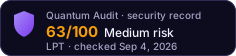
Based on automated analysis, Livepeer Token scores 67/100 (High Risk) on our risk scale. No honeypot was detected, but always verify independently before investing.

Is Livepeer Token safe to buy?

Our scanner flagged a risk score of 67/100. Ownership has not been renounced, which is a risk factor. DYOR before purchasing any token.

Has Livepeer Token been audited?

The contract has not been verified on-chain. Verification is not the same as a full security audit. Use Quantum Audit's free tool to run a deeper analysis of the contract code.

Related Audits

Espresso (ESP)High RiskOrderly Network (ORDER)High RiskGraph Token (GRT)High RiskCurve DAO Token (CRV)High RiskODYSHigh RiskNolaHigh Risk

Would You Like a More Detailed Audit of Livepeer Token?

Our AI-powered scanner gives you a deeper, real-time smart contract analysis — free, with every scoring factor shown.

Get Detailed Audit