
This audit report is based on a request for analysis of a smart contract at the provided address. However, no Solidity source code was supplied for review. Therefore, a comprehensive security assessment of the contract's implementation, logic, and potential vulnerabilities could not be performed. The findings below are general best practices and considerations for smart contract development, not specific vulnerabilities identified in the contract.
Early-stage security check — honeypot & rug-pull analysis
Is OpenUSD a Scam?
Not verified
This record has not gone through deep verification and is not being monitored. The score is a dated snapshot — the token’s risk can change at any time.Own this token? Put it under verification →This audit report is based on a request for analysis of a smart contract at the provided address.
Read the full analysis- Mint capability UNKNOWN
- Ownership status UNKNOWN
- Contract source not verified — its logic cannot be read
- LP lock status UNKNOWN — the pool's LP could not be read; this pool is 100% of DEX liquidity
Exact factors
- Mint capability UNKNOWN (implementation ABI unreadable)
- Ownership status UNKNOWN (owner could not be resolved)
- Contract source NOT verified — its logic cannot be read
- LP lock status UNKNOWN — the pool's LP could not be read; this pool is 100% of DEX liquidity
Security Checklist
as of audit · Oct 1Holders
as of audit · Oct 1, 2026How the supply is spread across holders could not be read — the indexer's holder list does not add up to the supply. Check the largest holders on a block explorer, which reads current balances.
Liquidity
as of audit · Oct 1Whether the LP tokens are locked could not be determined.
Security Findings
InfoAbsence of Source Code for Review
The Solidity source code for the contract at address 0xb200…5344 was not provided.I-01
Issue
The Solidity source code for the contract at address was not provided. This prevents any meaningful security analysis of the contract's implementation, logic, and potential vulnerabilities. Without the source, it is impossible to verify the contract's intended functionality or identify any security flaws.
Fix
Always provide the complete and verified Solidity source code for any contract intended for audit. This includes all imported libraries and dependencies. Ensure the provided source code matches the deployed bytecode.
Status
Unresolved
InfoImportance of Comprehensive Testing
Regardless of the contract's complexity, thorough testing is crucial.I-02
Issue
Regardless of the contract's complexity, thorough testing is crucial. This includes unit tests for individual functions, integration tests for inter-contract interactions, and fuzz testing to discover edge cases. Without source code, the extent of existing testing cannot be determined.
Fix
Implement a robust testing suite covering all critical paths and potential failure scenarios. Utilize tools like Hardhat, Foundry, and property-based testing frameworks to maximize test coverage and identify vulnerabilities early in the development cycle.
Status
Unresolved
InfoAccess Control Best Practices
Proper access control is fundamental to smart contract security, ensuring that only authorized entities can perform sensitive operations.I-03
Issue
Proper access control is fundamental to smart contract security, ensuring that only authorized entities can perform sensitive operations. Common patterns include Ownable, AccessControl, or custom role-based access. Without source code, the implementation of access control cannot be verified.
Fix
Clearly define and implement access control for all sensitive functions. Use established patterns like OpenZeppelin's Ownable or AccessControl and ensure that ownership or administrative roles are secured, ideally with multi-signature wallets.
Status
Unresolved
InfoConsideration for Upgradeability
If the contract is intended to be upgradeable (e.g., via a proxy pattern), the upgrade mechanism itself introduces a significant attack surface.I-04
Issue
If the contract is intended to be upgradeable (e.g., via a proxy pattern), the upgrade mechanism itself introduces a significant attack surface. Proper implementation of upgrade patterns (like UUPS or Transparent proxies) is critical. Without source code, it's unknown if the contract is upgradeable or how it's implemented.
Fix
If upgradeability is desired, use well-vetted proxy patterns and ensure that upgrade logic is secure, transparent, and subject to governance or multi-signature control. Thoroughly test upgrade paths and potential state migrations.
Status
Unresolved
InfoReview of Economic Model and External Dependencies
The economic model of a protocol, including tokenomics, fee structures, and incentive mechanisms, must be robust against manipulation.I-05
Issue
The economic model of a protocol, including tokenomics, fee structures, and incentive mechanisms, must be robust against manipulation. Additionally, interactions with external contracts (oracles, other DeFi protocols) introduce external risks. Without source code, these aspects cannot be assessed.
Fix
Conduct a comprehensive economic analysis to identify potential attack vectors such as flash loan exploits, oracle manipulation, or incentive misalignments. Carefully vet all external dependencies and understand their security profiles and potential failure modes.
Status
Unresolved
InfoListed, but not independently verified
Listed on CoinGecko as Open USD (OUSD).QA-IDENTITY
Issue
Listed on CoinGecko as Open USD (OUSD).
Fix
Match the contract address against the project's official channels before trading.
Status
Acknowledged
InfoThe market for this token
Liquidity $10.0M (DexScreener, all pools). 24h trading volume $189K (CoinGecko, all markets, daily snapshot).QA-MARKET
Issue
Liquidity $10.0M (DexScreener, all pools). 24h trading volume $189K (CoinGecko, all markets, daily snapshot). 24h trading volume $366K (DexScreener, all pools).
Fix
Size any position to the liquidity and daily volume shown — they set how much you can sell and at what price.
Status
Acknowledged
InfoAsset class: Stablecoin — issuer-backed (fiat reserves)
A token designed to hold a fixed value (usually $1). Its safety rests on what backs it and on who can mint, freeze or pause it.QA-PROFILE
Issue
A token designed to hold a fixed value (usually $1). Its safety rests on what backs it and on who can mint, freeze or pause it. Its identity is not independently verified, so it gets none of the allowances an established stablecoin gets: every power its owner holds over supply and transfers is scored in full, because a peg is only as good as whoever can mint. Basis: CoinGecko category: Fiat-backed Stablecoin. Tokenomics — Supply: mint capability could not be read. Control: an owner that could not be resolved. Code: not upgradeable (no proxy). Fees: no buy or sell tax. Market: $10.0M of DEX liquidity across 12 pools. Launch: 1 days of market history.
Fix
Check what backs the peg and who controls supply: reserve attestations for an issuer-backed coin, collateral and governance for a protocol coin.
Status
Acknowledged
InfoRecently launched — 1 day of market history
The token's oldest DEX pool is 1 day old.QA-RECENT
Issue
The token's oldest DEX pool is 1 day old.
Fix
Re-check ownership, liquidity and holder distribution as the token matures; those are the facts that move early.
Status
Acknowledged
Analysis
AI Copilotas of audit · Oct 1Due to the absence of provided Solidity source code, a technical analysis of the contract's architecture (7.1), code security (7.2), and access control mechanisms (7.3) could not be conducted. Without the code, it is impossible to identify common vulnerabilities such as reentrancy, integer overflows, or logic errors. Best practices typically include modular design and robust input validation.
Without the contract's source code, it is not possible to evaluate its economic model (7.4) or governance mechanisms (7.5). A robust economic model typically includes safeguards against manipulation and clear tokenomics. Effective governance often involves decentralized decision-making and transparent upgrade paths. External dependencies (7.6) and their potential impact also remain unknown.
The upgradeability strategy (7.7) and operational procedures (7.8) for the contract cannot be determined without access to its source code. If the contract is upgradeable, it is crucial to ensure that upgrade mechanisms are secure, well-tested, and transparent. Proper operational security includes multi-signature controls for critical functions and emergency pause capabilities.
For any smart contract deployment, it is paramount to conduct thorough security audits on the complete and final source code.
This includes reviewing the contract's logic, potential attack vectors, and adherence to best practices. Implement comprehensive testing, including unit, integration, and fuzz testing, to ensure all functionalities behave as expected under various conditions. Consider formal verification for critical components to mathematically prove their correctness.
Contract & Record
Free for any token on the record. It links to this page and always shows the current score and the date it was checked.
- Oct 1, 202655Medium
Score changes are recorded as dated snapshots — history is append-only and cannot be edited.
Frequently Asked Questions
What is the OUSD contract address?
The OpenUSD (OUSD) contract on Base is 0xb2000000000000000000002feb517dfec7415344. Compare it with the address the project itself publishes before trading: other contracts can carry the same name and ticker.
Is OpenUSD a scam?
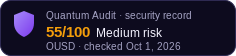
Quantum Audit's risk score for OpenUSD is 55/100 (Medium risk) as of Oct 1, 2026, computed by a deterministic function from on-chain facts — Contract verified: Not verified; Upgradeability: Fixed code. A score is a dated snapshot of those facts, not a guarantee; each one is listed on this page.
Would You Like a More Detailed Audit of OpenUSD?
This token is brand new. Run a deeper AI-powered analysis of the contract code — free and instant.
Get Detailed Audit Is this your token? Add your links and get it Verified