
This audit report is based on an unverified contract address where the source code was not provided. Therefore, a comprehensive security analysis for vulnerabilities, economic risks, or upgradeability concerns could not be performed. All risk levels are set to Low as no specific issues could be identified without code. Users should exercise extreme caution when interacting with unverified contracts.
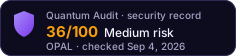
Early-stage security check — honeypot & rug-pull analysis
Is Opal a Scam?
Not verified
This record has not gone through deep verification and is not being monitored. The score is a dated snapshot — the token’s risk can change at any time.Own this token? Put it under verification →This audit report is based on an unverified contract address where the source code was not provided.
Read the full analysis- Ownership not renounced — owner is an EOA
- Top-10 concentration > 30%
- Token age < 7 days
Exact factors
- Ownership NOT renounced — owner is an EOA (single private key)
- Top-10 concentration > 30% (80.7% total → 35.9% effective; 6.1% in EOAs, 74.6% in contracts — moderate)
- Token age < 7 days (early, volatile)
Each factor is an on-chain fact recorded at the time of this analysis. The score is computed from them by a deterministic function, so the same contract returns the same score for anyone who runs the audit. How scores are computed
Security Checklist
as of audit · Sep 4Holders
as of audit · Sep 4, 2026- Contractstreasury, vesting, bridge, staking74.6%
- Walletsanonymous holders, free to sell6.1%
- Everyone elsethe rest of the supply19.3%
How holder types affect the score
Share held by contracts — treasury, vesting, bridge or staking — is discounted against share held by wallets when the score is computed: a contract cannot decide to sell the way an anonymous holder can, though it can still be drained or voted to sell. Effective concentration is the figure the risk score is actually calculated from.
Holder balances as recorded by the audit of Sep 4, 2026
Liquidity
as of audit · Sep 4The risk score reads depth across every pair.
The LP tokens of the analysed pool are locked or burned.
Security Findings
InfoSource Code Not Provided/Verified
The source code for the contract at 0x119b…cd1f was not provided or verified on the block explorer. This prevents any form of static analysis, dynamic testing, or manual review to identify vulnerabilities (7.2 Code Security). Without source code, the contract's intended functionality and security posture cannot be independently confirmed, posing a significant trust and transparency issue.I-01
Issue
The source code for the contract at was not provided or verified on the block explorer. This prevents any form of static analysis, dynamic testing, or manual review to identify vulnerabilities (7.2 Code Security). Without source code, the contract's intended functionality and security posture cannot be independently confirmed, posing a significant trust and transparency issue.
Fix
Always verify contract source code on block explorers. This allows for public scrutiny, independent audits, and user confidence in the contract's operations. Projects should prioritize transparency by publishing their code.
Status
Unresolved
InfoCentralization Risk from EOA Owner
The contract is owned by an Externally Owned Account (EOA) 0xa773…b13f. Without source code, the extent of control this owner has over critical functions (e.g., pausing, upgrading, fee changes, fund withdrawals) is unknown (7.3 Access Control). This poses a potential centralization risk, as a single entity could unilaterally execute privileged operations, potentially leading to censorship, fund manipulation, or other malicious actions.I-02
Issue
The contract is owned by an Externally Owned Account (EOA) . Without source code, the extent of control this owner has over critical functions (e.g., pausing, upgrading, fee changes, fund withdrawals) is unknown (7.3 Access Control). This poses a potential centralization risk, as a single entity could unilaterally execute privileged operations, potentially leading to censorship, fund manipulation, or other malicious actions.
Fix
Implement multi-signature wallets (e.g., Gnosis Safe) or decentralized governance mechanisms for critical administrative functions. This distributes control, reduces single points of failure, and enhances the security and trustlessness of the protocol.
Status
Unresolved
InfoUnknown External Dependencies and Interactions
Smart contracts often interact with other contracts, such as oracles, token contracts, or other DeFi protocols. Without source code, it's impossible to identify these external dependencies, assess their security, or understand the potential cascading risks from vulnerabilities in integrated protocols (7.6 External). This lack of visibility prevents a comprehensive risk assessment of the contract's broader ecosystem interactions.I-03
Issue
Smart contracts often interact with other contracts, such as oracles, token contracts, or other DeFi protocols. Without source code, it's impossible to identify these external dependencies, assess their security, or understand the potential cascading risks from vulnerabilities in integrated protocols (7.6 External). This lack of visibility prevents a comprehensive risk assessment of the contract's broader ecosystem interactions.
Fix
Clearly document all external dependencies and their respective contract addresses, functionalities, and security audit statuses. Ensure that all integrated protocols are robust, well-audited, and have strong security track records to minimize exposure to external risks.
Status
Unresolved
Analysis
AI Copilotas of audit · Sep 4Without access to the contract's source code, a technical security analysis (7.1 Architecture, 7.2 Code Security, 7.3 Access Control) cannot be performed. This prevents the identification of common vulnerabilities such as reentrancy, integer overflows, or logic errors. The lack of transparency significantly hinders any assessment of the contract's internal mechanisms and security posture, making it impossible to confirm adherence to secure coding practices.
An assessment of economic (7.4 Economic) and governance (7.5 Governance) risks is not possible without understanding the contract's functionality and tokenomics. The presence of an EOA owner () introduces a potential centralization risk, as a single entity controls critical functions. Without source code, the extent of this control and its implications for economic stability and governance remain unknown.
The contract's upgradeability status (7.7 Upgrades) is unknown as no source code was provided and is_proxy is false. Without this information, it's impossible to determine if the contract can be modified, which patterns are used (e.g., UUPS, Transparent), or what risks might be associated with potential upgrades. This lack of clarity impacts long-term security and maintainability, as future changes cannot be predicted or audited.
For any smart contract deployment, it is crucial to verify the source code on block explorers to ensure transparency and allow for public scrutiny.
Users should exercise extreme caution when interacting with unverified contracts, as their functionality and security cannot be independently confirmed. A full security audit requires complete access to the contract's source code and deployment configuration to identify and mitigate potential risks effectively.
Contract & Record
Free for any token on the record. It links to this page and always shows the current score and the date it was checked.
- Sep 4, 202636Medium
- Sep 2, 202664Medium
Score changes are recorded as dated snapshots — history is append-only and cannot be edited.
Frequently Asked Questions
What is the OPAL contract address?
The Opal contract on Base is 0x119b63b1605be3a8ff4543c7f76f7f1f79eecd1f. Compare it with the address the project itself publishes before trading: other contracts can carry the same name and ticker.
Is Opal a scam?
Quantum Audit's risk score for Opal is 36/100 (Medium risk) as of Sep 4, 2026, computed by a deterministic function from on-chain facts — Contract verified: Verified; Ownership: Retained; Mint: No mint; Liquidity lock: Locked; Upgradeability: Fixed code; Honeypot: None found; Buy / sell tax: 5% / 5%. A score is a dated snapshot of those facts, not a guarantee; each one is listed on this page.
Is OPAL liquidity locked?
Liquidity lock: Locked (as of Sep 4, 2026). Total DEX liquidity: $2.77M.
Who holds OPAL?
As of Sep 4, 2026, the 10 largest holders own 80.7% of the supply. The Holders section on this page shows who they are by holder type.
Would You Like a More Detailed Audit of Opal?
This token is brand new. Run a deeper AI-powered analysis of the contract code — free and instant.
Get Detailed Audit Is this your token? Publish your own audit on this page