
This audit covers a DelayedERC1967Proxy contract on the BSC network. The contract is a UUPS proxy, meaning its logic can be upgraded. Ownership and control over upgrades are managed by a 2-of-3 multisig wallet. No critical or high-severity vulnerabilities were identified in the proxy's code itself.

On-chain security analysis — is it a scam or legit?
Is MERL Safe?
Not verified
This record has not gone through deep verification and is not being monitored. The score is a dated snapshot — the token’s risk can change at any time.Own this token? Put it under verification →This audit covers a DelayedERC1967Proxy contract on the BSC network.
- Mint capability UNKNOWN
- Upgradeable proxy — the admin can replace the logic
- Liquidity not locked
- Top-10 concentration > 20%
Exact factors
- Mint capability UNKNOWN (implementation ABI unreadable)
- Upgradeable proxy — the admin can replace the logic
- Liquidity NOT locked (100% of the pool) — held by independent providers — market-depth risk
- Top-10 concentration > 20% (66.4% total → 29.3% effective; 20.4% in EOAs, 22.5% in contracts; 23.6% burned, locked or in pools excluded)
Security Checklist
as of audit · Oct 10Holders
as of audit · Oct 10, 2026- Contractstreasury, vesting, bridge, staking22.5%
- Walletsanonymous holders, free to sell20.4%
- DEX poolsthe pools' own liquidity23.6%
- Everyone else17,910 holders33.6%
How holder types affect the score
Share held by contracts — treasury, vesting, bridge or staking — is discounted against share held by wallets when the score is computed: a contract cannot decide to sell the way an anonymous holder can, though it can still be drained or voted to sell. Effective concentration is the figure the risk score is actually calculated from.
Holder balances as recorded by the audit of Oct 10, 2026
Liquidity
as of audit · Oct 10The LP tokens of the analysed pool are not locked or burned, so whoever holds them can withdraw that liquidity.
0x02c7…d10b0xf73d…9dc9No privileged address appears among these holders: the unlocked liquidity sits with independent providers, not with the deployer.
Security Findings
MediumLiquidity not locked
0.0% of the pool's LP is burned or time-locked. 100.0% is held, unlocked, by 2 address(es) other than the owner/deployer. One of them — a wallet, 0x02c7…d10b — holds 89.2% and can remove that share at once; who controls it is not visible on-chain, so it is not treated as an independent provider. Some pools are concentrated-liquidity (V3/V4) positions; shares above are by position as GoPlus reports them.QA-LIQUIDITY
Issue
0.0% of the pool's LP is burned or time-locked. 100.0% is held, unlocked, by 2 address(es) other than the owner/deployer. One of them — a wallet, 0x02c7…d10b — holds 89.2% and can remove that share at once; who controls it is not visible on-chain, so it is not treated as an independent provider. Some pools are concentrated-liquidity (V3/V4) positions; shares above are by position as GoPlus reports them.
Fix
Check the lock's end date and beneficiary on the locker's own page before relying on it.
Status
Acknowledged
InfoNo issues identified in the reviewed source
The verified source code was reviewed and no issue rising to Informational severity or above was identified. This is a statement about the code that was read, not a guarantee: the review covers the published source only. Fact-layer checks (mint/owner authority, holder concentration) were applied separately and feed the risk score.I-01
Issue
The verified source code was reviewed and no issue rising to Informational severity or above was identified. This is a statement about the code that was read, not a guarantee: the review covers the published source only. Fact-layer checks (mint/owner authority, holder concentration) were applied separately and feed the risk score.
Fix
Re-check after any contract upgrade or ownership change, both of which can alter behaviour without changing this page.
Status
Acknowledged
InfoWho holds the supply
The ten largest holders own 66.4% of supply. Of that, 23.6% in DEX pools — not holders that can sell, so excluded from the concentration score. What remains: 20.4% in wallets, 22.5% in other contracts. 17,920 holders in total.QA-HOLDERS
Issue
The ten largest holders own 66.4% of supply. Of that, 23.6% in DEX pools — not holders that can sell, so excluded from the concentration score. What remains: 20.4% in wallets, 22.5% in other contracts. 17,920 holders in total.
Fix
Watch the largest wallets that are not exchanges, pools or locks — those are the ones that can move the price.
Status
Acknowledged
InfoIdentity verified by independent sources
Listed on CoinGecko as Merlin Chain (MERL), market cap $65M, rank #403. 17,920 holders. Verified by: CoinGecko.QA-IDENTITY
Issue
Listed on CoinGecko as Merlin Chain (MERL), market cap $65M, rank #403. 17,920 holders. Verified by: CoinGecko.
Fix
Match the contract address against the project's official channels before trading.
Status
Acknowledged
InfoThe market for this token
Liquidity $2.0M (DexScreener, all pools). 24h trading volume $6.4M (CoinGecko, all markets, daily snapshot). 24h trading volume $2.9M (DexScreener, all pools). CoinGecko's record for this coin: all-time high $1.45 on 2024-04-19; the price is now 97.8596% below it.QA-MARKET
Issue
Liquidity $2.0M (DexScreener, all pools). 24h trading volume $6.4M (CoinGecko, all markets, daily snapshot). 24h trading volume $2.9M (DexScreener, all pools). CoinGecko's record for this coin: all-time high $1.45 on 2024-04-19; the price is now 97.8596% below it.
Fix
Size any position to the liquidity and daily volume shown — they set how much you can sell and at what price.
Status
Acknowledged
InfoAsset class: Project token
A token issued by a project for use, governance or fundraising. Scored on its contract and market facts. The class itself adds no points; the contract and market facts decide the score. Basis: no class-specific evidence. Tokenomics — Supply: mint capability could not be read. Control: a 2-of-3 multisig. Code: upgradeable proxy. Fees: no buy or sell tax. Market: $2.0M of DEX liquidity across 2 pools. Launch: 509 days of market history.QA-PROFILE
Issue
A token issued by a project for use, governance or fundraising. Scored on its contract and market facts. The class itself adds no points; the contract and market facts decide the score. Basis: no class-specific evidence. Tokenomics — Supply: mint capability could not be read. Control: a 2-of-3 multisig. Code: upgradeable proxy. Fees: no buy or sell tax. Market: $2.0M of DEX liquidity across 2 pools. Launch: 509 days of market history.
Fix
Check the project's own documentation for what the token is used for; this report covers what the contract allows.
Status
Acknowledged
Analysis
AI Copilotas of audit · Oct 107.1 Architecture, 7.2 Code Security: The contract functions as a DelayedERC1967Proxy, a standard UUPS proxy pattern, delegating calls to an implementation contract. It explicitly lacks direct ERC-20 token logic, indicating its role as an infrastructure component. Static analysis of the proxy code revealed no immediate technical vulnerabilities or privileged functions that directly alter transfer paths, suggesting a robust and minimal proxy architecture.
7.3 Access Control, 7.4 Economic, 7.5 Governance: Access control for the proxy's administrative functions, such as upgrades, is managed by a multisig wallet (2 out of 3 owners), significantly enhancing security against single points of failure. The proxy itself does not contain economic logic or directly manage token transfers, thus direct economic risks are deferred to its implementation. This setup strengthens governance over critical operational aspects.
7.7 Upgrades: The contract utilizes the UUPS proxy pattern, enabling future upgrades of its logic implementation. The upgrade mechanism is controlled by the designated multisig owner. While the 'Delayed' prefix in the contract name suggests a potential time-lock or delay mechanism for upgrades, the provided code map does not detail this specific functionality, meaning upgrades are subject to the multisig's direct action without explicit on-chain delays.
For a proxy contract, the primary security focus shifts to the implementation contract it points to and the upgrade process.
It is crucial to ensure that any future implementation contracts undergo thorough security audits before deployment. Maintain strict operational security for the controlling multisig wallet, and consider implementing a time-lock for upgrade operations if not already present, to provide a window for community review and emergency intervention.
Contract & Record
Free for any token on the record. It links to this page and always shows the current score and the date it was checked.
- Oct 10, 202629Low
Score changes are recorded as dated snapshots — history is append-only and cannot be edited.
Frequently Asked Questions
What is the MERL contract address?
The MERL contract on BNB Chain is 0xa0c56a8c0692bd10b3fa8f8ba79cf5332b7107f9. Compare it with the address the project itself publishes before trading: other contracts can carry the same name and ticker.
Is MERL a scam?
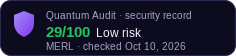
Quantum Audit's risk score for MERL is 29/100 (Low risk) as of Oct 10, 2026, computed by a deterministic function from on-chain facts — Contract verified: Verified; Ownership: Retained; Liquidity lock: Not locked; Upgradeability: Upgradeable; Honeypot: None found; Buy / sell tax: 0% / 0%. A score is a dated snapshot of those facts, not a guarantee; each one is listed on this page.
Is MERL liquidity locked?
Liquidity lock: Not locked (as of Oct 10, 2026). Total DEX liquidity: $2.02M.
Who holds MERL?
As of Oct 10, 2026, the 10 largest holders own 66.4% of the supply across 17,920 holders. The Holders section on this page shows who they are by holder type.
Would You Like a More Detailed Audit of MERL?
Our AI-powered scanner gives you a deeper, real-time smart contract analysis — free, with every scoring factor shown.
Get Detailed Audit Is this your token? Add your links and get it Verified