
Quantum Audit Logo

Is LQTY Safe?

On-chain security analysis — is it a scam or legit?

Is this your token? Publish your own audit on this page →

LQTY LQTY
0x6dea…c54d
Ethereum Not verifiedLast checked 3d ago 2 audits on record
Executive SummaryAI Copilot

The LQTYToken contract implements an ERC-20 token with EIP-2612 (Permit) functionality. It features a fixed supply, specific initial token allocations, and time-locked restrictions on the Liquity multisig's operations for the first year post-deployment. The contract utilizes OpenZeppelin's SafeMath for arithmetic safety and includes custom checks for valid recipients and core contract callers. Overall, the contract demonstrates robust design and implementation practices, with identified risks being primarily informational or low-severity, related to inherent design choices or standard EIP behaviors.
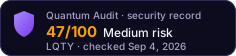

2 Low3 Informational
Volume 24h
$37.4K
Liquidity
$553.8K
Price
$0.2221
Token Age
5y
Top 10 Holders
84.8%

Security Findings

Low

Centralized Control via Multisig

L-01The `multisigAddress` receives a significant portion of the initial LQTY token supply (64.66 million tokens) and, after the initial one-year restriction period, will have unrestricted control over these tokens. While the initial time-locked restrictions mitigate immediate risks, the multisig remains a central point of control. A compromise of the multisig's private keys or its governance process could lead to unauthorized token movements.
IssueThe `multisigAddress` receives a significant portion of the initial LQTY token supply (64.66 million tokens) and, after the initial one-year restriction period, will have unrestricted control over these tokens. While the initial time-locked restrictions mitigate immediate risks, the multisig remains a central point of control. A compromise of the multisig's private keys or its governance process could lead to unauthorized token movements.
FixImplement robust security measures for the `multisigAddress`, including strong key management practices, multi-factor authentication, and strict operational procedures. Consider transitioning to more decentralized governance mechanisms over time if feasible.
StatusUnresolved
Low

Dependency on LockupContractFactory

L-02For the first year after deployment, the `multisigAddress` is restricted to only transferring LQTY tokens to `LockupContracts` that have been deployed via and registered in the `LockupContractFactory`. This introduces a dependency on the correct functioning and security of the `LockupContractFactory` contract. If the `LockupContractFactory` were compromised or malfunctioned, it could hinder the multisig's ability to distribute tokens as intended during the restricted period.
IssueFor the first year after deployment, the `multisigAddress` is restricted to only transferring LQTY tokens to `LockupContracts` that have been deployed via and registered in the `LockupContractFactory`. This introduces a dependency on the correct functioning and security of the `LockupContractFactory` contract. If the `LockupContractFactory` were compromised or malfunctioned, it could hinder the multisig's ability to distribute tokens as intended during the restricted period.
FixEnsure the `LockupContractFactory` contract is thoroughly audited and maintained with the highest security standards. Implement monitoring for the `LockupContractFactory` to detect any unusual activity or potential compromises that could impact the LQTY token distribution.
StatusUnresolved
Info

Non-Upgradeability of Contract

I-01The LQTYToken contract is implemented as a standard, non-upgradeable contract. This design choice means that once deployed, the contract's logic cannot be modified. Consequently, any bugs discovered post-deployment cannot be patched, and new features cannot be introduced without deploying an entirely new contract and migrating assets.
IssueThe LQTYToken contract is implemented as a standard, non-upgradeable contract. This design choice means that once deployed, the contract's logic cannot be modified. Consequently, any bugs discovered post-deployment cannot be patched, and new features cannot be introduced without deploying an entirely new contract and migrating assets.
FixAcknowledge this design choice. Ensure thorough testing and auditing pre-deployment, as the contract's immutability makes post-deployment fixes impossible. Communicate this characteristic clearly to users and stakeholders.
StatusUnresolved
Info

EIP-2612 Permit Front-Running Risk

I-02The contract implements EIP-2612's `permit` function, which allows users to approve token transfers via a signed message instead of an on-chain transaction. While standard, this mechanism can be susceptible to front-running. A malicious actor could observe a valid `permit` signature in the mempool and submit their own transaction with a higher gas price to execute the `permit` before the legitimate user, potentially gaining the approved allowance.
IssueThe contract implements EIP-2612's `permit` function, which allows users to approve token transfers via a signed message instead of an on-chain transaction. While standard, this mechanism can be susceptible to front-running. A malicious actor could observe a valid `permit` signature in the mempool and submit their own transaction with a higher gas price to execute the `permit` before the legitimate user, potentially gaining the approved allowance.
FixEducate users about the potential for front-running with `permit` and advise them to set a strict `deadline` parameter to limit the time window for exploitation. Off-chain relayers should also implement measures to prevent front-running.
StatusUnresolved
Info

Fixed Token Supply and Initial Distribution

I-03The LQTY token has a hard-capped total supply of 100 million tokens, all of which are minted during the contract's deployment. The initial distribution to specific addresses (bounty, community issuance, LP rewards, and multisig) is hardcoded in the constructor. This design ensures transparency and predictability of the token supply, as no further tokens can be minted or burned, and the initial distribution cannot be altered.
IssueThe LQTY token has a hard-capped total supply of 100 million tokens, all of which are minted during the contract's deployment. The initial distribution to specific addresses (bounty, community issuance, LP rewards, and multisig) is hardcoded in the constructor. This design ensures transparency and predictability of the token supply, as no further tokens can be minted or burned, and the initial distribution cannot be altered.
FixThis is a design choice that enhances transparency and predictability. No specific recommendation is needed beyond ensuring that the initial allocation addresses are correct and secure.
StatusUnresolved

Category Ratings

TechnicalLow8/10

The LQTYToken contract exhibits strong technical security. It leverages OpenZeppelin's battle-tested ERC-20 and EIP-2612 implementations, including SafeMath for robust integer arithmetic (7.2 Code Security). Custom access control mechanisms are well-defined, such as time-locked restrictions on the multisig's transfer and approval functions, and recipient validation to prevent accidental token loss (7.3 Access Control). The `CheckContract` dependency ensures proper contract interactions. A minor technical observation is the inherent front-running risk associated with EIP-2612's `permit` function, which is a standard consideration for this EIP.

GovernanceHigh3/10

The economic model of LQTYToken is transparent, featuring a hard-capped supply of 100 million tokens, all minted at deployment (7.4 Economic). The initial distribution to various stakeholders (bounty, community issuance, LP rewards, multisig) is clearly defined in the constructor. Governance risk is mitigated by time-locked restrictions on the multisig address for the first year, preventing immediate large-scale transfers or staking (7.5 Governance). While the multisig holds a significant portion and acts as a central control point, these initial restrictions reduce immediate centralization risks.

UpgradesLow7/10

The LQTYToken contract is not designed as an upgradeable proxy (7.7 Upgrades). This means that its logic cannot be altered post-deployment. While this design choice eliminates upgrade-related risks such as proxy misconfigurations or implementation bugs, it also implies that any discovered vulnerabilities or desired feature enhancements cannot be addressed without a new deployment and migration.

Security Checklist

Contract VerifiedPass
Ownership RenouncedFail
No Mint FunctionPass
Liquidity LockedPass
Not a ProxyPass

Holder Composition

21.1% in wallets63.7% in contracts
Effective Concentration46.6%

Share held by contracts — treasury, vesting, bridge or staking — is discounted against share held by wallets when the score is computed: a contract cannot decide to sell the way an anonymous holder can, though it can still be drained or voted to sell. Effective concentration is the figure the risk score is actually calculated from.

Liquidity Depth

The risk score reads depth across every pair. The volume figure and the volume-to-liquidity ratio elsewhere on this page describe only the pair this audit analysed, so the two are not directly comparable.

LP Distribution

Top-1 Unlocked Holder54.2%
Top-3 Unlocked94.3%

Key Addresses

Deployer
0xa850…2984
Unlocked LP Held By
0xa67b…c8120x7cc7…68ff0x61b9…b8ff0x7163…e53c0x7bb8…9a6b0xc185…983b0x4b39…563b0xdc6b…03630x5e6a…f79b

No privileged address appears among these holders: the unlocked liquidity sits with independent providers, not with the deployer.

What Raised This Score

  • Ownership NOT renounced (admin/mint authority retained)
  • Top-10 concentration > 30% (84.8% total → 46.6% effective; 21.1% in EOAs, 63.7% in contracts — moderate)
  • LP top1 unlocked holder = 54.2% (independent LP — depth risk, pool = 99% of DEX liquidity)
  • LP top3 unlocked holders = 94.3% (independent LP — depth risk, pool = 99% of DEX liquidity)
  • LP claimed locked but only 0.0% actually locked
  • 2 Low finding(s) from audit

Each factor is an on-chain fact recorded at the time of this analysis. The score is computed from them by a deterministic function, so the same contract returns the same score for anyone who runs the audit. How scores are computed

Frequently Asked Questions

Is LQTY a scam?

Based on automated analysis, LQTY scores 61/100 (High Risk) on our risk scale. No honeypot was detected, but always verify independently before investing.

Is LQTY safe to buy?

Our scanner flagged a risk score of 61/100. Ownership has not been renounced, which is a risk factor. DYOR before purchasing any token.

Has LQTY been audited?

The contract has not been verified on-chain. Verification is not the same as a full security audit. Use Quantum Audit's free tool to run a deeper analysis of the contract code.

Related Audits

Safe Token (SAFE)High RiskVestra DAO (VSTR)High RiskMOMOHigh RiskDog Food Token (OISHII)High RiskCapHigh Riskc8ntinuum (CTM)High Risk

Would You Like a More Detailed Audit of LQTY?

Our AI-powered scanner gives you a deeper, real-time smart contract analysis — free, with every scoring factor shown.

Get Detailed Audit