

The provided source code includes standard OpenZeppelin libraries (Context, SafeMath, Address, Ownable) and Uniswap V2 interfaces. However, the main contract implementation for 'KITSUNETOKEN' was truncated and not fully provided. Therefore, this audit is limited to the analysis of the included libraries and interfaces, and a comprehensive security assessment of the token's core logic cannot be performed. The analyzed components exhibit good security practices, though SafeMath is redundant in Solidity 0.8.x.
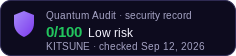

On-chain security analysis — is it a scam or legit?
Is Kitsune Token Safe?
Not verified
This record has not gone through deep verification and is not being monitored. The score is a dated snapshot — the token’s risk can change at any time.Own this token? Put it under verification →The provided source code includes standard OpenZeppelin libraries (Context, SafeMath, Address, Ownable) and Uniswap V2 interfaces.
Read the full analysis- Liquidity < $50k
Security Checklist
as of audit · Sep 12Holders
as of audit · Sep 12, 2026- Contractstreasury, vesting, bridge, staking11.6%
- Walletsanonymous holders, free to sell14.9%
- Everyone elsethe rest of the supply73.5%
How holder types affect the score
Share held by contracts — treasury, vesting, bridge or staking — is discounted against share held by wallets when the score is computed: a contract cannot decide to sell the way an anonymous holder can, though it can still be drained or voted to sell. Effective concentration is the figure the risk score is actually calculated from.
Holder balances as recorded by the audit of Sep 12, 2026
Liquidity
as of audit · Sep 12The LP tokens of the analysed pool are locked or burned.
0x0ed9…97060x5bd1…968fNo privileged address appears among these holders: the unlocked liquidity sits with independent providers, not with the deployer.
Security Findings
LowRenounce Ownership Functionality
Not confirmed by static analysis (the model's own reading of the source).L-01
Issue
Not confirmed by static analysis (the model's own reading of the source). The Ownable contract includes a waiveOwnership() function, which allows the contract owner to renounce their ownership by setting the owner address to the zero address. While this can be a desired feature for decentralization or to prevent future administrative actions, if executed accidentally or maliciously, it could leave the contract without an owner, making critical administrative functions (e.g., pausing, upgrading, setting fees) permanently inaccessible (7.3 Access Control, 7.8 Operations).
Fix
Ensure that the waiveOwnership() function is intended for the protocol's long-term strategy. If not, consider removing or restricting its access. If intended, ensure robust operational procedures are in place to prevent accidental execution and that the implications of renouncing ownership are fully understood.
Status
Unresolved
InfoRedundant SafeMath Library in Solidity 0.8.x
Not confirmed by static analysis (the model's own reading of the source).I-01
Issue
Not confirmed by static analysis (the model's own reading of the source). The SafeMath library is included and used for arithmetic operations. While SafeMath is crucial for preventing integer overflow/underflow in Solidity versions prior to 0.8.0, Solidity 0.8.0 and later versions include built-in checks for these conditions, causing arithmetic operations to revert on overflow/underflow by default. Therefore, using SafeMath in Solidity 0.8.4 is redundant and adds unnecessary gas overhead.
Fix
Consider removing the SafeMath library and relying on Solidity's native overflow/underflow checks. This will reduce contract size and gas costs without compromising security.
Status
Unresolved
InfoMissing Main Contract Source Code
Not confirmed by static analysis (the model's own reading of the source).I-02
Issue
Not confirmed by static analysis (the model's own reading of the source). The provided source code is incomplete, specifically missing the full implementation of the main 'KITSUNETOKEN' contract. Only standard libraries and interfaces were supplied. This significantly limits the scope of the audit, as the core business logic, state variables, and specific functionalities of the token could not be analyzed for vulnerabilities (7.1 Architecture, 7.2 Code Security, 7.4 Economic).
Fix
Provide the complete and final source code for the 'KITSUNETOKEN' contract to enable a comprehensive security audit. A full audit is essential to identify potential vulnerabilities specific to the token's implementation before deployment or significant user interaction.
Status
Unresolved
Analysis
AI Copilotas of audit · Sep 12The technical architecture relies on well-established OpenZeppelin libraries (Context, Address, Ownable) and standard Uniswap V2 interfaces (7.1 Architecture). The code security (7.2 Code Security) is generally robust within the provided scope, utilizing SafeMath for arithmetic safety, although this is redundant in Solidity 0.8.x. Access control (7.3 Access Control) is managed via the Ownable pattern, ensuring only the designated owner can perform privileged operations. A key limitation is the absence of the main contract's code, preventing a full review of its specific logic and potential vulnerabilities.
Due to the absence of the main contract's implementation, a detailed analysis of economic models (7.4 Economic) or governance mechanisms (7.5 Governance) is not possible. The Ownable contract provides basic administrative control, allowing the owner to manage the contract. The waiveOwnership function, if used, would remove all administrative control, which could be a security feature or a risk depending on the protocol's intent. No external dependencies beyond standard ERC-20 and Uniswap V2 interfaces were identified (7.6 External).
No proxy patterns or explicit upgrade mechanisms were identified within the provided code (7.7 Upgrades). The contract appears to be non-upgradeable based on the available information. This implies that any future changes would require a new deployment and migration of assets, which is a common design choice for simple tokens.
A comprehensive security audit requires the full source code of the 'KITSUNETOKEN' contract.
Without it, a complete assessment of potential vulnerabilities, economic risks, and operational considerations is not possible. It is strongly recommended to provide the complete and final source code for a thorough review before deployment or significant usage. Ensure that the core token logic correctly implements ERC-20 standards and handles all interactions securely.
Contract & Record
Free for any token on the record. It links to this page and always shows the current score and the date it was checked.
- Sep 12, 20260Low
Score changes are recorded as dated snapshots — history is append-only and cannot be edited.
Frequently Asked Questions
What is the KITSUNE contract address?
The Kitsune Token (KITSUNE) contract on BNB Chain is 0xb6623b503d269f415b9b5c60cdda3aa4fe34fd22. Compare it with the address the project itself publishes before trading: other contracts can carry the same name and ticker.
Is Kitsune Token a scam?
Quantum Audit's risk score for Kitsune Token is 0/100 (Low risk) as of Sep 12, 2026, computed by a deterministic function from on-chain facts — Contract verified: Verified; Ownership: Renounced; Mint: No mint; Liquidity lock: Locked; Upgradeability: Fixed code; Honeypot: None found; Buy / sell tax: 6% / 7%. A score is a dated snapshot of those facts, not a guarantee; each one is listed on this page.
Is KITSUNE liquidity locked?
Liquidity lock: Locked (as of Sep 12, 2026). Total DEX liquidity: $15.5K.
Who holds KITSUNE?
As of Sep 12, 2026, the 10 largest holders own 26.5% of the supply. The Holders section on this page shows who they are by holder type.
Would You Like a More Detailed Audit of Kitsune Token?
Our AI-powered scanner gives you a deeper, real-time smart contract analysis — free, with every scoring factor shown.
Get Detailed Audit Is this your token? Add your links and get it Verified