

Quantum Audit Logo

Is KAITO Safe?

On-chain security analysis — is it a scam or legit?

KAITO KAITO
0x98d0…7553
Base Not verifiedLast checked 3d ago 1 audit on record
Executive SummaryAI Copilot

The Kaito token contract is a standard ERC20 implementation leveraging OpenZeppelin's battle-tested libraries, including ERC20Permit for gas-less approvals. The contract features a fixed total supply minted entirely during deployment. While technically robust, the initial distribution model concentrates all tokens in a predefined set of wallets, posing a centralization risk. The absence of administrative controls like pausing or blacklisting is a deliberate design choice that enhances decentralization but removes emergency response capabilities.
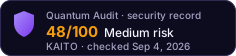

1 Medium1 Low1 Informational
Volume 24h
$1.0K
Liquidity
$11.9K
Price
$0.3022
Token Age
1y
Top 10 Holders
86.7%

Security Findings

Medium

Centralized Initial Token Distribution

M-01The contract's constructor mints the entire `TOTALSUPPLY` (1 billion tokens) to a predefined list of `wallets` and `amounts`. This design choice results in a highly centralized initial distribution, concentrating significant control over the token supply in the hands of a few addresses. This could lead to market manipulation or governance issues if the token were to be used in a decentralized governance system (7.4 Economic, 7.5 Governance).
IssueThe contract's constructor mints the entire `TOTALSUPPLY` (1 billion tokens) to a predefined list of `wallets` and `amounts`. This design choice results in a highly centralized initial distribution, concentrating significant control over the token supply in the hands of a few addresses. This could lead to market manipulation or governance issues if the token were to be used in a decentralized governance system (7.4 Economic, 7.5 Governance).
FixWhile this is a design choice, it is crucial to acknowledge and communicate the implications of such a centralized initial distribution. Consider implementing a vesting schedule or a more decentralized distribution mechanism for future token projects to mitigate concentration risk. Ensure transparency regarding the ownership and purpose of the initial recipient wallets.
StatusUnresolved
Low

Absence of Emergency Administrative Controls

L-01The `Kaito` token contract does not implement any administrative functions such as `pause` or `blacklist` (7.3 Access Control). While this design promotes decentralization and immutability, it also means that in the event of a critical vulnerability in an integrated DeFi protocol or a major security incident, there is no mechanism to halt token transfers or freeze malicious accounts. This lack of emergency response capability could exacerbate losses in unforeseen circumstances (7.8 Operations).
IssueThe `Kaito` token contract does not implement any administrative functions such as `pause` or `blacklist` (7.3 Access Control). While this design promotes decentralization and immutability, it also means that in the event of a critical vulnerability in an integrated DeFi protocol or a major security incident, there is no mechanism to halt token transfers or freeze malicious accounts. This lack of emergency response capability could exacerbate losses in unforeseen circumstances (7.8 Operations).
FixAssess the project's risk tolerance and operational needs. If the ability to react to emergencies is deemed critical, consider adding a `Pausable` mechanism (e.g., from OpenZeppelin) controlled by a multi-signature wallet. If decentralization is paramount, ensure all users are aware of the immutable nature and lack of intervention capabilities.
StatusUnresolved
Info

Fixed Total Supply

I-01The `TOTALSUPPLY` is defined as a `constant` and all tokens are minted exclusively during the contract's deployment. There is no function to mint additional tokens after the initial distribution. This design ensures a fixed and immutable total supply of 1 billion tokens (1e9 ether), preventing any future inflation through additional minting (7.4 Economic).
IssueThe `TOTALSUPPLY` is defined as a `constant` and all tokens are minted exclusively during the contract's deployment. There is no function to mint additional tokens after the initial distribution. This design ensures a fixed and immutable total supply of 1 billion tokens (1e9 ether), preventing any future inflation through additional minting (7.4 Economic).
FixThis is a deliberate design choice that should be clearly communicated to all token holders and potential investors. Ensure that all project documentation, whitepapers, and public communications explicitly state that the token supply is fixed and cannot be increased.
StatusUnresolved

Category Ratings

TechnicalLow8/10

The Kaito contract (7.1 Architecture) is a straightforward ERC20 token, inheriting robust and audited functionalities from OpenZeppelin's ERC20 and ERC20Permit libraries. The code (7.2 Code Security) is minimal, primarily extending standard token behavior with a constructor for initial distribution and a basic burn function. No complex logic or external interactions beyond standard token transfers are present, mitigating common technical vulnerabilities like reentrancy or integer overflows, which are handled by OpenZeppelin's battle-tested implementations.

GovernanceHigh1/10

The contract's economic model (7.4 Economic) establishes a fixed total supply of 1 billion tokens, all minted during deployment. A key design choice is the initial distribution (7.5 Governance), where the entire supply is allocated to a predefined list of wallets. This creates a high degree of centralization at launch, potentially allowing initial holders to exert significant influence. The absence of administrative controls (7.3 Access Control) like pausing or blacklisting means the token is immutable and decentralized in operation, but lacks emergency response capabilities.

UpgradesMedium6/10

The Kaito token contract is not designed as an upgradeable proxy (7.7 Upgrades). It is a standard, immutable contract deployed directly to the blockchain. This design choice eliminates upgrade-related risks such as proxy implementation vulnerabilities or administrative key compromise for upgrades, ensuring the contract's logic remains fixed post-deployment.

Security Checklist

Contract VerifiedPass
Ownership Renounced?
No Mint FunctionPass
Liquidity LockedFail
Not a ProxyPass
HoneypotNoneBuy Tax0.0%Sell Tax0.0%

Holder Composition

78.1% in wallets8.6% in contracts
Effective Concentration81.6%

Share held by contracts — treasury, vesting, bridge or staking — is discounted against share held by wallets when the score is computed: a contract cannot decide to sell the way an anonymous holder can, though it can still be drained or voted to sell. Effective concentration is the figure the risk score is actually calculated from.

Liquidity Depth

Show 4 more pairsShow less

The 3 remaining pairs hold $25 between them and are not listed.

The risk score reads depth across every pair. The volume figure and the volume-to-liquidity ratio elsewhere on this page describe only the pair this audit analysed, so the two are not directly comparable.

LP Distribution

Top-1 Unlocked Holder66.8%
Top-3 Unlocked100.0%

Key Addresses

Deployer
0xfd0d…a5f6
Unlocked LP Held By
0xb333…1bd00xfe72…626b0x4d06…703c

No privileged address appears among these holders: the unlocked liquidity sits with independent providers, not with the deployer.

What Raised This Score

  • Ownership status UNKNOWN (owner could not be resolved)
  • Top-10 concentration > 70% (86.7% total → 81.6% effective; 78.1% in EOAs, 8.6% in contracts — extreme)
  • Liquidity not locked, but no owner/deployer address holds LP — market-depth risk, not rug risk
  • Liquidity < $50k ($46,350 across 13 pairs — thin market)
  • LP top1 unlocked holder = 66.8% (independent LP — depth risk, pool = 26% of DEX liquidity)
  • LP top3 unlocked holders = 100.0% (independent LP — depth risk, pool = 26% of DEX liquidity)
  • 1 Medium finding(s) from audit
  • 1 Low finding(s) from audit

Each factor is an on-chain fact recorded at the time of this analysis. The score is computed from them by a deterministic function, so the same contract returns the same score for anyone who runs the audit. How scores are computed

Related Audits

Coinbase Wrapped Staked ETH (CBETH)High RiskThe Innovation Game (TIG)High RiskBasemateHigh RiskCAPACITRHigh RiskViciCoin (VCNT)High RiskAvantis (AVNT)High Risk

Would You Like a More Detailed Audit of KAITO?

Our AI-powered scanner gives you a deeper, real-time smart contract analysis — free, with every scoring factor shown.

Get Detailed Audit