
Quantum Audit Logo

Is jesse Safe?

On-chain security analysis — is it a scam or legit?

jesse JESSE
0x50f8…0d59
Base Not verifiedLast checked 3d ago 1 audit on record
Executive SummaryAI Copilot

The audit of the CreatorCoin and BaseCoin contracts identified a critical architectural misconfiguration related to the use of upgradeable patterns in a standalone deployment, which could lead to an uninitialized or exploitable state if not handled correctly. Additionally, the system exhibits centralization risks through its MultiOwnable pattern and lacks event emissions for key configuration changes. The vesting mechanism appears robust, and the code quality is generally high, leveraging OpenZeppelin standards. Addressing the critical architectural issue is paramount for the secure operation of the protocol.
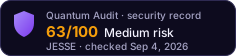

1 Critical1 Medium1 Low2 Informational
Volume 24h
$6.1K
Liquidity
$553.9K
Price
$0.001868
Token Age
9mo
Top 10 Holders
77.4%

Security Findings

Critical

Architectural Misconfiguration: Upgradeable Pattern in Standalone Contract

C-01The `BaseCoin` contract, from which `CreatorCoin` inherits, utilizes OpenZeppelin's `Upgradeable` contracts (`ERC20PermitUpgradeable`, `ERC165Upgradeable`) and the `initializer` modifier in both its constructor and its `initialize` function. This pattern is exclusively designed for proxy-based upgradeable contracts (e.g., UUPS or Transparent proxies). However, the deployment context indicates `is_proxy: false`, meaning `CreatorCoin` is deployed as a standalone contract. When deployed directly, the contract's constructor runs once. The `initializer` modifier on the constructor will execute. Subsequently, the `initialize` function *must be called separately* to set up critical contract parame…
IssueThe `BaseCoin` contract, from which `CreatorCoin` inherits, utilizes OpenZeppelin's `Upgradeable` contracts (`ERC20PermitUpgradeable`, `ERC165Upgradeable`) and the `initializer` modifier in both its constructor and its `initialize` function. This pattern is exclusively designed for proxy-based upgradeable contracts (e.g., UUPS or Transparent proxies). However, the deployment context indicates `is_proxy: false`, meaning `CreatorCoin` is deployed as a standalone contract. When deployed directly, the contract's constructor runs once. The `initializer` modifier on the constructor will execute. Subsequently, the `initialize` function *must be called separately* to set up critical contract parame…
FixIf the contract is intended to be non-upgradeable, remove all `Upgradeable` base contracts and the `initializer` modifier. Move all initialization logic from the `initialize` function directly into the constructor. If the contract *is* intended to be upgradeable, it must be deployed behind a proxy contract (e.g., UUPS proxy), and the `is_proxy` flag in the deployment context should be `true`.
StatusUnresolved
Medium

Centralization Risk with MultiOwnable

M-01The `BaseCoin` contract uses the `MultiOwnable` pattern for critical administrative functions such as `setPayoutRecipient` and `setContractURI`. While `MultiOwnable` allows for multiple addresses to collectively control these functions, it still represents a centralized point of control. A compromise of a majority of the owner keys could lead to unauthorized changes to the contract's configuration, including redirecting the `payoutRecipient` to a malicious address, potentially impacting token distributions.
IssueThe `BaseCoin` contract uses the `MultiOwnable` pattern for critical administrative functions such as `setPayoutRecipient` and `setContractURI`. While `MultiOwnable` allows for multiple addresses to collectively control these functions, it still represents a centralized point of control. A compromise of a majority of the owner keys could lead to unauthorized changes to the contract's configuration, including redirecting the `payoutRecipient` to a malicious address, potentially impacting token distributions.
FixConsider implementing a timelock mechanism for critical administrative actions controlled by `MultiOwnable`. This would introduce a delay between the initiation and execution of sensitive changes, allowing for monitoring and potential intervention, thereby mitigating the immediate impact of a compromised owner key. Additionally, ensure robust key management practices for all owner addresses.
StatusUnresolved
Low

Lack of Event Emission for Critical Configuration Changes

L-01The `_setPayoutRecipient` and `_setContractURI` internal functions, which are called by external `onlyOwner` functions (`setPayoutRecipient`, `setContractURI`), do not emit events upon execution. While the `CreatorVestingClaimed` event is emitted for vesting claims, changes to core configuration parameters like the `payoutRecipient` or `contractURI` are not logged on-chain. This makes it challenging to monitor and audit changes to the contract's operational parameters, hindering transparency and off-chain analysis.
IssueThe `_setPayoutRecipient` and `_setContractURI` internal functions, which are called by external `onlyOwner` functions (`setPayoutRecipient`, `setContractURI`), do not emit events upon execution. While the `CreatorVestingClaimed` event is emitted for vesting claims, changes to core configuration parameters like the `payoutRecipient` or `contractURI` are not logged on-chain. This makes it challenging to monitor and audit changes to the contract's operational parameters, hindering transparency and off-chain analysis.
FixEmit specific events (e.g., `PayoutRecipientUpdated(address oldRecipient, address newRecipient)` and `ContractURIUpdated(string oldURI, string newURI)`) whenever critical configuration parameters are changed. This will provide a clear, immutable record of all administrative actions on-chain, improving transparency and auditability.
StatusUnresolved
Info

Reliance on Hardcoded Constants

I-01The `CreatorCoin` contract relies heavily on hardcoded constants defined in `CoinConstants.sol` for critical parameters such as `CREATOR_COIN_MARKET_SUPPLY`, `TOTAL_SUPPLY`, `CREATOR_VESTING_DURATION`, and `CREATOR_COIN_CURRENCY`. While using constants ensures immutability and predictability, it removes flexibility for future adjustments or parameter tuning without requiring a full contract redeployment.
IssueThe `CreatorCoin` contract relies heavily on hardcoded constants defined in `CoinConstants.sol` for critical parameters such as `CREATOR_COIN_MARKET_SUPPLY`, `TOTAL_SUPPLY`, `CREATOR_VESTING_DURATION`, and `CREATOR_COIN_CURRENCY`. While using constants ensures immutability and predictability, it removes flexibility for future adjustments or parameter tuning without requiring a full contract redeployment.
FixFor parameters that might require future adjustments (e.g., vesting duration, supply caps), consider making them configurable by an authorized entity (e.g., `MultiOwnable` or governance) through setter functions, rather than hardcoding them. This would allow for greater adaptability to changing market conditions or protocol needs. If immutability is the explicit design choice, document this decision clearly.
StatusUnresolved
Info

Potential for Vesting Dust Amounts Due to Integer Division

I-02The `_calculateVestedAmount` function uses integer division: `(CoinConstants.CREATOR_COIN_CREATOR_VESTING_SUPPLY * elapsedTime) / CoinConstants.CREATOR_VESTING_DURATION`. If `CREATOR_COIN_CREATOR_VESTING_SUPPLY` is not perfectly divisible by `CREATOR_VESTING_DURATION`, or if the `elapsedTime` does not perfectly align with a full vesting period, there might be a small remainder (dust) that is truncated during the division. This could result in a tiny amount of tokens being perpetually locked or the final claim being slightly less than expected.
IssueThe `_calculateVestedAmount` function uses integer division: `(CoinConstants.CREATOR_COIN_CREATOR_VESTING_SUPPLY * elapsedTime) / CoinConstants.CREATOR_VESTING_DURATION`. If `CREATOR_COIN_CREATOR_VESTING_SUPPLY` is not perfectly divisible by `CREATOR_VESTING_DURATION`, or if the `elapsedTime` does not perfectly align with a full vesting period, there might be a small remainder (dust) that is truncated during the division. This could result in a tiny amount of tokens being perpetually locked or the final claim being slightly less than expected.
FixWhile generally negligible for large token amounts, consider using a fixed-point math library or adjusting the calculation to ensure that any remaining dust is accounted for, especially in the final vesting period. For example, ensure the last claim explicitly transfers any remaining balance up to `CREATOR_COIN_CREATOR_VESTING_SUPPLY - totalClaimed` to prevent dust from being locked.
StatusUnresolved

Category Ratings

TechnicalLow7/10

The technical architecture of CreatorCoin, inheriting from BaseCoin, is generally well-structured, leveraging OpenZeppelin contracts for ERC20 and access control. The vesting logic in CreatorCoin is clearly implemented and appears mathematically sound, preventing over-claiming (7.2 Code Security). However, a critical architectural misconfiguration arises from using upgradeable contract patterns (e.g., `initializer` modifier) in a contract deployed as standalone, which can lead to an uninitialized state if the `initialize` function is not called post-deployment (7.1 Architecture). Furthermore, the `MultiOwnable` pattern, while allowing multiple owners, centralizes control over critical parameters like `payoutRecipient`, posing a centralization risk (7.3 Access Control).

GovernanceHigh1/10

The economic model for CreatorCoin incorporates a vesting schedule for creator supply, with `_calculateVestedAmount` and `getClaimableAmount` functions designed to prevent over-claiming, ensuring a predictable release of tokens (7.4 Economic). However, the `MultiOwnable` pattern, while providing multi-signature control, still represents a centralized point of failure for administrative actions such as setting the `payoutRecipient` (7.5 Governance). The use of hardcoded constants for critical parameters like total supply and vesting duration limits the protocol's flexibility for future adjustments without requiring a full redeployment (7.4 Economic).

UpgradesHigh1/10

The `CreatorCoin` and `BaseCoin` contracts incorporate OpenZeppelin's `Upgradeable` components and the `initializer` modifier, which are standard for proxy-based upgradeable systems. However, the contract is deployed as a standalone implementation, as indicated by `is_proxy: false` (7.7 Upgrades). This architectural misconfiguration means the contract is not upgradeable, rendering the `Upgradeable` base contracts redundant and potentially misleading. More critically, it necessitates a two-step initialization process (constructor then `initialize` function call) that is susceptible to operator error, potentially leaving the contract in an uninitialized and vulnerable state if `initialize` is not called post-deployment (7.7 Upgrades).

Security Checklist

Contract VerifiedPass
Ownership Renounced?
No Mint FunctionPass
Liquidity LockedFail
Not a ProxyFail
HoneypotNoneBuy Tax0.0%Sell Tax0.0%

Proxy Upgrade Controls

Proxy TypeEtherscan Detected Custom
ImplementationVerified source
Upgrades (30d)0 · stable

Holder Composition

5.4% in wallets72.0% in contracts
Effective Concentration34.2%

Share held by contracts — treasury, vesting, bridge or staking — is discounted against share held by wallets when the score is computed: a contract cannot decide to sell the way an anonymous holder can, though it can still be drained or voted to sell. Effective concentration is the figure the risk score is actually calculated from.

Liquidity Depth

Show 4 more pairsShow less

The 10 remaining pairs hold $32 between them and are not listed.

The risk score reads depth across every pair. The volume figure and the volume-to-liquidity ratio elsewhere on this page describe only the pair this audit analysed, so the two are not directly comparable.

LP Distribution

Top-1 Unlocked Holder98.8%
Top-3 Unlocked100.0%

Key Addresses

Deployer
0x8d47…b123
Unlocked LP Held By
0x5ca2…d75f0x531c…e46c0x6313…1a60

No privileged address appears among these holders: the unlocked liquidity sits with independent providers, not with the deployer.

What Raised This Score

  • Ownership status UNKNOWN (owner could not be resolved)
  • Proxy contract (upgradeable — admin can replace logic)
  • Non-standard proxy storage (Etherscan-confirmed)
  • Top-10 concentration > 30% (77.4% total → 34.2% effective; 5.4% in EOAs, 72.0% in contracts — moderate)
  • Liquidity not locked, but no owner/deployer address holds LP — market-depth risk, not rug risk
  • LP top1 unlocked holder = 98.8% (independent LP — depth risk, pool = 98% of DEX liquidity)
  • LP top3 unlocked holders = 100.0% (independent LP — depth risk, pool = 98% of DEX liquidity)
  • 1 Critical finding(s) from audit
  • 1 Medium finding(s) from audit
  • 1 Low finding(s) from audit

Each factor is an on-chain fact recorded at the time of this analysis. The score is computed from them by a deterministic function, so the same contract returns the same score for anyone who runs the audit. How scores are computed

Related Audits

VelvetHigh RiskDiemHigh RiskRipe DAO Governance Token (RIPE)High RiskUmiaHigh RiskJito Staked SOL (JITOSOL)High RiskDolphin (POD)High Risk

Would You Like a More Detailed Audit of jesse?

Our AI-powered scanner gives you a deeper, real-time smart contract analysis — free, with every scoring factor shown.

Get Detailed Audit